Biology questions, chapter 4
Nama / NameKelas / ClassTarikh / Date
Transport in Plants
44 marks. Use Practice to check each answer as you go, or Exam to answer everything against the clock first.
Section A: objective questions
15 marksChoose the best answer for each question.
1
Question 1
Which of the following is a non-vascular plant?
Show answerHide answer
B
Algae and mosses have no xylem or phloem, so they are non-vascular. The others are flowering (vascular) plants.
2
Question 2
Which substance thickens the walls of xylem vessels?
Show answerHide answer
C
Uneven lignin thickening strengthens xylem vessels and supports the plant.
3
Question 3
Which structure supplies ATP for the active transport of sucrose into a sieve tube?
Show answerHide answer
A
Companion cells contain many mitochondria that produce ATP for loading sucrose into the sieve tube.
4
Question 4
Root hair cells have a lower water potential than the soil water. What causes this?
Show answerHide answer
D
Active uptake of mineral ions lowers the water potential of the cell sap, so water enters by osmosis.
5
Question 5
Cohesion force in the xylem is the attraction between
Show answerHide answer
B
Cohesion is between water molecules; adhesion is between water molecules and the xylem wall.
6
Question 6
A plant is set up as in the transpirational pull experiment. Some leaves are then removed. What happens to the water level in the side tube?
Show answerHide answer
A
Fewer leaves means fewer stomata and a lower rate of transpiration, so less water is pulled up and the level falls more slowly.
7
Question 7
Guttation is the release of
Show answerHide answer
C
Guttation releases water droplets at special structures at the end of leaf veins, caused by high root pressure.
8
Question 8
Which statement is true of transpiration but NOT of guttation?
Show answerHide answer
B
Transpiration loses water vapour through stomata. Guttation uses special structures at vein ends, happens at night and releases mineral-rich water.
9
Question 9
Translocation is the transport of organic substances in the
Show answerHide answer
A
Translocation takes place in the phloem, from the leaves to other parts.
10
Question 10
In translocation, water enters the sieve tube from the xylem. Why?
Show answerHide answer
C
Sucrose loaded into the sieve tube lowers its water potential, so water moves in from the xylem by osmosis, raising hydrostatic pressure.
11
Question 11
A ring of bark including the phloem is removed from a woody stem. After three weeks, what is seen?
Show answerHide answer
D
The phloem is removed, so sucrose from the leaves cannot pass downward and builds up above the ring. The xylem is left intact.
12
Question 12
Which plant is used to remove radioactive caesium and strontium from soil?
Show answerHide answer
D
Sunflowers are hyperaccumulators used after the Chernobyl accident.
13
Question 13
Which cells are dead at maturity and have no cytoplasm?
Show answerHide answer
C
Xylem vessels are dead, empty cells joined end to end. Phloem cells (sieve tubes and companion cells) are living.
14
Question 14
By which process does water from the soil enter the root hair cells?
Show answerHide answer
A
Water diffuses from the soil, where its water potential is higher, into the root hair cells by osmosis.
15
Question 15
Which structure in the endodermis is not permeable to water and so blocks the apoplast pathway?
Show answerHide answer
B
The Casparian strip in the endodermis cell walls blocks the apoplast route, so water must go through the cytoplasm (simplast pathway).
Section B: structured questions
29 marksAnswer all questions.
16
Question 16
Xylem vessels and tracheids are dead at maturity.
[1 mark]
(a)State the main function of xylem.
Show answerHide answer
Tick each point you got.
[4 marks]
(b)State two structural adaptations of xylem vessels or tracheids and the function of each.
Show answerHide answer
Any of these points, up to 4 marks
Tick each point you got.
17
Question 17
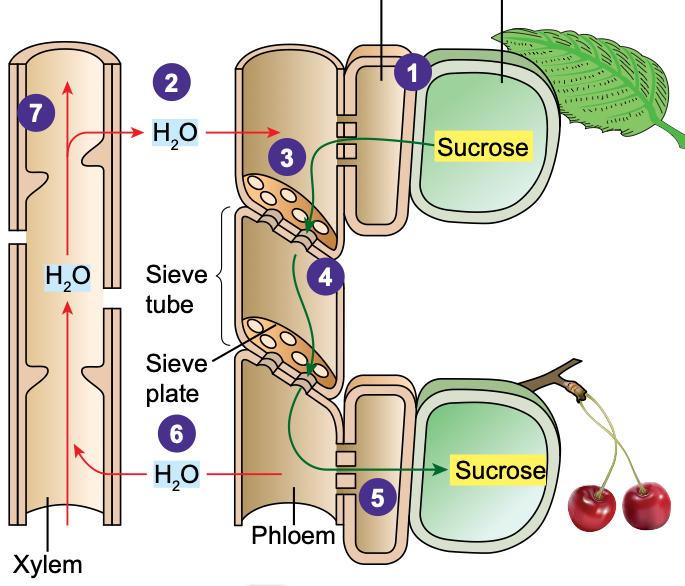
Diagram 1 shows how sucrose is transported from a leaf to a fruit.
[1 mark]
(a)Name the process shown in Diagram 1.
Show answerHide answer
Tick each point you got.
[2 marks]
(b)How is sucrose moved from the leaf cell into the sieve tube?
Show answerHide answer
Tick each point you got.
[2 marks]
(c)Explain why water moves from the xylem into the sieve tube.
Show answerHide answer
Tick each point you got.
[1 mark]
(d)What forces the phloem sap along the sieve tube to the fruit?
Show answerHide answer
Tick each point you got.
18
Question 18
Compare guttation and transpiration.
[1 mark]
(a)State one similarity.
Show answerHide answer
Any 1 points
Tick each point you got.
[2 marks]
(b)State two differences.
Show answerHide answer
Any 2 points
Tick each point you got.
[1 mark]
(c)Predict one effect on a plant if transpiration did not occur.
Show answerHide answer
Any 1 points
Tick each point you got.
19
Question 19
A balsam stem is cut 5 cm above the soil and attached to a water manometer with a rubber tube. The joint is sealed with petroleum jelly. After 30 minutes the water level in the manometer arm has risen.
[1 mark]
(a)Why is petroleum jelly applied to the joint?
Show answerHide answer
Tick each point you got.
[1 mark]
(b)Compare the water potential of the root cells with that of the soil water.
Show answerHide answer
Tick each point you got.
[1 mark]
(c)State the inference from the experiment.
Show answerHide answer
Tick each point you got.
[2 marks]
(d)Why is root pressure alone not enough for a tall tree?
Show answerHide answer
Tick each point you got.
20
Question 20
A farmer next to an industrial area digs a trench to bring irrigation water to his crops and plants water hyacinths in it.
[1 mark]
(a)What is the method of using plants to treat polluted water called?
Show answerHide answer
Tick each point you got.
[2 marks]
(b)Justify the farmer's action.
Show answerHide answer
Tick each point you got.
[1 mark]
(c)Suggest one problem if the water hyacinths are not managed.
Show answerHide answer
Any 1 points
Tick each point you got.
[1 mark]
(d)Name one other plant used for phytoremediation and the pollutant it removes.
Show answerHide answer
Any 1 points
Tick each point you got.
21
Question 21
State whether each statement is about xylem or phloem.
[1 mark]
(a)Has living cells with cytoplasm.
Show answerHide answer
Phloem
[1 mark]
(b)Has lignin thickening in the walls.
Show answerHide answer
Xylem
[1 mark]
(c)Has sieve plates with pores.
Show answerHide answer
Phloem
[1 mark]
(d)Carries water and mineral salts.
Show answerHide answer
Xylem