Biology questions, chapter 5
Nama / NameKelas / ClassTarikh / Date
Response in Plants
45 marks. Use Practice to check each answer as you go, or Exam to answer everything against the clock first.
Section A: objective questions
12 marksChoose the best answer for each question.
1
Question 1
Which statement describes tropism?
Show answerHide answer
B
Tropism is the response of a plant part such as the root or shoot towards or away from a stimulus. Option A describes a nastic response.
2
Question 2
A root grows towards a source of water in the soil. This response is
Show answerHide answer
C
The stimulus is water, so the response is hydrotropism. The root grows towards it, so it is positive.
3
Question 3
The leaves of a river tamarind plant close at night. This is an example of
Show answerHide answer
D
Nyctinasty is a response to the onset of darkness (a circadian rhythm). Photonasty is a response to light, e.g. opening of petals.
4
Question 4
Which phytohormone closes the stomata during a drought?
Show answerHide answer
A
Abscisic acid induces stomatal closing in drought, and also seed dormancy.
5
Question 5
A Venus flytrap shuts its leaves when an insect touches the hairs inside. Which statement is correct?
Show answerHide answer
C
The trap closes the same way whichever hair is touched, so the direction is independent of the stimulus: a nastic response (thigmonasty).
6
Question 6
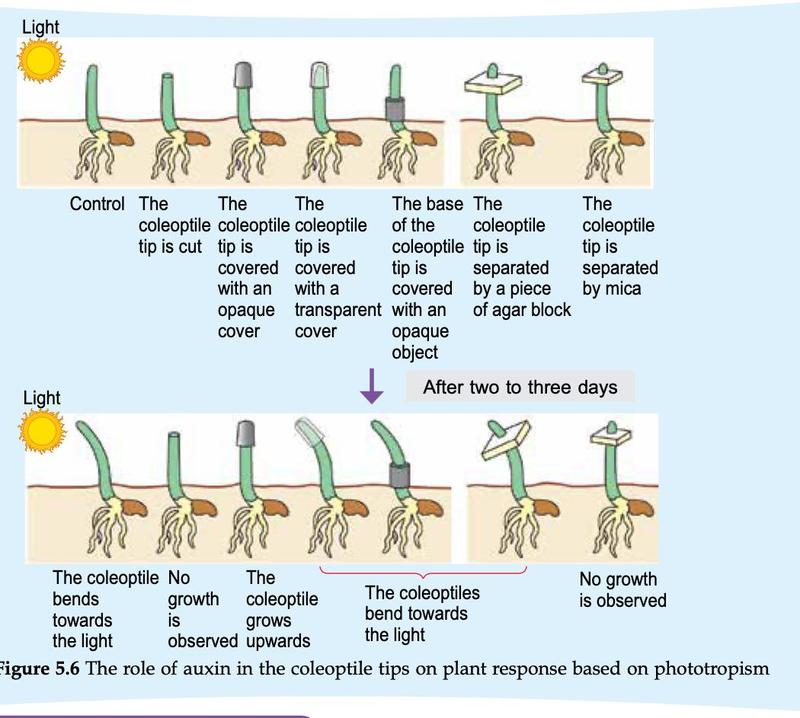
Diagram 1 shows seven coleoptile treatments in one-sided light. Seedling 3, counting from the left, has its tip covered with an opaque cover. What is observed on seedling 3 after two to three days?
Show answerHide answer
B
With the tip covered, the tip cannot detect the light, so auxin stays evenly distributed and the coleoptile grows upwards.
7
Question 7
Why does a shoot bend towards a window?
Show answerHide answer
D
Auxin moves away from the light. The higher concentration on the shaded side makes those cells elongate more, so the shoot bends towards the light.
8
Question 8
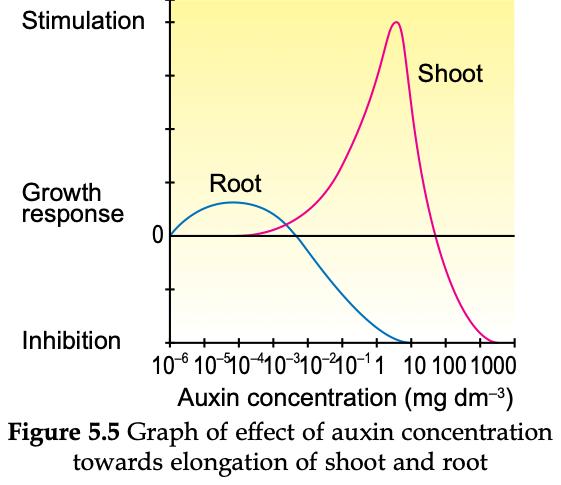
Diagram 2 shows the effect of auxin concentration on the growth of a shoot and a root. What is the effect of an auxin concentration of 1 mg dm⁻³?
Show answerHide answer
A
At 1 mg dm⁻³ the shoot curve is high above zero (stimulation) while the root curve is below zero (inhibition).
9
Question 9
An unripe mango is kept in a paper bag together with a ripe banana. The mango ripens faster because the banana releases
Show answerHide answer
B
Ripe fruit gives off ethylene gas, which stimulates ripening.
10
Question 10
Which is a characteristic of tropism but not of nastic responses?
Show answerHide answer
C
In tropism the direction of growth depends on the direction of the stimulus. Tropism is slow, not quick.
11
Question 11
A farmer has dwarf mutant plants and wants them to grow to normal height and produce larger grapes. Which phytohormone should he use?
Show answerHide answer
D
Gibberellin makes dwarf mutants grow to normal height and is used to produce larger grapes.
12
Question 12
Tulip flowers open when the room is warm and close when it is cool. Which is correct?
Show answerHide answer
A
Temperature is the stimulus, and the opening and closing is independent of direction, so it is thermonasty.
Section B: structured questions
33 marksAnswer all questions. Write your answers in the spaces provided.
13
Question 13
Choose the type of tropism for each stimulus.
[1 mark]
(a)Gravity
Show answerHide answer
Geotropism
[1 mark]
(b)Touch
Show answerHide answer
Thigmotropism
[1 mark]
(c)Mineral salts in the soil
Show answerHide answer
Chemotropism
[1 mark]
(d)Light
Show answerHide answer
Phototropism
14
Question 14
A student noticed that the leaves of a mimosa plant fold within seconds when touched, but a tendril takes hours to coil around a stick.
[1 mark]
(a)Name the response of the mimosa leaves.
Show answerHide answer
Tick each point you got.
[1 mark]
(b)Name the response of the tendril.
Show answerHide answer
Tick each point you got.
[2 marks]
(c)State two differences between the two types of response.
Show answerHide answer
Any 2 points
Tick each point you got.
15
Question 15
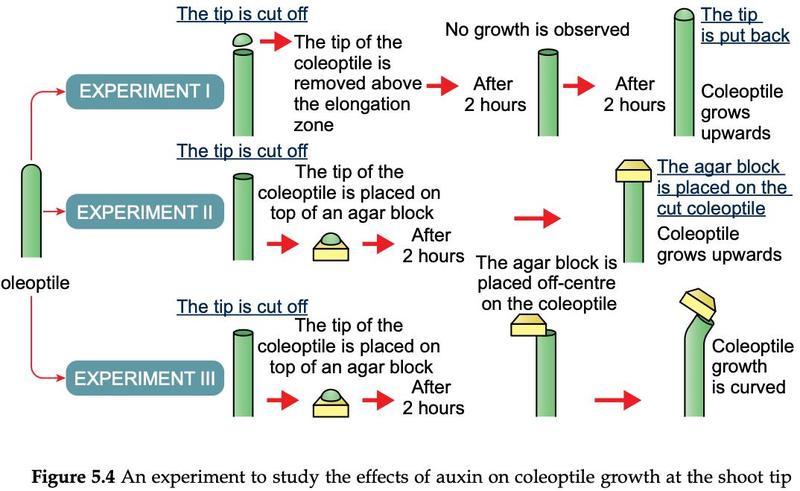
Diagram 3 shows three experiments on coleoptiles.
[1 mark]
(a)Name the phytohormone made at the coleoptile tip.
Show answerHide answer
Tick each point you got.
[1 mark]
(b)Why is no growth observed in Experiment I after the tip is removed?
Show answerHide answer
Tick each point you got.
[2 marks]
(c)Explain why the coleoptile in Experiment III curves.
Show answerHide answer
Tick each point you got.
[1 mark]
(d)Why does the coleoptile in Experiment II grow straight upwards?
Show answerHide answer
Tick each point you got.
16
Question 16
A bean seed germinates while lying on its side in the soil.
[2 marks]
(a)State the direction in which the root grows and name the response.
Show answerHide answer
Tick each point you got.
[2 marks]
(b)Explain how auxin makes the shoot bend upwards.
Show answerHide answer
Tick each point you got.
[2 marks]
(c)Explain why the same high auxin concentration makes the root bend downwards.
Show answerHide answer
Tick each point you got.
17
Question 17
A student grew oat seedlings in one-sided light. Seedling P had its tip covered with an opaque cover. Seedling Q had its tip separated from the rest of the coleoptile by a mica sheet. Seedling R was untreated.
[1 mark]
(a)State the response of seedling R.
Show answerHide answer
Tick each point you got.
[2 marks]
(b)Predict the growth of seedling P and explain.
Show answerHide answer
Tick each point you got.
[1 mark]
(c)Seedling Q does not grow. Explain.
Show answerHide answer
Tick each point you got.
18
Question 18
A fruit farm sells key limes. Mrs Faridah put an unripe key lime and a ripe banana in a closed container at room temperature.
[1 mark]
(a)Justify her decision to put both fruits in the same closed container.
Show answerHide answer
Tick each point you got.
[2 marks]
(b)What would happen if the container were kept in a refrigerator? Explain.
Show answerHide answer
Tick each point you got.
[2 marks]
(c)Suggest a method to delay ripening of fruits during export and justify it.
Show answerHide answer
Tick each point you got.
19
Question 19
Plan an experiment to find out whether ethylene speeds up the ripening of tomatoes. You are given unripe tomatoes, a ripe banana and paper bags.
[2 marks]
(a)State the manipulated variable and the responding variable.
Show answerHide answer
Tick each point you got.
[1 mark]
(b)State one constant variable.
Show answerHide answer
Any 1 points
Tick each point you got.
[2 marks]
(c)Describe the procedure.
Show answerHide answer
Tick each point you got.