Biology notes, chapter 5
Response in Plants
Textbook Biology Form 5 (DLP), pages 96–111
What this chapter covers
- Define tropism and nastic responses, and give examples of each type (5.1)
- Compare the characteristics of tropism and nastic responses (5.1)
- Define phytohormones and state the types of phytohormones and their functions (5.2)
- Explain the effects of auxin on growth using the coleoptile experiments (5.2)
- Explain the role of auxin in phototropism and geotropism of shoots and roots (5.2)
- Describe the application of phytohormones in agriculture and the effect of ethylene on fruit ripening (5.3)
5.1Types of responses
A plant response is how a plant adjusts to a change in its surroundings (a stimulus). Responses to stimuli are growth responses and are of two types: tropism and nastic responses.
Tropism
Tropism is the response of a part of a plant, such as the root or shoot, towards or away from a stimulus. The word comes from the Greek tropos, "a turning".
- The response is slow and not very apparent, and is permanent (a growth response) influenced by plant hormones.
- The direction of the response depends on the direction of the stimulus.
- Positive tropism = growth towards the stimulus. Negative tropism = growth away from the stimulus.
| Type | Stimulus | Example |
|---|---|---|
| Thigmotropism | Touch | Tendrils coil around a stake (positive) |
| Geotropism | Gravity | Roots grow down (positive); shoots grow up (negative) |
| Hydrotropism | Water | Roots grow towards water (positive) |
| Phototropism | Light | Shoots grow towards light (positive) |
| Chemotropism | Chemical | Roots grow towards mineral salts (positive) and away from poison (negative) |
Nastic responses
A nastic response is a response to a stimulus where the direction of the response does not depend on the direction of the stimulus.
- Quicker and more apparent than tropism.
- Not all nastic responses are growth responses.
- Some nastic responses help survival.
| Type | Stimulus | Example |
|---|---|---|
| Photonasty | Light | Japanese roses open in bright sunlight and close at night |
| Seismonasty | Mechanical stimulus such as shock, touch, wind, raindrops | Leaves of the mimosa fold when touched |
| Nyctinasty | Onset of darkness (a circadian rhythm) | Leaves of the river tamarind close at night and unfurl by day |
| Thermonasty | Change in temperature | Tulips open when warm and close when the temperature drops |
| Thigmonasty | Vibration / touch | Venus flytrap clamps its leaves shut on an insect |
Mixing up thigmotropism and thigmonasty. In tropism the growth is towards or away from the touch, so the direction depends on the stimulus (a tendril coils towards a stake). In nastic responses the direction does not (a Venus flytrap shuts whichever side the insect touches).
Tropism Towards/away = The direction matters. Nastic = Not related to direction.
The leaves of a mimosa plant fold when raindrops fall on them. Name the response and say why it is useful.
Show answerHide answer
Seismonasty (a nastic response to a mechanical stimulus). Folding the leaves reduces the area exposed to the impact of the rain, so it helps the plant to survive.
5.2Phytohormones
Phytohormones (plant hormones) are chemical substances that stimulate and coordinate responses in plants at low concentrations. They are made in one organ and carried to a target organ, generally through the phloem.
Plants have no nervous or endocrine system, so their responses are seen clearly only after a period of time.
Types of phytohormones and their functions
| Phytohormone | Functions |
|---|---|
| Auxin | Phototropism and geotropism; apical dominance; cell elongation in roots and shoots; adventitious roots on stem cuttings; cell division in cambium; inhibits abscission of fruits and young leaves; inhibits lateral buds |
| Gibberellin | Stem elongation; development of leaves, flowers and fruits; seed development and germination; flowering of dwarf plants; inhibits root development |
| Cytokinin | Cell division and elongation (with auxin); seed germination; inhibits apical dominance; delays leaf senescence; stimulates lateral buds |
| Abscisic acid | Inhibits growth; stimulates abscission of mature fruits, leaves and flowers; seed dormancy; closes stomata in drought; inhibits bud growth and germination |
| Ethylene | Ripening of fruits; senescence; abscission of leaves and fruits |
Remember the opposites: auxin inhibits abscission but abscisic acid and ethylene stimulate it. Cytokinin promotes lateral buds but auxin inhibits them.
Effects of auxin on growth
The coleoptile experiments show where auxin is made and how it acts.
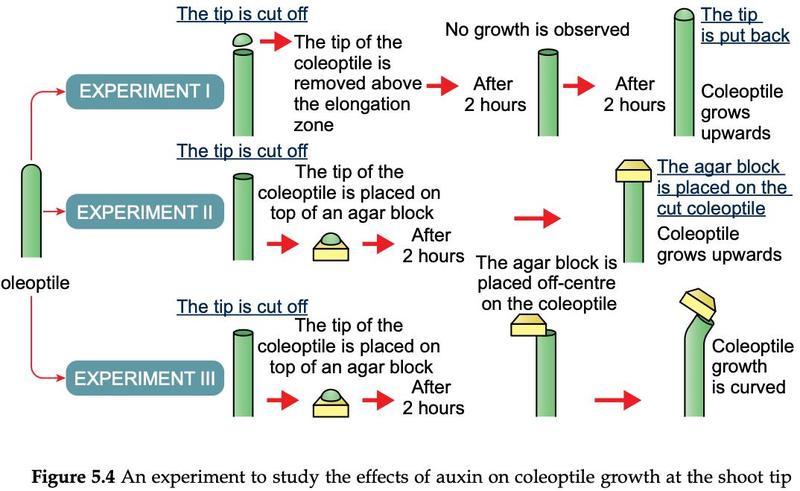
Experiments to study the effect of auxin on coleoptile growth
Textbook Figure 5.4, p. 104.
- Auxin is made at the coleoptile tip and stimulates cell elongation behind the tip. With the tip removed there is no growth.
- Auxin diffuses into an agar block, so an agar block that held the tip can replace the tip.
- Even distribution of auxin makes the coleoptile grow upwards. The side with more auxin grows faster, so the coleoptile curves towards the side with less (or no) auxin.
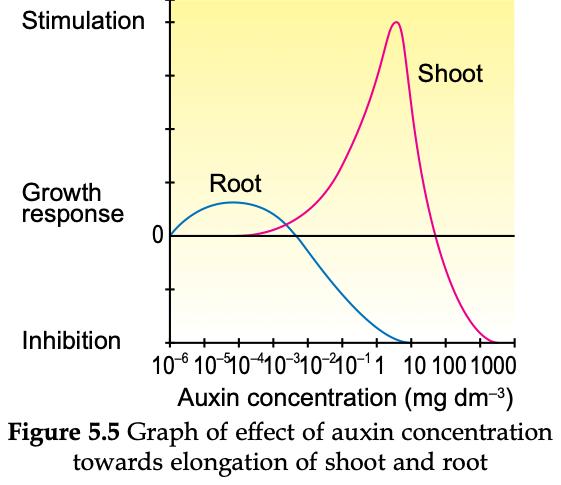
Effect of auxin concentration on shoot and root elongation
Textbook Figure 5.5, p. 104.
Shoots and roots react differently: a high auxin concentration stimulates elongation in the shoot but inhibits elongation in the root. Roots are stimulated only by very low concentrations.
Role of auxin in phototropism
- Light from all sides gives even auxin distribution, so the shoot grows upwards.
- Light from one side makes auxin move away from the light, so auxin concentration is higher on the shaded side.
- Cells on the shaded side elongate more than those on the bright side, so the shoot bends towards the light (positive phototropism).
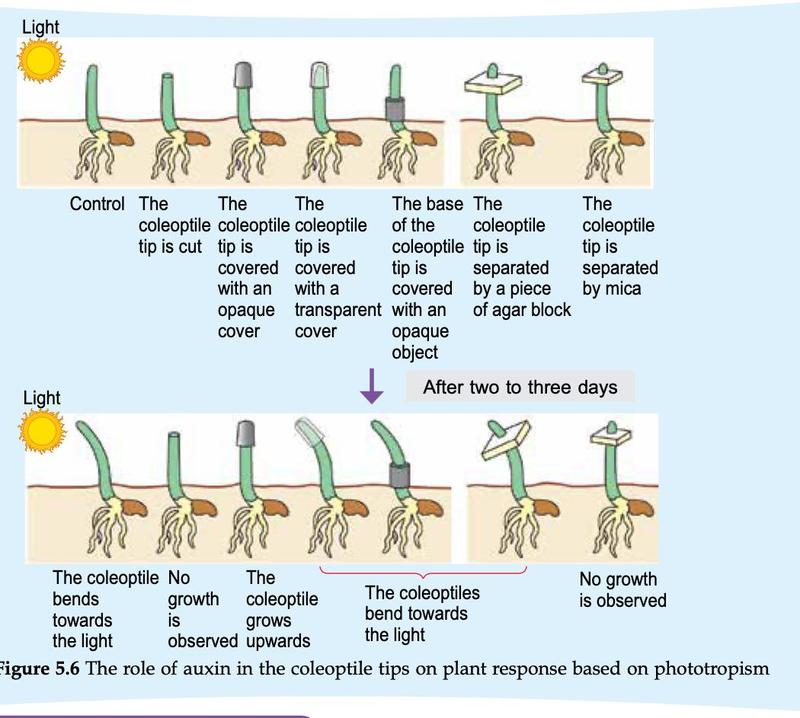
Role of auxin in the coleoptile tip in phototropism
Textbook Figure 5.6, p. 105.
| Treatment | Result | Reason |
|---|---|---|
| Control | Bends towards light | Auxin accumulates on the shaded side |
| Tip cut off | No growth | No source of auxin |
| Tip covered with opaque cover | Grows upwards | Tip cannot detect light, so auxin stays even |
| Tip covered with transparent cover | Bends towards light | Tip still detects light |
| Base covered with opaque object | Bends towards light | The tip detects light; the base is not the light-sensing part |
| Tip separated by agar block | Bends towards light | Auxin diffuses through agar |
| Tip separated by mica | No growth | Mica blocks auxin from reaching the elongation zone |
Role of auxin in geotropism
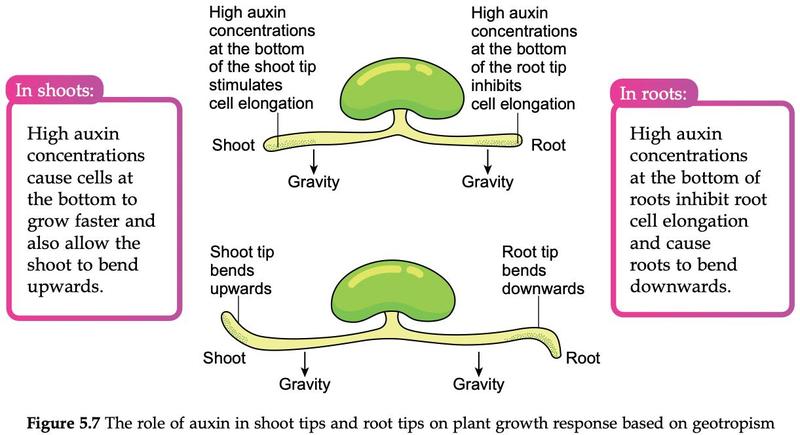
Role of auxin in geotropism of shoot and root
Textbook Figure 5.7, p. 106.
- Gravity makes auxin collect on the lower side of a horizontal shoot and root.
- Shoot: high auxin on the lower side stimulates elongation there, so the shoot bends upwards (negative geotropism).
- Root: high auxin on the lower side inhibits elongation there, so the upper side grows faster and the root bends downwards (positive geotropism).
Writing that auxin "makes the root grow downwards". It is the inhibition of the lower side by high auxin that bends the root down.
A seedling is placed horizontally in the dark. State what happens to the shoot and explain.
Show answerHide answer
The shoot bends upwards (negative geotropism). Auxin collects on the lower side, which elongates faster than the upper side, so the shoot curves up.
5.3Application of phytohormones in agriculture
| Phytohormone | Applications |
|---|---|
| Auxin | Promotes crop growth; rooting of woody stem cuttings (asexual reproduction); seedless fruit by parthenocarpy; weed killer; keeps potatoes dormant in storage |
| Gibberellin | Makes dwarf mutants grow to normal height; elongates flower stems; larger grapes; germination of seeds at low temperature and low light |
| Cytokinin | Tissue culture: cell division and differentiation, with auxin to form roots and stems; delays leaf senescence in cut flowers |
| Abscisic acid | Inhibits germination and growth |
| Ethylene | Quick and even ripening of fruits; simultaneous flowering of plants in the field |
Parthenocarpy is the production of fruit without fertilisation, so the fruit has no seeds. An auxin is applied to the unpollinated flower.
Effect of ethylene on fruit ripening
Experiment: an unripe tomato is sealed in paper bag A alone and in paper bag B together with a ripe banana. After 12 hours the tomato in B is redder and softer.
- Manipulated variable: presence of ethylene (ripe banana). Responding variable: ripening of the tomato. Constant: type of fruit, temperature.
- The ripe banana releases ethylene, which stimulates ripening of the tomato.
- Use paper bags, not plastic bags: trapped moisture in plastic makes fruits spoil faster.
- Conclusion: the hypothesis is accepted. Tomatoes ripen faster in the presence of ethylene.
A refrigerator slows ripening because the low temperature slows the reactions that make and respond to ethylene.
Why are bananas on the tree sometimes wrapped in waterproof sacks?
Show answerHide answer
The sack traps the ethylene given off by the bananas, which speeds up ripening.