Transport in Plants
What this chapter covers
- Explain why plants need a transport system and compare vascular and non-vascular plants (4.1)
- Relate the structure of xylem vessels and tracheids to the transport of water and mineral salts (4.1)
- Relate the structure of sieve tubes and companion cells to the transport of organic substances (4.1)
- Describe how transpirational pull, capillary action and root pressure move water from the soil to the leaves (4.2)
- Explain guttation and compare it with transpiration, including what happens without each process (4.2)
- Define translocation and describe its pathway in the phloem (4.3)
- Explain phytoremediation and how plants are used to control water and soil pollution (4.4)
4.1Vascular tissues
A large, tall plant has too little surface area compared with its volume to take in all it needs directly from the surroundings. Plants with a transport system are vascular plants. Algae and mosses have no transport system, so they are non-vascular.
| Xylem | Phloem | |
|---|---|---|
| Carries | Water and mineral salts | Dissolved organic compounds such as sucrose and amino acids |
| Direction | Roots to stems and leaves | Leaves to stems, roots, fruits and storage organs |
| Cells | Dead at maturity, no cytoplasm | Living, with cytoplasm |
| Main cells | Xylem vessels, tracheids | Sieve tubes, companion cells |
| Extra job | Mechanical support | Distribution to storage |
Xylem vessels and tracheids
- Cells are dead and empty, joined end to end into a continuous tube, so water flows without obstruction.
- Lignin thickens the walls unevenly: it strengthens the vessel so it does not collapse under tension and pressure changes, and it supports the plant.
- Tracheids also have lignified walls and pits so water can pass sideways to neighbouring cells.
Sieve tubes and companion cells
- Sieve tubes have no nucleus, ribosomes or vacuole, leaving room for sucrose to flow.
- A sieve plate with pores at each end lets sap pass from one sieve tube to the next.
- Companion cells are packed with mitochondria; the ATP they make drives active transport of sucrose into the sieve tube.
Show answerHide answer
4.2Transport of water and mineral salts
Three processes move water from the soil to the leaves.
| Process | What happens |
|---|---|
| Root pressure | Root hair cells pump mineral ions into the vacuole, so their cell sap has a lower water potential than the soil. Water enters by osmosis and moves across cortex, endodermis and pericycle into the xylem, pushing water upward. |
| Capillary action | Adhesion (water molecules sticking to the xylem wall) and cohesion (water molecules sticking together) pull water up the narrow vessels against gravity. |
| Transpirational pull | Water vapour leaves through open stomata; spongy mesophyll cells lose water and draw more from the xylem by osmosis, pulling the whole water column up. |
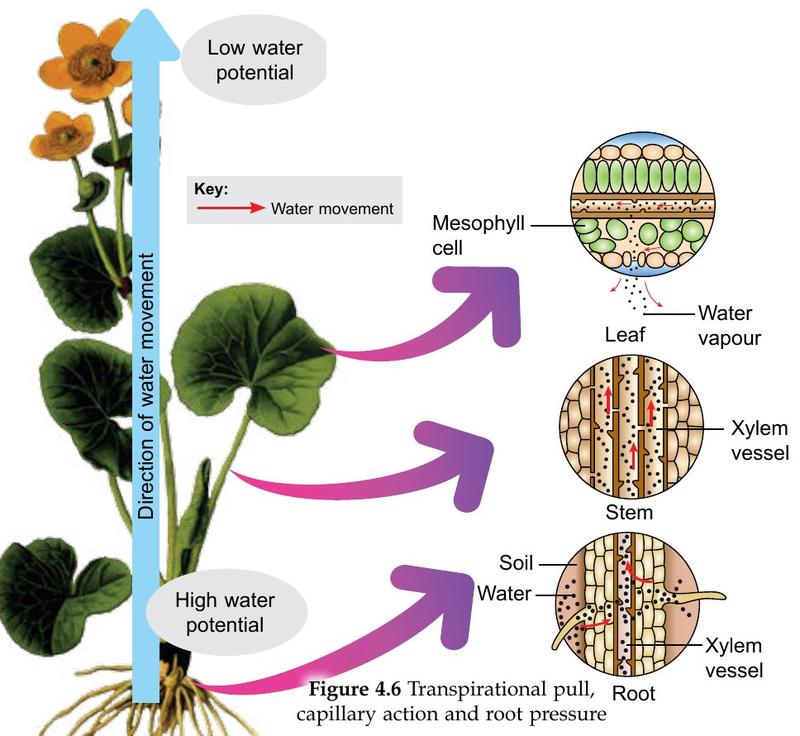
Based on textbook Figure 4.6, p. 79.
Two experiments
- Root pressure: a balsam stem is cut 5 cm above the soil and joined to a water manometer, with petroleum jelly to make the joint airtight. After about 30 minutes the water level in the manometer rises, so root pressure pushes water up the stem.
- Transpirational pull: a plant with roots is sealed into a bottle of water joined to a side tube; a drop of oil on the water in the side tube stops evaporation. In sunlight the water level in the side tube falls as the plant takes up water. With fewer leaves, transpiration is lower and the level falls more slowly.
In the root, water can cross through the cytoplasm (symplast pathway, spelt simplast in the textbook) or along cell walls (apoplast pathway). The Casparian strip in the endodermis blocks the apoplast route, forcing water through the cytoplasm.
Guttation and transpiration
| Guttation | Transpiration | |
|---|---|---|
| When | Night, early morning | Hot, windy days |
| Form of water | Liquid droplets | Water vapour |
| Where | End of leaf veins | Stomata |
| Driven by | High root pressure | Evaporation; stomata open or close |
| Contents | Water with minerals | Pure water |
| Which plants | Herbaceous plants only | All plants |
Both occur through leaves and both lose water permanently from the plant.
| If the process did not occur | Effect |
|---|---|
| No guttation | Root pressure cannot be kept up, so water absorption is disrupted in humid air; wastes are not removed; vein pressure may burst the veins and let pathogens in |
| No transpiration | Plant overheats and enzymes denature; minerals are not carried to leaves; water transport fails and the plant wilts and may die |
Show answerHide answer
4.3Translocation
It supplies roots, fruits, shoot tips and developing flowers for growth and respiration, and moves extra products to storage in rhizomes, tubers and bulbs.
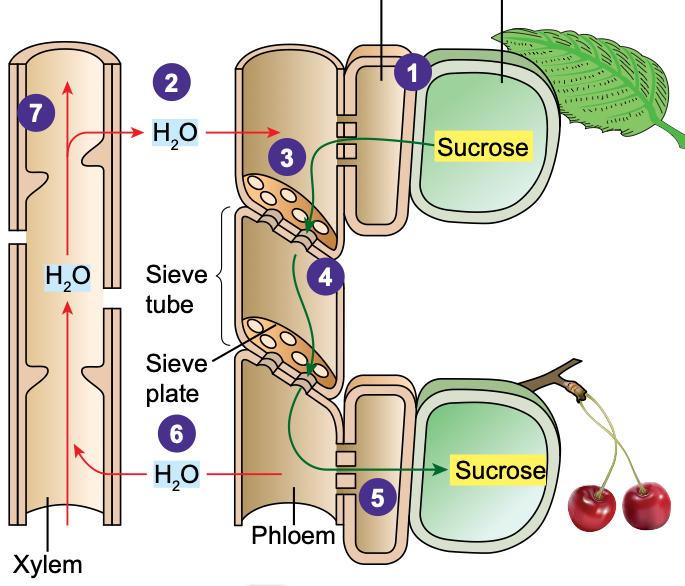
Textbook Figure 4.12, p. 87.
- Sucrose is actively transported from leaf cells into the sieve tube by the companion cell.
- The water potential in the sieve tube falls, so water enters from the xylem by osmosis.
- Hydrostatic pressure in the sieve tube rises.
- The pressure pushes the phloem sap along the sieve tube to the parts that need it.
- Sucrose leaves the sieve tube by active transport; water returns to the xylem by osmosis.
4.4Phytoremediation
| Plant | Use |
|---|---|
| Water hyacinth (Eichhornia crassipes) | Long roots accumulate heavy metals such as copper and lead; absorbs ammonia from lake water |
| Sunflower | Hyperaccumulator; cleans soil of zinc, lead, nickel and radioactive caesium and strontium (Chernobyl) |
| Water lettuce (Pistia stratiotes) | Grows fast; takes up heavy metals and nutrients in waste-water plants |
| Water spinach | Roots absorb mercury from soil and cadmium from water; absorbs ammonia in soil |
Show answerHide answer
Summary
| Remember | Key fact |
|---|---|
| Xylem | Dead, lignified; water and mineral salts upward |
| Phloem | Living; sucrose and amino acids to all parts |
| Water up the plant | Root pressure, capillary action, transpirational pull |
| Guttation | Droplets, night, high root pressure |
| Translocation | Sucrose moved in phloem by pressure from the leaves |
| Phytoremediation | Plants remove pollutants from soil and water |