Biology questions, chapter 6
Nama / NameKelas / ClassTarikh / Date
Sexual Reproduction in Flowering Plants
45 marks. Use Practice to check each answer as you go, or Exam to answer everything against the clock first.
Section A: objective questions
12 marksChoose the best answer for each question.
1
Question 1
Which two parts make up the stamen of a flower?
Show answerHide answer
A
The stamen, the male organ, consists of the filament and the anther.
2
Question 2
Which part of the flower receives the pollen grains?
Show answerHide answer
C
The stigma is the top of the carpel and receives pollen.
3
Question 3
Which statement is true of a bisexual flower such as a lily?
Show answerHide answer
B
A bisexual flower (hermaphrodite) has male and female organs in the same flower.
4
Question 4
Pollen grains develop from diploid cells in the pollen sacs. What are these cells called?
Show answerHide answer
D
Pollen grains form from microspore mother cells (2n).
5
Question 5
A microspore mother cell divides by meiosis. What is produced?
Show answerHide answer
C
Meiosis gives four haploid microspores (a tetrad), which develop into pollen grains.
6
Question 6
One megaspore cell divides by mitosis three times. How many nuclei does the embryo sac contain?
Show answerHide answer
A
1 to 2 to 4 to 8 nuclei: three mitotic divisions give eight.
7
Question 7
What is pollination?
Show answerHide answer
D
Pollination is the transfer of pollen grains from the anther to the stigma.
8
Question 8
What happens to the tube nucleus when the pollen tube reaches the embryo sac?
Show answerHide answer
B
The generative nucleus gives two male gametes. The tube nucleus degenerates.
9
Question 9
A male gamete fuses with the two polar nuclei. What is formed?
Show answerHide answer
A
Male gamete (n) + two polar nuclei gives a triploid (3n) endosperm nucleus.
10
Question 10
After fertilisation, which part of the flower develops into the seed?
Show answerHide answer
D
The ovule becomes the seed; the ovary becomes the fruit.
11
Question 11
The pericarp of a fruit develops from which structure?
Show answerHide answer
B
The ovary wall becomes the pericarp (exocarp, mesocarp and endocarp).
12
Question 12
Which feature of a seed allows it to be stored for a long time before germinating?
Show answerHide answer
C
Seeds can become dormant structures, so they survive storage until conditions suit germination.
Section B: structured questions
33 marksAnswer all questions. Write your answers in the spaces provided.
13
Question 13
Diagram 1 shows a longitudinal section of a flower.
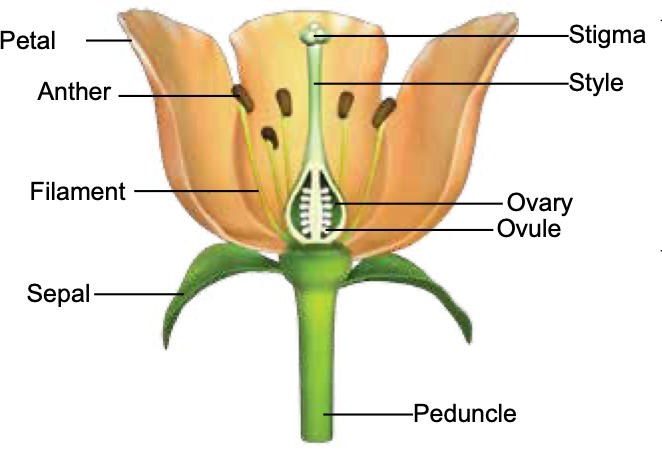
[2 marks]
(a)State the name of the male reproductive organ and the female reproductive organ of the flower.
Show answerHide answer
Tick each point you got.
[2 marks]
(b)Name the part of the carpel that becomes the fruit, and the part that receives pollen.
Show answerHide answer
Tick each point you got.
14
Question 14
A microspore mother cell in an anther produces pollen grains.
[1 mark]
(a)Name the type of cell division that forms the tetrad.
Show answerHide answer
Tick each point you got.
[3 marks]
(b)The nucleus of a pollen grain divides by mitosis. Name the two nuclei formed and state what happens to each when the pollen tube reaches the embryo sac.
Show answerHide answer
Tick each point you got.
15
Question 15
The embryo sac forms from a megaspore mother cell in the ovule.
[2 marks]
(a)How many megaspore cells are formed by meiosis, and how many develop further?
Show answerHide answer
Tick each point you got.
[2 marks]
(b)The surviving cell divides by mitosis three times. Calculate the number of nuclei formed.
Show answerHide answer
Tick each point you got.
16
Question 16
Diagram 2 shows a pollen tube reaching an embryo sac.
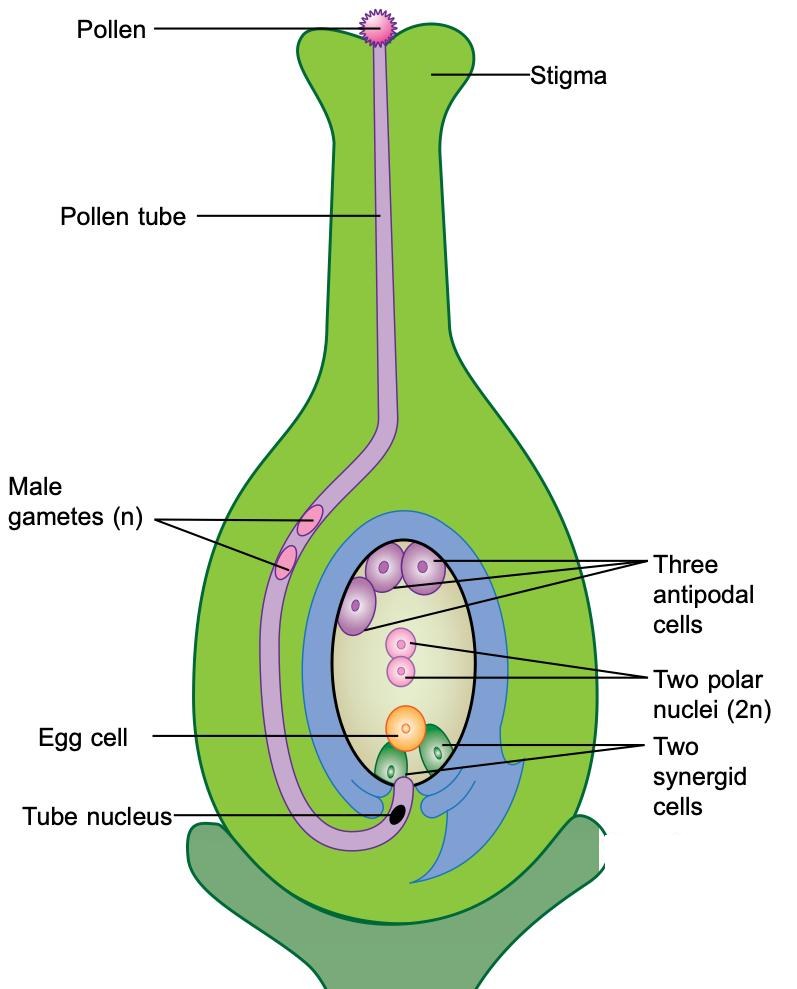
[1 mark]
(a)Through which opening does the pollen tube enter the ovule?
Show answerHide answer
Tick each point you got.
[4 marks]
(b)Describe the two fusions of double fertilisation and name the product of each.
Show answerHide answer
Tick each point you got.
17
Question 17
A fungus damages the stigma of a flower so that pollen grains cannot germinate on it.
[2 marks]
(a)Predict whether the flower can form a seed. Give a reason.
Show answerHide answer
Tick each point you got.
[3 marks]
(b)Explain why double fertilisation is important for the survival of the plant species.
Show answerHide answer
Tick each point you got.
18
Question 18
After fertilisation, the flower changes into a fruit containing seeds.
[2 marks]
(a)State what each of these becomes: (i) ovule (ii) ovary wall.
Show answerHide answer
Tick each point you got.
[3 marks]
(b)Name the three layers of the pericarp.
Show answerHide answer
Tick each point you got.
[1 mark]
(c)State the function of the suspensor.
Show answerHide answer
Tick each point you got.
19
Question 19
A farmer stores dried long bean seeds for the next planting season.
[3 marks]
(a)Explain how a seed is able to survive storage.
Show answerHide answer
Tick each point you got.
[2 marks]
(b)Suggest why a plant that produces many seeds has a better chance of survival.
Show answerHide answer
Tick each point you got.