Biology notes, chapter 6
Sexual Reproduction in Flowering Plants
Textbook Biology Form 5 (DLP), pages 112–131
What this chapter covers
- Describe the structure of a flower and compare the male and female reproductive structures (6.1)
- Explain how pollen grains form in the anther and the embryo sac forms in the ovule (6.2)
- Describe pollination, the growth of the pollen tube and double fertilisation (6.3)
- Explain how the ovule becomes the seed and the ovary becomes the fruit (6.4)
- Justify the importance of seeds for the survival of plant species (6.5)
6.1Structure of a flower
Flowers are the reproductive organs of angiosperms. A flower has a male part (the stamen) and a female part (the carpel), surrounded by petals and sepals on a stalk called the peduncle.
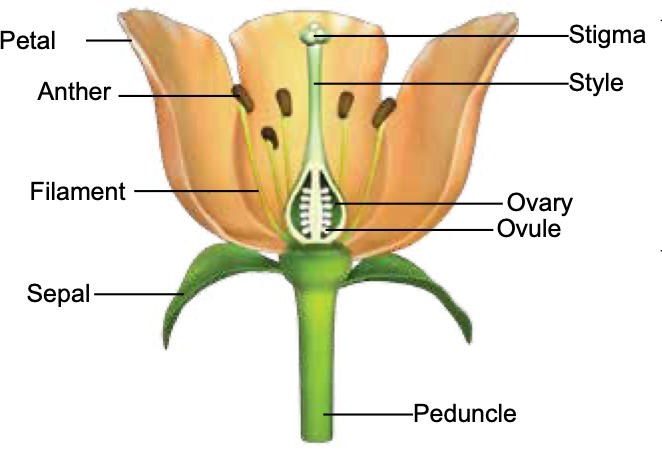
Figure: Biology Form 5 (DLP) textbook, Figure 6.1, p. 114.
| Male: stamen | Female: carpel | |
|---|---|---|
| Parts | Filament and anther | Stigma, style and ovary |
| Produces | Pollen grains (male gametes develop from them) | Embryo sac (inside the ovule) |
| Position | Stamens project outwards from the base of the ovary | Located in the middle of the flower |
Both sets of organs make gametes and both sit in the flower. A flower that holds both, such as a lily, is a bisexual flower (a hermaphrodite).
Name the three parts of the carpel and the two parts of the stamen.
Show answerHide answer
Carpel: stigma, style, ovary. Stamen: filament and anther.
6.2Development of pollen grains and embryo sac
Pollen grains in the anther
- Each anther lobe forms four pollen sacs. Each sac holds hundreds of diploid (2n) microspore mother cells.
- Each mother cell divides by meiosis into four haploid (n) microspore cells, a tetrad. Each cell becomes a pollen grain.
- The nucleus of each pollen grain divides by mitosis into a generative nucleus and a tube nucleus.
- The pollen sac wall breaks when the grain is mature and the pollen grains are released.
Embryo sac in the ovule
The ovule hangs from the ovary wall on a funicle, attached at the placenta. It contains the nucellus, covered by the integument with a small opening, the micropyle.
- One nucellus cell, the diploid megaspore mother cell, divides by meiosis into four haploid megaspores.
- Three megaspores degenerate. One survives.
- Its nucleus divides by mitosis three times, giving a cell with eight nuclei: the embryo sac.
- Three nuclei move to one end (antipodal cells). Two nuclei in the centre are the polar nuclei. At the other end, three nuclei form two synergid cells and one egg cell.
| Pollen grain | Embryo sac | |
|---|---|---|
| Starts as | Microspore mother cell (2n) | Megaspore mother cell (2n) |
| Meiosis gives | 4 microspores, all develop | 4 megaspores, 3 degenerate |
| Mitosis gives | 2 nuclei (generative and tube) | 8 nuclei |
Meiosis halves the chromosome number so that gametes are haploid. Fertilisation then restores the diploid number.
How many nuclei are in a mature embryo sac, and how many of them are haploid?
Show answerHide answer
Eight nuclei, all haploid (n), formed by three mitotic divisions of one haploid megaspore.
6.3Pollination and fertilisation
Pollination is the transfer of pollen grains from the anther to the stigma, by agents such as insects, birds, mammals, water or wind.
- A pollen grain on the stigma germinates and forms a pollen tube that grows down the style towards the ovule.
- The tube secretes an enzyme that digests the style tissue.
- The generative nucleus moves down the tube and divides by mitosis into two male gametes (n).
- The tube enters the ovule through the micropyle. The tube nucleus degenerates and both male gametes enter the embryo sac.
Double fertilisation
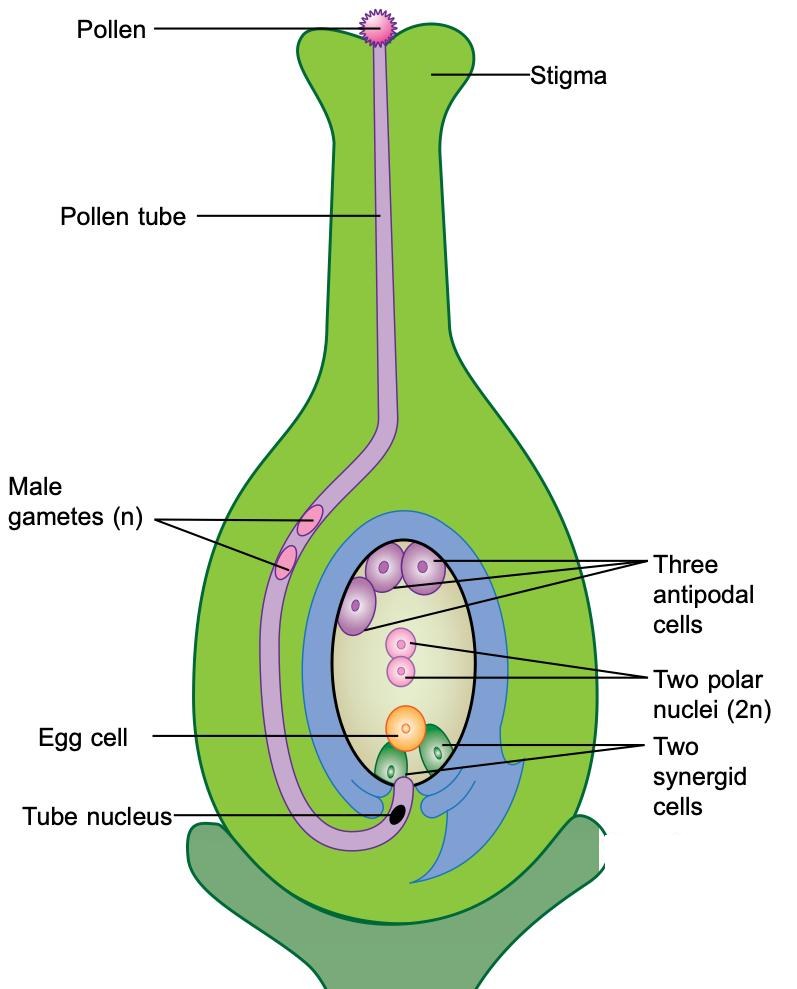
Figure: Biology Form 5 (DLP) textbook, Figure 6.9, p. 123 (cropped).
| Fusion | Product | Importance |
|---|---|---|
| Male gamete + egg cell | Diploid (2n) zygote | Passes genetic information on; restores the diploid number |
| Male gamete + two polar nuclei | Triploid (3n) endosperm nucleus | Becomes food tissue for the embryo |
Why double fertilisation matters for survival
- The zygote passes genetic information from one generation to the next and restores the diploid number.
- The endosperm feeds the developing embryo, which helps it stay alive in the seed until conditions suit germination.
Mixing up the two fusions. The egg cell gives the zygote (2n). The polar nuclei give the endosperm (3n). Do not call the endosperm a zygote.
Why is the process called double fertilisation?
Show answerHide answer
Two male gametes take part: one fertilises the egg cell and the other fuses with the two polar nuclei.
6.4Development of seeds and fruits
- The endosperm nucleus divides by mitosis to form the endosperm, which stores food around the embryo.
- The zygote divides into a large cell (becomes the suspensor, anchoring the embryo) and a small cell (becomes the embryo: plumule, radicle and cotyledon).
- The ovule becomes the seed; the integument becomes the seed coat (testa).
- The ovary becomes the fruit; the ovary wall becomes the pericarp (exocarp, mesocarp, endocarp). The stigma and style wither and leave a scar.
| Flower part | Becomes |
|---|---|
| Ovule | Seed |
| Integument | Seed coat |
| Ovary | Fruit |
| Ovary wall | Pericarp |
| Zygote | Embryo (and suspensor) |
| Triploid nucleus | Endosperm |
Types of fruit
| Type | Develops from | Example |
|---|---|---|
| Simple | One carpel, or several fused carpels, in one flower | Peas |
| Aggregate | Many separate carpels in one flower | Raspberry |
| Multiple | Carpels of a cluster of flowers | Pineapple |
| Accessory | Tissue near the carpel, not the ovary | Apple |
What does the ovule develop into and what protects the embryo inside it?
Show answerHide answer
The ovule becomes the seed. The integument becomes the seed coat, which protects the embryo.
6.5Importance of seeds for survival
- The seed holds an embryo that germinates into a seedling.
- Endosperm or cotyledons supply nutrients and energy for germination.
- The strong, waterproof testa protects the embryo from damage and spoilage.
- Seeds can stay dormant, so they can be stored for a long time until conditions suit germination.
- Seeds are light, spongy or strong, so they are dispersed far away, which reduces competition.
- Seeds from sexual reproduction give genetic variation; many seeds raise the chance that some survive.
Writing "seeds are produced so plants can grow". Link each feature to survival: testa, so the embryo does not spoil; dormancy, so it waits for good conditions.