Biodiversity
What this chapter covers
- Explain why organisms need a classification system and scientific names (8.1.1)
- Classify organisms into the six kingdoms and state the main features of each (8.1.2, 8.1.3)
- Describe the Linnaeus taxonomic hierarchy and write scientific names using binomial nomenclature (8.1.3, 8.1.4)
- Use a dichotomous key to identify organisms (8.1.5)
- Describe genetic, species and ecosystem diversity (8.2.1)
- Explain what a phylogenetic tree shows and why biodiversity is important and must be conserved (8.2.2, 8.2.3)
- State the main characteristics of bacteria, protozoa, algae, fungi and viruses (8.3.1)
- Describe the roles of microorganisms in the nitrogen cycle, as producers, decomposers, parasites and symbionts (8.3.2, 8.3.3)
- Define pathogens and vectors and explain how pathogens affect human health (8.3.4, 8.3.5)
8.1Classification system and naming of organisms
| Part of taxonomy | Tool used |
|---|---|
| Classification | Taxonomic hierarchy (based on physical features) |
| Identification | Dichotomous key |
| Naming | Binomial nomenclature system |
A common system lets scientists around the world study and discuss organisms in a systematic way. Carolus Linnaeus is known as the father of taxonomy.
The six kingdoms
Organisms are placed in six kingdoms using three clues: the type of cell, the number of cells and the type of nutrition.
| Kingdom | Cell type | Number of cells | Nutrition | Key features and examples |
|---|---|---|---|---|
| Archaebacteria | Prokaryote | Unicellular | Autotroph or heterotroph | Cell wall without peptidoglycan; lives in very hot, acidic, salty or oxygen-free places (methanogens, halophiles, thermophiles). Halobacterium salinarum |
| Eubacteria | Prokaryote | Unicellular, often in colonies | Autotroph or heterotroph | "True" bacteria; cell wall of peptidoglycan; ribosomes and plasmids but no membrane-bound organelles. Vibrio cholerae |
| Protista | Eukaryote | Unicellular or multicellular | Autotroph, heterotroph or both | Simple cell organisation, no specialised tissue; protozoa, algae and slime mould. Amoeba, Spirogyra |
| Fungi | Eukaryote | Unicellular or multicellular | Heterotroph (saprophyte or parasite) | Cell wall of chitin; body is a mycelium of hyphae. Yeast, mushroom |
| Plantae | Eukaryote | Multicellular | Autotroph (photosynthesis) | Have chlorophyll; sexual or asexual reproduction. Ferns, flowering plants |
| Animalia | Eukaryote | Multicellular | Heterotroph | Most can move and reproduce sexually. Starfish, elephant |
Whittaker (1969) proposed five kingdoms with Monera as one kingdom. Woese (1990) split Monera into bacteria and archaebacteria, giving six kingdoms, because RNA differs between the two groups.
The Linnaeus hierarchy
From the biggest group to the smallest: domain, kingdom, phylum, class, order, family, genus, species. Going down the hierarchy, the number of organisms in each group decreases and the organisms are more closely related genetically. A species is the smallest group; its members can interbreed to produce viable, fertile offspring.
Binomial nomenclature
- The scientific name has two words: the genus first, then the species.
- The genus starts with a capital letter; the species starts with a small letter.
- Printed names are in italics. Handwritten, underline each word separately.
Dichotomous key
A dichotomous key identifies organisms using couplets: two contrasting statements at every step. Use features that are obvious, observable and do not overlap. A key can be written as numbered statements or drawn as a branching diagram.
| Couplet | Statement | Go to / answer |
|---|---|---|
| 1a | Animals | 2 |
| 1b | Plants | 6 |
| 6a | Has seeds | 7 |
| 6b | Does not have seeds | Fern |
| 7a | Flowering plant | Hibiscus |
| 7b | Non-flowering plant | Pine tree |
Part of the sample key in textbook Figure 8.4, p. 151.
Show answerHide answer
8.2Biodiversity
| Type | Meaning | Example |
|---|---|---|
| Genetic diversity | Variation of genes within a population and between populations of the same species | Many varieties of cultivated rice |
| Species diversity | Number of species in a community (species richness) and how evenly they are spread (species evenness) | Tropical rainforest: millions of insect species |
| Ecosystem diversity | Variety of biotic communities and ecological processes on land, in the sea and in other aquatic habitats | Ocean, desert, swamp |
Phylogenetic tree
Phylogenetic classification often uses homologous structures: body parts with the same basic structure because the animals share an ancestor, even if their functions differ (the limbs of a human, cat, whale and bat have the same bones).
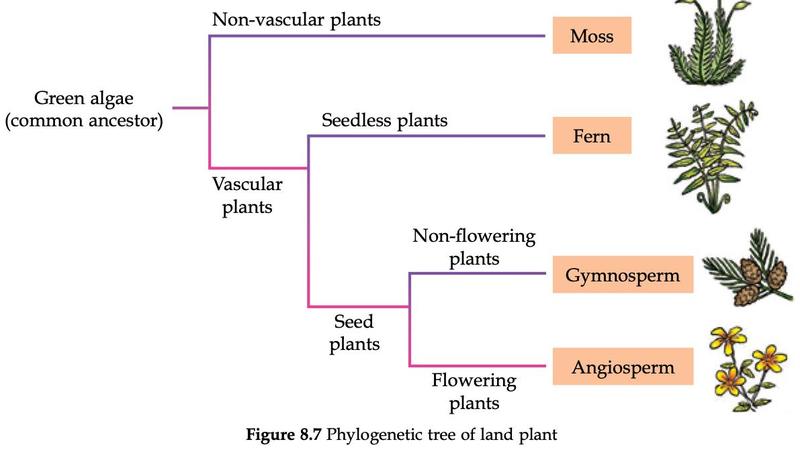
Textbook Figure 8.7, p. 154.
Importance and conservation of biodiversity
- Biodiversity is a source of food, medicine and education, keeps nature in balance, and is used for recreation and scientific research.
- In situ conservation keeps species in their natural habitat, e.g. national parks, permanent forest reserves, the Sepilok orangutan rehabilitation centre.
- Ex situ conservation keeps species outside their natural habitat, e.g. zoos and botanical gardens.
- Threats to biodiversity: deforestation, illegal hunting, water pollution, and tourism that exploits biodiversity.
Show answerHide answer
8.3Microorganisms and viruses
Microorganisms are too small to see with the naked eye. They include bacteria, protozoa, algae, fungi and viruses.
| Group | Main characteristics |
|---|---|
| Bacteria | No nucleus; DNA free in the cytoplasm as a nucleoid; some have plasmids. 1 to 10 µm long. Shapes: coccus (sphere), vibrio (comma), bacillus (rod), spirillum (spiral) |
| Protozoa | Animal-like and unicellular; move by pseudopodia (Amoeba), cilia (Paramecium) or flagellum (Euglena); mostly aquatic; free-living or parasitic; Euglena has chloroplasts |
| Algae | Unicellular (Chlamydomonas) or multicellular (Fucus); have chloroplasts so are autotrophs; no true roots, stems or leaves; live in ponds, lakes and the sea |
| Fungi | No chlorophyll, so heterotrophs (parasites or saprophytes); chitin cell wall; hyphae form a mycelium; found in dark, moist places and on dead organisms. Yeast is unicellular, Mucor is multicellular |
| Viruses | Not cellular and not in any kingdom; nucleic acid (DNA or RNA) in a protein capsid; 20 to 400 nm, seen only with an electron microscope; reproduce only inside host cells. Examples: tobacco mosaic virus, T4 bacteriophage, HIV |
Roles of microorganisms
Nitrogen cycle
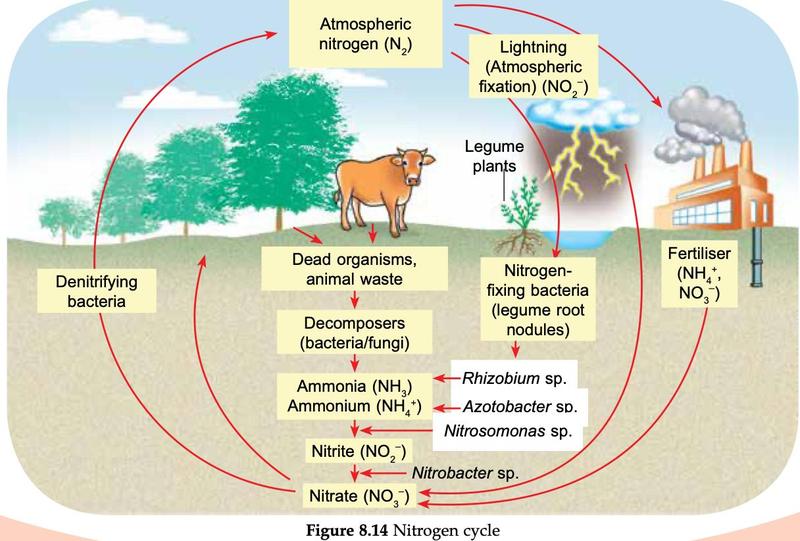
Textbook Figure 8.14, p. 159.
| Process | What happens | Microorganism |
|---|---|---|
| Nitrogen fixation | N2 from the air becomes ammonium ions (NH4+) | Rhizobium (legume root nodules), Azotobacter (free-living) |
| Ammonification | Protein in dead organisms and waste becomes ammonium ions | Decomposers (bacteria, saprophytic fungi) |
| Nitrification (1) | Ammonium to nitrite (NO2−) | Nitrosomonas |
| Nitrification (2) | Nitrite to nitrate (NO3−) | Nitrobacter |
| Denitrification | Nitrate to nitrogen gas | Denitrifying bacteria |
Lightning and industrial fertilisers also add usable nitrogen to the soil. Plants absorb nitrates to make protein; animals get nitrogen by eating plants.
Other roles
- Producers: phytoplankton (green algae, cyanobacteria, dinoflagellates, diatoms) photosynthesise and start aquatic food chains.
- Decomposers: saprophytic fungi and bacteria secrete digestive enzymes onto dead matter and absorb the products, returning carbon, nitrogen and sulphur to the soil.
- Parasites: the parasite benefits while the host is harmed. Most parasites do not kill the host, because they depend on it. Plasmodium causes malaria.
- Symbionts: live in close association with a host. An ectosymbiont lives outside host cells (ectomycorrhiza on roots); an endosymbiont lives inside (Trichonympha in termites).
Pathogens and vectors
| Vector | Pathogen | Disease |
|---|---|---|
| Housefly (Musca domestica) | Bacterium Vibrio cholerae | Cholera |
| Aedes aegypti mosquito | Dengue virus | Dengue |
| Cockroach (Periplaneta americana) | Bacterium Salmonella typhi | Typhoid |
| Pathogen | Example of disease | Symptoms |
|---|---|---|
| Virus | Hepatitis B | Liver inflammation, skin and eyes turn yellowish, may be fatal |
| Bacteria | Tuberculosis | Weight loss, coughing blood, shortness of breath |
| Protozoa | Dysentery | Stomach ache, diarrhoea, vomiting |
| Fungi | Tinea versicolour | Whitish or pinkish patches on the skin |
In Malaysia, scientists inject Wolbachia bacteria into the eggs of Aedes aegypti to curb the growth of the dengue virus in the mosquitoes.