Biology questions, chapter 8
Nama / NameKelas / ClassTarikh / Date
Biodiversity
45 marks. Use Practice to check each answer as you go, or Exam to answer everything against the clock first.
Section A: objective questions
12 marksChoose the best answer for each question.
1
Question 1
Which three activities make up taxonomy?
Show answerHide answer
B
Taxonomy involves classifying, identifying and naming organisms in an organised way.
2
Question 2
A unicellular prokaryote lives in a hot spring. Its cell wall has no peptidoglycan. Which kingdom does it belong to?
Show answerHide answer
D
Archaebacteria are prokaryotes with cell walls lacking peptidoglycan and live in extreme places such as hot springs. Eubacteria have peptidoglycan.
3
Question 3
An organism has a cell wall made of chitin and a body made of hyphae. It cannot make its own food. To which kingdom does it belong?
Show answerHide answer
A
Chitin cell walls, hyphae forming a mycelium and heterotrophic nutrition are features of Fungi.
4
Question 4
Which shows the Linnaeus hierarchy from the largest group to the smallest group?
Show answerHide answer
C
The hierarchy runs domain, kingdom, phylum, class, order, family, genus, species. Option D is the correct order but from smallest to largest.
5
Question 5
Which is the correct way to write the printed scientific name of the common sunflower according to binomial nomenclature?
Show answerHide answer
B
The genus begins with a capital letter, the species name is in small letters and the whole name is in italics.
6
Question 6
The number of species in a tropical rainforest and how evenly they are spread describes which type of biodiversity?
Show answerHide answer
A
Species diversity includes species richness (number of species) and species evenness (distribution).
7
Question 7
The forelimbs of a human, a cat, a whale and a bat have the same bone structure but different functions. What does this show?
Show answerHide answer
D
Homologous structures have the same basic structure because the animals share a common ancestor, even though the functions differ.
8
Question 8
Which is an example of in situ conservation?
Show answerHide answer
C
In situ conservation keeps species in their natural habitat, such as national parks and permanent forest reserves. Zoos and botanical gardens are ex situ.
9
Question 9
A bacterium is shaped like a comma. What is the shape called?
Show answerHide answer
C
Coccus is a sphere, bacillus is a rod, vibrio is a comma and spirillum is a spiral.
10
Question 10
Why are viruses not placed in any of the six kingdoms?
Show answerHide answer
A
A virus is made of nucleic acid and a protein capsid, has no cell structure and carries out no life process outside a host cell.
11
Question 11
Which microorganism converts nitrates in the soil into nitrogen gas?
Show answerHide answer
D
Denitrifying bacteria carry out denitrification. Rhizobium fixes nitrogen; Nitrosomonas and Nitrobacter are nitrifying bacteria.
12
Question 12
Mushrooms look like plants because they grow from the ground, yet they are placed in kingdom Fungi. Which statement best justifies this classification?
Show answerHide answer
B
Plants have chlorophyll and photosynthesise. Fungi lack chlorophyll, feed as saprophytes or parasites and have chitin cell walls, so they are not plants.
Section B: structured questions
33 marksAnswer all questions.
13
Question 13
The table shows the taxonomy of the domestic cat.
| Rank | Taxon |
|---|---|
| Kingdom | Animalia |
| Class | Mammalia |
| Family | Felidae |
| Genus | Felis |
| Species | catus |
[1 mark]
(a)Write the scientific name of the domestic cat as it is printed.
Show answerHide answer
Tick each point you got.
[1 mark]
(b)How must the name be written by hand?
Show answerHide answer
Tick each point you got.
14
Question 14
Organisms are classified in a taxonomic hierarchy.
[1 mark]
(a)State the rank that is directly below class.
Show answerHide answer
Tick each point you got.
[2 marks]
(b)What is meant by a species?
Show answerHide answer
Tick each point you got.
15
Question 15
The table shows features of three organisms, P, Q and R.
| Organism | Features |
|---|---|
| P | Unicellular, no nucleus, cell wall without peptidoglycan, lives in a very salty lake |
| Q | Has a nucleus, cell wall of chitin, body made of hyphae, absorbs food from dead matter |
| R | Multicellular, has a nucleus, makes its own food by photosynthesis |
[3 marks]
(a)Name the kingdom of each organism, P, Q and R.
Show answerHide answer
Tick each point you got.
[1 mark]
(b)State one difference in nutrition between Q and R.
Show answerHide answer
Tick each point you got.
16
Question 16
A dichotomous key is used to identify four animals: eagle, bat, tilapia and frog.
| Couplet | Statement | Go to / answer |
|---|---|---|
| 1a | Has wings | 2 |
| 1b | Has no wings | 3 |
| 2a | Body covered with feathers | Eagle |
| 2b | Body covered with fur | Bat |
| 3a | Has gills as an adult | Tilapia |
| 3b | Has no gills as an adult | Frog |
[1 mark]
(a)Which animal has wings and fur?
Show answerHide answer
Tick each point you got.
[2 marks]
(b)State the couplets used to identify the tilapia.
Show answerHide answer
Tick each point you got.
[1 mark]
(c)Why must the features used in a dichotomous key be obvious and must not overlap?
Show answerHide answer
Tick each point you got.
17
Question 17
Choose the type of biodiversity shown in each situation.
[1 mark]
(a)Many varieties of cultivated rice exist all over the world.
Show answerHide answer
Genetic diversity
[1 mark]
(b)A tropical rainforest has millions of insect species and thousands of flowering plant species.
Show answerHide answer
Species diversity
[1 mark]
(c)A country has oceans, deserts and swamps.
Show answerHide answer
Ecosystem diversity
18
Question 18
Diagram 1 shows a phylogenetic tree of land plants.
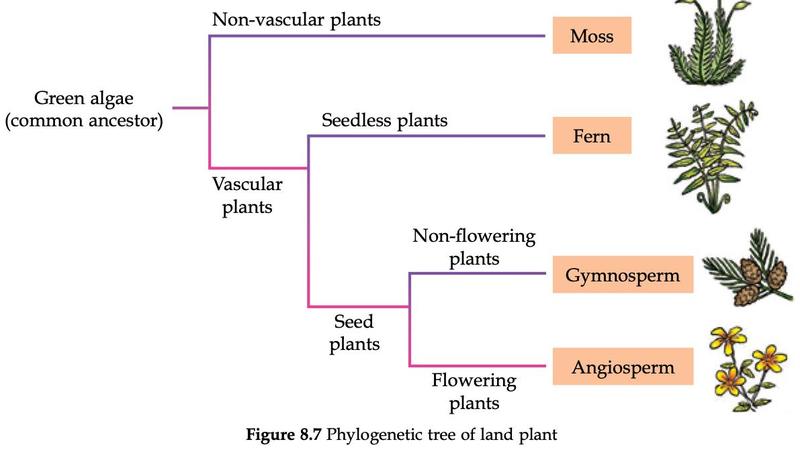
[1 mark]
(a)What is the common ancestor of these land plants?
Show answerHide answer
Tick each point you got.
[1 mark]
(b)Which plant in Diagram 1 is a seedless vascular plant?
Show answerHide answer
Tick each point you got.
[1 mark]
(c)Explain why angiosperms are considered the most successful land plants.
Show answerHide answer
Tick each point you got.
[1 mark]
(d)State what a phylogenetic tree shows.
Show answerHide answer
Tick each point you got.
19
Question 19
The Sepilok orangutan rehabilitation centre protects orangutans in their natural habitat in Sabah.
[1 mark]
(a)Which type of conservation is this?
Show answerHide answer
In situ
The species is kept in its natural habitat.
[1 mark]
(b)Give one example of ex situ conservation.
Show answerHide answer
Any 1 points
Tick each point you got.
[2 marks]
(c)State two reasons why biodiversity is important to humans.
Show answerHide answer
Any 2 points
Tick each point you got.
20
Question 20
Diagram 2 shows the nitrogen cycle.
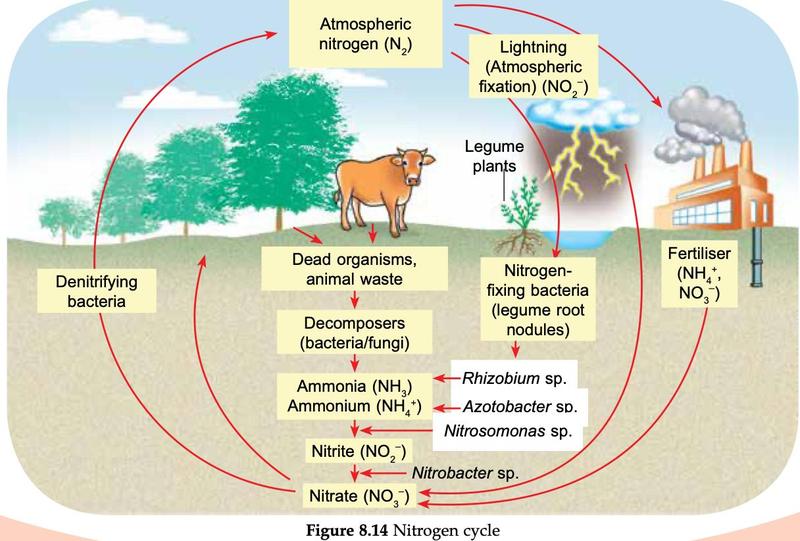
[1 mark]
(a)Name the bacterium that converts nitrite ions into nitrate ions.
Show answerHide answer
Tick each point you got.
[1 mark]
(b)Name the process in which decomposers change protein in dead organisms into ammonium ions.
Show answerHide answer
Tick each point you got.
[1 mark]
(c)State the role of Rhizobium sp. in the root nodules of legumes.
Show answerHide answer
Tick each point you got.
[2 marks]
(d)Farmers plant legumes in a field after a crop that removes a lot of nitrogen. Explain why this helps.
Show answerHide answer
Tick each point you got.
21
Question 21
Many residents of a housing area suffer from dengue fever.
[2 marks]
(a)Name the pathogen and the vector of dengue.
Show answerHide answer
Tick each point you got.
[2 marks]
(b)Suggest one way to reduce the number of vectors without harming the environment and explain why it works.
Show answerHide answer
Tick each point you got.