Biology questions, chapter 9
Nama / NameKelas / ClassTarikh / Date
Ecosystem
46 marks. Use Practice to check each answer as you go, or Exam to answer everything against the clock first.
Section A: objective questions
12 marksChoose the best answer for each question.
1
Question 1
Which describes a population?
Show answerHide answer
B
A population is organisms of the same species in one habitat. Option A is a community, C is a species and D is a habitat.
2
Question 2
What is the niche of an organism?
Show answerHide answer
C
A niche is the role of an organism in an ecosystem, covering its behaviour and interactions. Where it lives is its habitat.
3
Question 3
Nitrobacter sp. makes organic compounds without light, using energy from oxidising inorganic substances. How is it classified?
Show answerHide answer
A
It gains energy by oxidising inorganic substances (chemosynthesis), so it is a chemoautotroph.
4
Question 4
What is the role of decomposers in an ecosystem?
Show answerHide answer
D
Decomposers such as bacteria and fungi break dead organisms and waste into simple substances like carbon dioxide and ammonia.
5
Question 5
A grassland food chain starts with producers containing 5 000 kJ. About how much energy reaches the secondary consumers?
Show answerHide answer
B
Only 10% passes on at each level: 5 000 × 0.1 = 500 kJ (primary), then 500 × 0.1 = 50 kJ (secondary).
6
Question 6
A remora fish feeds on scraps from a shark. The shark is neither helped nor harmed. What interaction is this?
Show answerHide answer
C
One organism benefits and the other is unaffected: commensalism.
7
Question 7
What is the function of the pneumatophore roots of Avicennia sp.?
Show answerHide answer
A
Pneumatophores project above the mud and exchange gases through lenticels. Prop roots give support and viviparous seeds germinate on the parent.
8
Question 8
Which plants are the pioneer species in the coastal zone of a mangrove forest?
Show answerHide answer
D
Avicennia and Sonneratia colonise the coastal zone first and trap mud; Rhizophora then succeeds them.
9
Question 9
A species is found in 6 out of 8 quadrats. What is its frequency?
Show answerHide answer
C
Frequency = 6 ÷ 8 × 100% = 75%.
10
Question 10
25 beetles are marked and released. A later sample of 40 beetles contains 5 marked ones. What is the estimated population?
Show answerHide answer
A
Population = (25 × 40) ÷ 5 = 200.
11
Question 11
What usually causes a clumped pattern of population distribution?
Show answerHide answer
D
Clumped groups form where resources are patchy. Uniform distribution results from competition; random from little interaction.
12
Question 12
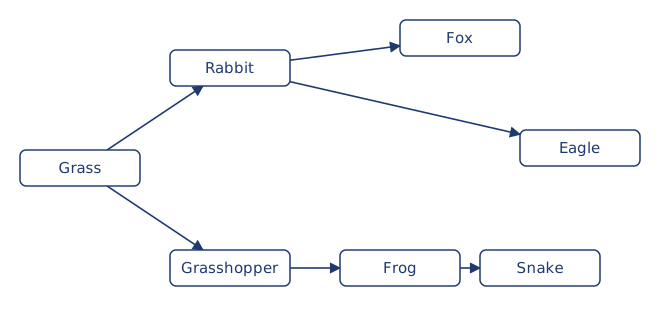
Diagram 1 shows a food web. All the frogs die from a disease. What is the most likely immediate effect?
Show answerHide answer
B
Frogs eat grasshoppers, so grasshoppers increase. The snake feeds only on frogs in this web, so it decreases.
Section B: structured questions
34 marksAnswer all questions. Write your answers in the spaces provided.
13
Question 13
Diagram 2 shows a food web in a grassland.
[1 mark]
(a)How many food chains are in the food web?
Show answerHide answer
Tick each point you got.
[1 mark]
(b)State the trophic level of the snake in the longest food chain.
Show answerHide answer
Grass, grasshopper, frog, snake: the snake is a tertiary consumer.
Tick each point you got.
[1 mark]
(c)Name one organism that is a secondary consumer.
Show answerHide answer
Tick each point you got.
[2 marks]
(d)All the rabbits are removed. Explain the effect on the fox.
Show answerHide answer
Tick each point you got.
14
Question 14
Give the meaning of each term.
[1 mark]
(a)Habitat
Show answerHide answer
Tick each point you got.
[1 mark]
(b)Community
Show answerHide answer
Tick each point you got.
[1 mark]
(c)Niche
Show answerHide answer
Tick each point you got.
15
Question 15
Name the type of interaction in each situation.
[1 mark]
(a)A tapeworm absorbs nutrients from the human intestine.
Show answerHide answer
Tick each point you got.
[1 mark]
(b)Two different plant species compete for sunlight.
Show answerHide answer
Tick each point you got.
[1 mark]
(c)A myna eats lice from a buffalo.
Show answerHide answer
The myna gets food and the buffalo is rid of lice, so both benefit.
Tick each point you got.
16
Question 16
A food chain is: paddy, grasshopper, frog, snake. The paddy contains 8 000 kJ of energy.
[1 mark]
(a)Calculate the energy transferred to the frog.
Show answerHide answer
Grasshopper 800 kJ, frog 80 kJ.
Tick each point you got.
[1 mark]
(b)Calculate the energy transferred to the snake.
Show answerHide answer
Tick each point you got.
[2 marks]
(c)Explain why food chains usually end at the secondary or tertiary consumer.
Show answerHide answer
Tick each point you got.
17
Question 17
Mangrove trees grow in soft, muddy soil that is covered by seawater at high tide.
[2 marks]
(a)Name the roots of Rhizophora sp. and state their function.
Show answerHide answer
Tick each point you got.
[2 marks]
(b)Explain how pneumatophore roots help the tree survive in waterlogged mud.
Show answerHide answer
Tick each point you got.
[1 mark]
(c)What is the advantage of viviparous seeds to mangrove trees?
Show answerHide answer
Tick each point you got.
18
Question 18
A mangrove area has Avicennia sp. near the sea, Rhizophora sp. in the middle and Bruguiera sp. inland.
[1 mark]
(a)Name the process in which Rhizophora sp. gradually replaces Avicennia sp.
Show answerHide answer
Tick each point you got.
[2 marks]
(b)Explain how Avicennia sp. prepares the area for Rhizophora sp.
Show answerHide answer
Tick each point you got.
[2 marks]
(c)The Rhizophora zone is cleared to build a fish pond. Give two effects on the ecosystem.
Show answerHide answer
Any 2 points
Tick each point you got.
19
Question 19
A student used ten 1 m × 1 m quadrats to study plant X. The numbers of plants in the quadrats were 3, 0, 5, 2, 0, 4, 1, 0, 3, 2. Plant X covered a total area of 1.2 m² in all the quadrats.
[1 mark]
(a)Calculate the frequency of plant X.
Show answerHide answer
Tick each point you got.
[1 mark]
(b)Calculate the density of plant X.
Show answerHide answer
Tick each point you got.
[1 mark]
(c)Calculate the coverage percentage.
Show answerHide answer
Tick each point you got.
[1 mark]
(d)Why must the quadrats be placed randomly?
Show answerHide answer
Tick each point you got.
20
Question 20
To estimate the number of fish in a pond, 60 fish were caught, marked and released. A week later, 45 fish were caught and 9 of them were marked.
[2 marks]
(a)Calculate the estimated population size.
Show answerHide answer
Tick each point you got.
[1 mark]
(b)Suggest a suitable marker.
Show answerHide answer
Tick each point you got.
[2 marks]
(c)State two assumptions that make the estimate reliable.
Show answerHide answer
Tick each point you got.