Ecosystem
What this chapter covers
- Define habitat, species, population, community, ecosystem and niche (9.1.1)
- Describe the biotic and abiotic components of an ecosystem and how abiotic factors affect organisms (9.1.2)
- Classify organisms by mode of nutrition (9.1.3)
- Explain trophic levels, food chains and food webs (9.1.4, 9.1.5)
- Explain pyramids of numbers, biomass and energy (9.1.6)
- Describe interactions among organisms and compare competition types (9.1.7)
- Describe the mangrove ecosystem, its adaptations, succession and importance (9.1.8)
- Explain factors affecting population distribution and the three distribution patterns (9.2.1)
- Estimate population size using quadrat and capture-mark-release-recapture techniques (9.2.2)
9.1Community and ecosystem
Terms to know
| Term | Meaning | Example |
|---|---|---|
| Habitat | The natural surrounding or living place of an organism | A pond for a frog |
| Species | A group of similar organisms able to interbreed and produce offspring | Clown fish |
| Population | Organisms of the same species living in the same habitat | All the clown fish on one reef |
| Community | Populations of different species living and interacting in the same habitat | All the fish, corals and algae on the reef |
| Ecosystem | Communities interacting with each other and with non-living (abiotic) components such as water, air and soil | A marine ecosystem |
| Niche | The role of an organism in an ecosystem, including its behaviour and its interactions with biotic and abiotic components | A butterfly caterpillar and an adult butterfly have different niches |
Abiotic components
| Factor | How it affects organisms |
|---|---|
| pH value | Most organisms live in neutral or almost neutral conditions. A small change in soil pH disturbs soil microorganisms and reduces fertility. |
| Temperature | Enzymes are sensitive to temperature, so metabolic rate changes. Most organisms live between 20 °C and 40 °C; polar bears (tundra, about –14 °C) and desert foxes (up to 45 °C) are extremes. |
| Light intensity | Controls the distribution of plants. Under the tropical rainforest canopy only small plants such as ferns grow; coniferous forests have fewer, shorter plants. |
| Topography | Altitude, gradient and aspect. Higher altitude gives lower humidity, pressure and oxygen. Steep slopes have thin, dry soil. Aspect is the direction of wind and sunlight; slopes facing the sea or the sun have denser plants. |
| Microclimate | The climate of a small area that differs from its surroundings, for example under a rock or in the shade of the canopy. |
| Air humidity | More organisms live in humid areas. Low humidity increases transpiration, which also cools the plant. |
Modes of nutrition
| Type | Description | Example |
|---|---|---|
| Photoautotroph | Makes complex organic compounds from carbon dioxide using light energy (photosynthesis) | Green plants |
| Chemoautotroph | Makes organic compounds without light, using energy from oxidising inorganic substances such as hydrogen sulphide or ammonia | Nitrobacter sp. |
| Saprotroph | Digests dead and decaying matter outside the body, then absorbs the nutrients | Fungi |
| Holozoic | Eats solid organic matter, then digests and absorbs it inside the body | Squirrel, humans |
| Parasitic | Absorbs nutrients from a living host | Flea, tapeworm |
Autotrophs ("self-feeders") make their own food; heterotrophs ("other-feeders") depend on other organisms.
Trophic levels, food chains and food webs
- Producers make organic substances from inorganic ones (green plants use sunlight).
- Primary consumers are herbivores; secondary and tertiary consumers are carnivores (or omnivores).
- Decomposers (bacteria, fungi) break down waste and dead organisms into simpler substances such as carbon dioxide and ammonia.
An animal that eats more than one food type can sit at different trophic levels. A bird that eats paddy is a primary consumer; the same bird eating grasshoppers is a secondary consumer.
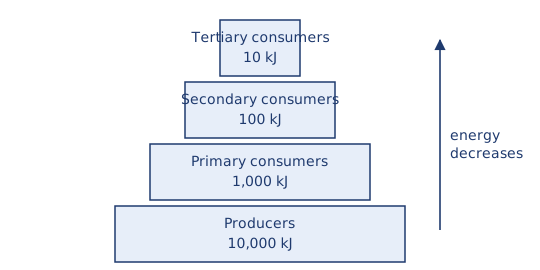
Ecological pyramids
| Pyramid | Shows | Trend going up |
|---|---|---|
| Numbers | Number of organisms at each trophic level | Number decreases; size of organisms increases |
| Biomass | Total dry mass per unit area at each level | Biomass decreases |
| Energy | Total energy at each level | Only about 10% is passed on; about 90% is lost as heat, in life processes and in excretion |
Show answerHide answer
Interactions among organisms
Mutualism, commensalism and parasitism are kinds of symbiosis: different species living together and interacting.
| Interaction | Description | Example |
|---|---|---|
| Saprophytism | Food obtained from dead organic matter | Mushrooms on a dead trunk |
| Mutualism | Both organisms benefit | Myna eats lice from a buffalo |
| Commensalism | One benefits, the other is unaffected | Remora fish eats scraps of a shark's food |
| Parasitism | One benefits, the other (host) is harmed | Tapeworm in the human intestine |
| Predation | A predator eats its prey | Owl and rat |
| Competition | Organisms compete for food, water, light or mates. Intraspecific: same species. Interspecific: different species. | Different plants competing for sunlight (interspecific); males competing for mates (intraspecific) |
Experiment 9.1 sows corn alone, paddy alone and corn mixed with paddy. The manipulated variable is the type of seeds, the responding variable is the height of seedlings, and the constant variables include soil, water, fertiliser and light. Higher competition gives slower growth.
The mangrove ecosystem
Mangrove trees live in estuaries where abiotic conditions are extreme: waves and tides, soft muddy soil lacking aeration, high salt, low dissolved oxygen, strong wind and strong light.
| Part | Adaptation | Function |
|---|---|---|
| Leaves | Thick cuticle, sunken stomata, succulent, salt-excreting hydathodes; old leaves store salt then fall | Reduce transpiration, store water, remove excess salt |
| Pneumatophore roots (Avicennia) | Short roots projecting above the mud with lenticels | Gas exchange in waterlogged soil |
| Prop roots (Rhizophora) | Branch from the lower stem into the soil | Support against wind and waves |
| Buttress roots (Bruguiera) | Thick roots widening the base | Support on soft soil next to solid land |
| Viviparous seeds | Germinate while still on the parent plant | Fallen seedlings stick into mud and are not uprooted by waves |
Colonisation and succession
| Zone | Dominant plants | What happens |
|---|---|---|
| Coastal | Avicennia and Sonneratia (pioneers) | Roots trap mud, soil rises; Rhizophora succeeds |
| Middle | Rhizophora | Tangled prop roots trap twigs and mud; soil becomes higher and drier; Bruguiera succeeds |
| Inland | Bruguiera | Land rises, flooded only at high tide; land trees such as Nypa and Pandanus succeed |
Importance: a natural barrier against waves and wind and a shelter for young fish, shrimps and crabs and a feeding site for migratory birds (protection); fish, shrimps and crabs for income; timber, handicrafts and charcoal; edible fruits and medicine such as Bruguiera bark for diarrhoea.
9.2Population ecology
Factors affecting distribution
- Plants: temperature (optimum 25–30 °C), water, light, soil pH and mineral salt content.
- Animals: temperature, water, breeding sites and food supply.
| Pattern | Description | Cause |
|---|---|---|
| Clumped | Separate groups | Uneven distribution of resources |
| Random | Free pattern | Little interaction among individuals |
| Uniform | Evenly spread | Individuals compete for limited resources |
Estimating population size
Quadrat sampling suits plants and slow-moving animals. Place the quadrat randomly, never where the plant is most abundant.
Density = total individuals ÷ (number of quadrats × area of a quadrat)
Coverage % = area covered ÷ (number of quadrats × area of a quadrat) × 100%
Capture-mark-release-recapture suits animals that move freely. Capture and mark P animals, release them, then recapture Q animals of which R are marked. Population size = (P × Q) ÷ R.
Show answerHide answer
Content: Biology Form 5 (DLP) textbook, Chapter 9, pp. 168–199.