Biology questions, chapter 11
Nama / NameKelas / ClassTarikh / Date
Inheritance
45 marks. Use Practice to check each answer as you go, or Exam to answer everything against the clock first.
Section A: objective questions
12 marksChoose the best answer for each question.
1
Question 1
Which statement describes monohybrid inheritance?
Show answerHide answer
B
Monohybrid inheritance involves one characteristic with contrasting traits controlled by one gene. Two characteristics is dihybrid inheritance.
2
Question 2
Which of the following is a trait?
Show answerHide answer
C
A trait is a variation of a characteristic. Height, flower colour and blood group are characteristics; dwarf is a trait of height.
3
Question 3
A homozygous dominant genotype for flower colour is BB. What is a genotype with different alleles called?
Show answerHide answer
A
Bb has two different alleles, so it is a heterozygote. A purebreed has two identical alleles.
4
Question 4
A heterozygous tall pea plant (Tt) is crossed with a dwarf plant (tt). What is the phenotypic ratio of the offspring?
Show answerHide answer
D
Gametes T, t and t, t give Tt, Tt, tt, tt: 1 tall : 1 dwarf.
5
Question 5
Which statement is Mendel's First Law?
Show answerHide answer
B
The Law of Segregation: a pair of alleles separates, so each gamete carries one allele. Option A is the Second Law.
6
Question 6
A round, yellow pea plant (RrYy) is crossed with a constricted, green pea plant (rryy). R is the dominant allele for round and Y for yellow. Which phenotypes are produced in the offspring?
Show answerHide answer
A
RrYy gives gametes RY, Ry, rY and ry; rryy gives only ry. Offspring: RrYy, Rryy, rrYy and rryy, so all four phenotypes in a ratio of 1 : 1 : 1 : 1.
7
Question 7
How many different types of gametes are produced by a plant with the genotype AaBb?
Show answerHide answer
D
AB, Ab, aB and ab: 4 types of gametes.
8
Question 8
A couple has a child with blood group O. The father is blood group A and the mother is blood group B. What are the genotypes of the parents?
Show answerHide answer
C
The child IO IO received one IO from each parent, so both parents are heterozygous: IA IO (group A) and IB IO (group B).
9
Question 9
What is a locus?
Show answerHide answer
A
A locus is the specific location of a gene on a chromosome. An alternative form of a gene is an allele.
10
Question 10
A female with Turner syndrome has how many chromosomes in her body cells?
Show answerHide answer
D
Turner syndrome is 44 + XO: one X chromosome is missing, so there are 45 chromosomes.
11
Question 11
A colour blind boy has parents with normal eyesight. Which genotype must his mother have? (XB is normal, Xb is colour blind.)
Show answerHide answer
B
The boy (Xb Y) got Xb from his mother. She has normal eyesight, so she must be a carrier, XB Xb. His father (XB Y) gave him the Y chromosome.
12
Question 12
Which couple can have a rhesus negative child?
Show answerHide answer
C
A rhesus negative child is Rh−Rh−, so each parent must carry an Rh− allele. Only option C has two parents who both carry Rh−; both are heterozygous: Rh+Rh− and Rh+Rh−.
Section B: structured questions
33 marksAnswer all questions. Write your answers in the spaces provided.
13
Question 13
Mendel crossed a purebreed tall pea plant with a purebreed dwarf pea plant. All the F1 plants were tall. The F1 plants were then self-pollinated to produce the F2 generation.
[1 mark]
(a)State one reason why Mendel chose the pea plant for his experiments.
Show answerHide answer
Any 1 points
Tick each point you got.
[2 marks]
(b)Which trait is recessive? Give a reason.
Show answerHide answer
Tick each point you got.
[3 marks]
(c)Mendel obtained 787 tall plants and 277 dwarf plants in his F2 generation. Calculate the ratio of tall to dwarf plants to two decimal places and explain why it is not exactly 3 : 1.
Show answerHide answer
Tick each point you got.
14
Question 14
A pea plant with purple flowers and inflated pods (PPSS) is crossed with a plant with white flowers and constricted pods (ppss). P is the dominant allele for purple and S the dominant allele for inflated pods. Two plants of the F1 generation are then crossed to produce 16 F2 progeny.
[2 marks]
(a)State the genotype and phenotype of the F1 generation.
Show answerHide answer
Tick each point you got.
[1 mark]
(b)State the probability of an F2 plant with purple flowers and constricted pods.
Show answerHide answer
Tick each point you got.
[1 mark]
(c)State the phenotypic ratio of the F2 generation (purple inflated : purple constricted : white inflated : white constricted).
Show answerHide answer
Tick each point you got.
[2 marks]
(d)State Mendel's Second Law.
Show answerHide answer
Tick each point you got.
15
Question 15
A man with normal eyesight (XB Y) marries a woman who is colour blind (Xb Xb). XB is the dominant allele for normal eyesight and Xb is the recessive allele for colour blindness.
[3 marks]
(a)Draw a schematic diagram to show the genotypes of their children.
Show answerHide answer
Tick each point you got.
[1 mark]
(b)State the probability that a child is colour blind.
Show answerHide answer
Tick each point you got.
[2 marks]
(c)Explain why colour blindness is more common in males than in females.
Show answerHide answer
Tick each point you got.
16
Question 16
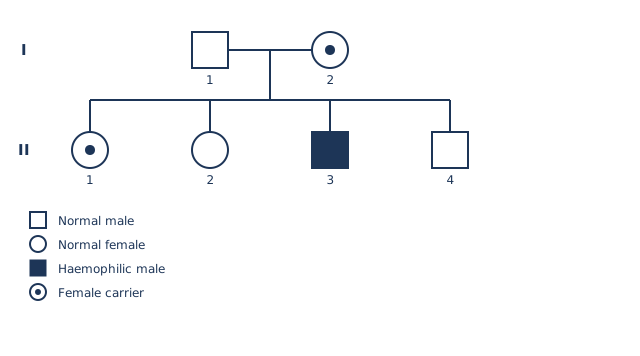
Diagram 1 shows the pedigree of a family for haemophilia.
[2 marks]
(a)State the genotype of I-2 and of II-3. Use XH and Xh.
Show answerHide answer
Tick each point you got.
[2 marks]
(b)From which parent did II-3 inherit the haemophilia allele? Explain.
Show answerHide answer
Tick each point you got.
17
Question 17
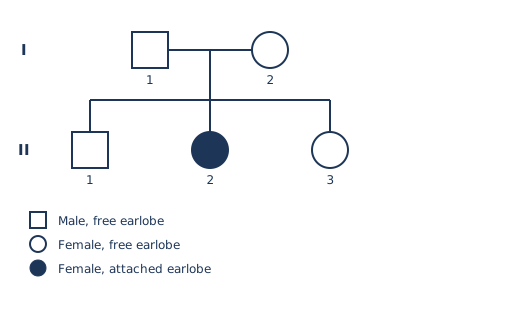
Diagram 2 shows the pedigree for the type of earlobe in a family. Free earlobe is dominant (E) and attached earlobe is recessive (e).
[1 mark]
(a)What is the genotype of the daughter with attached earlobes?
Show answerHide answer
Tick each point you got.
[3 marks]
(b)The parents both have free earlobes. Explain how the daughter has attached earlobes.
Show answerHide answer
Tick each point you got.
[1 mark]
(c)State the probability that the next child has attached earlobes.
Show answerHide answer
Tick each point you got.
18
Question 18
Nondisjunction during meiosis can cause genetic disorders such as Down syndrome.
[1 mark]
(a)What is nondisjunction?
Show answerHide answer
Tick each point you got.
[1 mark]
(b)A gamete with 24 chromosomes fertilises a normal gamete. State the number of chromosomes in the zygote.
Show answerHide answer
Tick each point you got.
19
Question 19
In cattle, white face (W) and long horns are dominant over black face (w) and short horns. A breeder wants a herd with all white-faced cattle, but he does not know whether his white-faced bull is purebreed or hybrid.
[2 marks]
(a)Suggest how he can find out. State the genotype of the cow that he should use.
Show answerHide answer
Tick each point you got.
[2 marks]
(b)State the result that shows that the bull is purebreed and the result that shows that it is a hybrid.
Show answerHide answer
Tick each point you got.