Inheritance
What this chapter covers
- Define monohybrid inheritance, explain Mendel's experiment on pea plants and state Mendel's First Law (11.1)
- Use the terms gene, allele, trait, genotype, phenotype, dominant, recessive, homozygote, heterozygote, purebreed, hybrid, P and F generations (11.1)
- Draw schematic diagrams and Punnett squares for monohybrid crosses and predict ratios (11.1)
- Define dihybrid inheritance, work out the 9:3:3:1 ratio and state Mendel's Second Law (11.2)
- Explain the relationship between locus, gene and allele on a pair of homologous chromosomes (11.3)
- Describe autosomes, sex chromosomes and the human karyotype, and explain genetic disorders caused by nondisjunction (11.4)
- Solve problems on ABO blood group, rhesus factor, thalassemia, sex determination and sex-linked inheritance (11.4)
- Interpret a family pedigree (11.4)
11.1Monohybrid inheritance
Mendel's experiments with pea plants
Mendel used the pea plant, Pisum sativum, because it grows easily and bears many seedlings, has both male and female reproductive structures, has a short generation interval and has obvious contrasting traits. He studied seven characteristics.
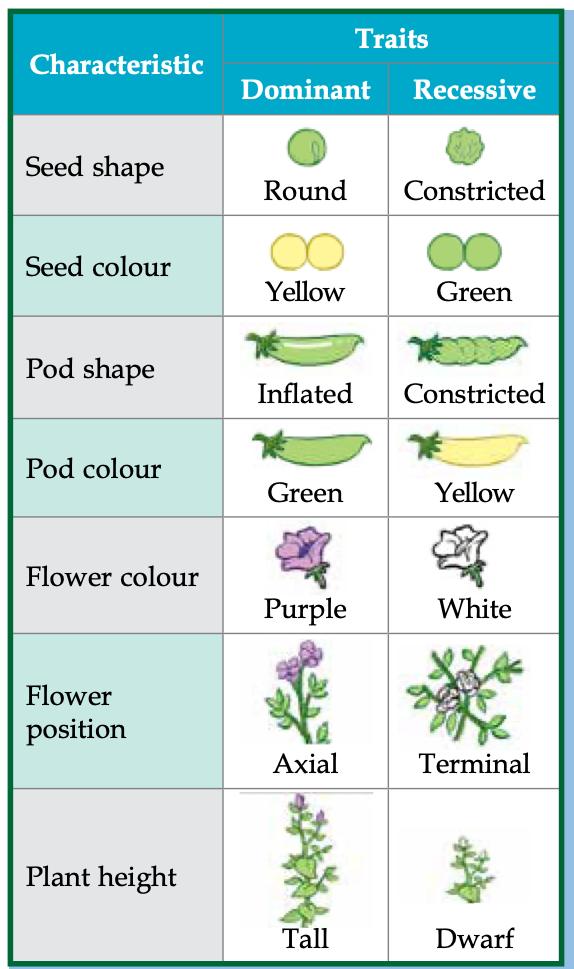
Textbook figure 11.1, p. 230.
Mendel started with purebreed plants as the parental (P) generation. He crossed a purebreed tall plant (TT) with a purebreed dwarf plant (tt):
- All the F1 offspring were tall (Tt). The tall trait is dominant; the dwarf trait is recessive and was suppressed.
- When F1 plants were self-pollinated (Tt × Tt), the F2 generation had tall and dwarf plants in a ratio of 3 : 1. The dwarf trait reappeared.
Terms used in inheritance
| Term | Meaning | Example |
|---|---|---|
| Gene | Basic unit of inheritance: a DNA segment at a specific locus of a chromosome that controls a characteristic | Gene for height |
| Allele | An alternative form of a gene, at the same locus on a pair of homologous chromosomes | T and t |
| Characteristic and trait | A characteristic is a heritable feature; a trait is a variation of it | Height (characteristic); tall or dwarf (traits) |
| Genotype | Genetic composition of an organism, which cannot be seen | TT, Tt, tt |
| Phenotype | Observable characteristic of an organism | Tall, dwarf |
| Dominant allele | Always shows its trait when present; written as a capital letter | B |
| Recessive allele | Shows its trait only when both alleles are recessive; written as a small letter | b |
| Homozygote | Two identical alleles | BB (homozygous dominant), bb (homozygous recessive) |
| Heterozygote | Two different alleles | Bb |
| Purebreed | Carries two identical alleles for a trait; self-cross always gives offspring with the same trait | BB or bb |
| Hybrid | Product of mating between two purebreed varieties | Bb |
| Parental (P) and filial (F) generations | P is the first generation that is mated; F1, F2 are the successive generations | F1 from P × P |
A monohybrid cross step by step
- Parental genotypes: BB × bb. Gametes (by meiosis): B and b.
- Fertilisation gives F1: all Bb, all purple.
- F1 self-cross: Bb × Bb. Gametes: B, b from each parent.
- F2 genotypes: 1 BB : 2 Bb : 1 bb. F2 phenotypes: 3 purple : 1 white.
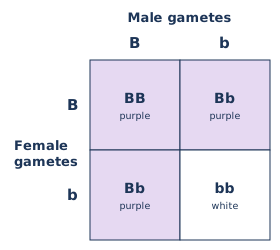
Mendel's First Law (Law of Segregation)
- The pair of alleles separates randomly during gamete formation (meiosis), so each gamete has one allele.
- The zygote receives one allele from each parent, and fertilisation is random.
- Homozygous dominant and heterozygous genotypes show the dominant trait; only homozygous recessive shows the recessive trait.
Show answerHide answer
11.2Dihybrid inheritance
Cross a purebreed round, yellow pea (BBKK) with a purebreed constricted, green pea (bbkk). B is round, b constricted, K yellow, k green.
- Gametes: BK and bk. F1 is all BbKk: round and yellow (only the dominant traits show).
- F1 × F1 (BbKk × BbKk): each parent makes four kinds of gametes, BK, Bk, bK and bk, because any allele for seed shape can pair with any allele for seed colour.
- That gives 4 × 4 = 16 combinations in the Punnett square.
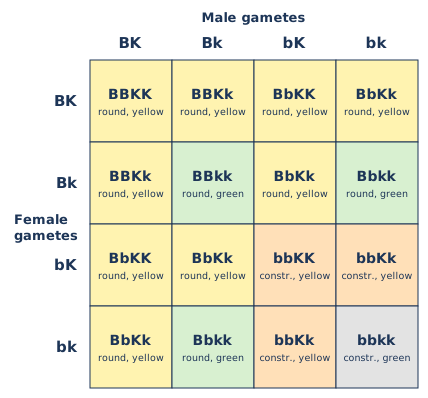
| F2 phenotype | Number of boxes | Fraction |
|---|---|---|
| Round, yellow | 9 | 9/16 |
| Round, green | 3 | 3/16 |
| Constricted, yellow | 3 | 3/16 |
| Constricted, green | 1 | 1/16 |
Two new combinations appear in F2, constricted yellow and round green, which were not in the parents.
Mendel's Second Law (Law of Independent Assortment)
Show answerHide answer
11.3Genes and alleles
- An allele that represents a gene is found at the same locus on each chromosome of a pair of homologous chromosomes.
- Same alleles at a locus (FF or jj): the gene is homozygous. Different alleles (Mm): heterozygous.
11.4Inheritance in humans
Chromosomes and karyotype
| Autosome | Sex chromosome | |
|---|---|---|
| Number | 22 pairs (numbers 1 to 22) | 1 pair (number 23) |
| Function | Control all characteristics of somatic cells | Carry genes that determine gender |
| Examples | Blood group, height, skin colour | Male XY, female XX |
A human somatic cell has 44 autosomes and 2 sex chromosomes (44 + XY male, 44 + XX female). A karyotype is the number and structure of chromosomes in a nucleus, arranged in homologous pairs by size, position of centromere and banding pattern.
Nondisjunction and genetic disorders
If homologous chromosomes fail to separate in anaphase I, or sister chromatids fail to separate in anaphase II, a gamete has 22 or 24 chromosomes instead of 23. Fertilisation with a normal gamete gives a zygote with 45 or 47 chromosomes.
| Disorder | Chromosomes | Description |
|---|---|---|
| Down syndrome | 47 (45 + XY or 45 + XX) | Extra chromosome 21 (trisomy 21); males and females |
| Turner syndrome | 45 (44 + XO) | One X chromosome missing; female |
| Klinefelter syndrome | 47 (44 + XXY) | Extra X chromosome; male with poorly developed secondary sex characteristics |
ABO blood group
Blood group is controlled by one gene with three alleles (multiple alleles): IA, IB and IO. A person has only two. IA and IB are dominant to IO and codominant to each other: when both are present, both show (AB).
| Blood group (phenotype) | Genotype |
|---|---|
| A | IAIA or IAIO |
| B | IBIB or IBIO |
| AB | IAIB |
| O | IOIO |
Rhesus factor and thalassemia
- Rhesus factor (antigen D): Rh+ is dominant, Rh− recessive. Rh-positive is Rh+Rh+ or Rh+Rh−; Rh-negative is Rh−Rh−. It follows Mendel's Law. Rh+Rh+ × Rh−Rh− gives all Rh-positive; Rh+Rh− × Rh−Rh− gives ½ positive : ½ negative.
- Thalassemia: an inherited disease caused by a gene mutation on an autosome (chromosome 11 or 16) which gives abnormal and low haemoglobin; red blood cells are smaller and paler. A carrier (thalassemia minor) has one recessive allele and no symptoms; a patient (thalassemia major) has two recessive alleles. Two carriers have a 1/4 chance of a child with thalassemia in each pregnancy. It is confirmed by a blood test.
Sex determination
Every ovum carries 22 + X. A sperm carries 22 + X or 22 + Y. The sex of the child is decided at fertilisation by the sperm: X gives a girl (44 + XX), Y gives a boy (44 + XY). The ratio of girls to boys is 1 : 1.
Sex-linked inheritance
Genes on the sex chromosomes that control characteristics other than sex are sex-linked genes. Colour blindness and haemophilia are caused by a recessive allele on the X chromosome. The Y chromosome is shorter and has few alleles, so a male shows the trait whenever his single X carries the recessive allele.
| Phenotype | Male | Female |
|---|---|---|
| Normal | XBY | XBXB |
| Carrier | none | XBXb |
| Colour blind | XbY | XbXb |
Haemophilia (blood cannot clot because of a lack of clotting factor) is written the same way with XH and Xh.
Other inherited traits
Ability to roll the tongue and free earlobes are dominant traits; inability to roll the tongue and attached earlobes are recessive. They are inherited by Mendel's Law.
Family pedigree
A pedigree is a chart over several generations showing relationships and how a characteristic is inherited. Squares are males, circles are females, a horizontal line joins a married couple, and generations are numbered with Roman numerals (I, II, III). A dominant gene normally appears in every generation; a recessive gene may be hidden in some generations. If two normal parents have an affected child, the trait is recessive and both parents are heterozygous.