Environmental Sustainability
What this chapter covers
- Define environmental sustainability and explain why it matters (10.1)
- Explain how climate change, deforestation, eutrophication, pollution and population growth threaten the environment (10.1)
- Describe BOD and how the methylene blue test compares water quality (10.1)
- Differentiate preservation, conservation (in situ and ex situ) and restoration of an ecosystem (10.2)
- Describe practices that sustain the environment and the four components of food security (10.3)
- Explain green technology, the NGTP pillars and the role of environmental education (10.4)
10.1Threats to the environment
Threats come from human activities in the ecosystem. Recycling bins are one strategy: blue for paper, brown for glass, orange for metal and plastic.
Climate change and global warming
Sunlight enters the atmosphere and some is reflected back as infrared rays. Greenhouse gases (carbon dioxide, methane, nitrogen oxide, CFC) absorb part of this heat, which keeps the earth warm enough for life. Human activities raise the concentration of these gases, so more heat is trapped. This is the greenhouse effect, and it leads to global warming and climate change (melting ice, rising sea level, storms, drought, El Nino and La Nina).
| Activity | Gas involved |
|---|---|
| Burning fossil fuels | Carbon dioxide, nitrogen oxide |
| Deforestation | Carbon dioxide |
| Animal farming | Methane |
| Nitrogen fertiliser | Nitrogen oxide |
| Cooling substances | CFC |
Deforestation and loss of biodiversity
Deforestation is clearing a wide area of trees on a large scale (for timber, mining, farming, housing and roads). It destroys habitats and is the main cause of biodiversity loss. Other effects: soil erosion, flash floods, climate change, loss of water catchment areas and disruption of the nitrogen, water and carbon cycles. Illegal hunting and acid rain also reduce species.
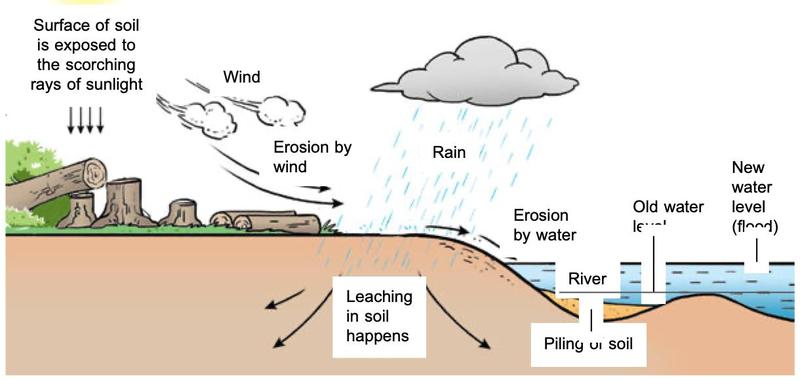
Adapted from textbook Figure 10.3, p. 205.
Eutrophication and BOD
- Excess nitrate and phosphate (fertiliser, detergent, sewage, animal waste) flows into lakes and rivers.
- Algae multiply rapidly and cover the surface (algal bloom); sunlight cannot penetrate.
- Aquatic plants photosynthesise less, so dissolved oxygen falls.
- Plants and algae die; decomposer bacteria multiply and use up even more oxygen.
- Fish and other aquatic life die; water quality drops.
Experiment: BOD of water samples (methylene blue)
- Add 1 ml of 0.1% methylene blue to 250 ml of each sample in a full, capped bottle; keep in the dark, do not shake. Distilled water is the control.
- Record the time for the blue colour to disappear. Rate of pollution = 1 / time (hour⁻¹).
- Faster decolourisation means more microorganisms, higher BOD, more polluted water. Drain water is expected to have the highest BOD.
Types of pollution
| Pollution | Cause | Effect |
|---|---|---|
| Air | Vehicle fumes, factories, open burning (CO, NOx, SO₂, lead, soot) | Harms health of humans, animals and plants |
| Acid rain | Nitrogen oxides (NOx) and sulphur dioxide (SO₂) from vehicles and factories dissolve in water vapour to form nitric and sulphuric acid | pH below 5: infertile soil, damaged leaves and roots, fewer plankton, fish die |
| Thermal | Hot water from cooling in factories and power plants discharged into rivers | Dissolved oxygen falls; fish eggs hatch early or fail; algae grow, BOD rises |
| Noise | Vehicles, construction, machines, loud music | High blood pressure, depression, headache |
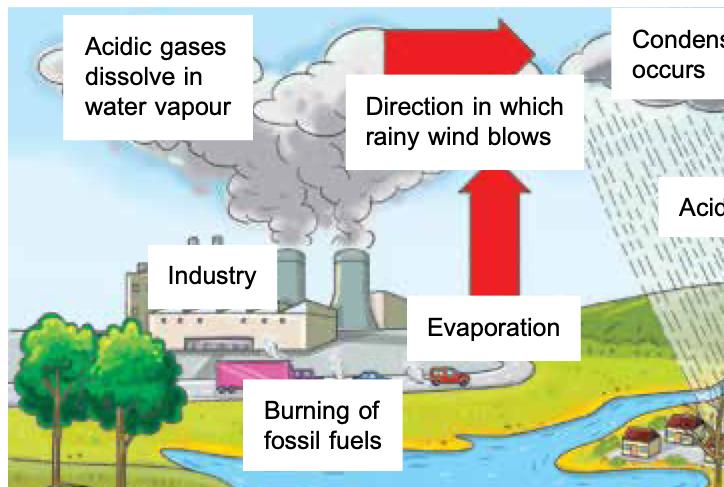
Adapted from textbook Figure 10.8, p. 209.
Human population growth explosion
More people need more land, water, food and energy, which leads to deforestation, biodiversity loss, pollution, disease and a heavier cost of treating water and sewage.
Show answerHide answer
10.2Preservation, conservation and restoration
| Term | Meaning | Example |
|---|---|---|
| Preservation | Protect ecosystem components so they stay in the natural state | Gazetting forest reserves such as Belum Forest Reserve |
| Conservation | Efforts to save resources and endangered components so they continue to exist | In situ: natural and marine parks. Ex situ: zoos, botanical parks |
| Restoration | Renewing ecosystems that were damaged or destroyed | Reforestation, cover crops, mangrove replanting |
Show answerHide answer
10.3Practices in environmental sustainability
- Environment-friendly transport: bicycles, hybrid and electric vehicles, carpooling, public transport.
- Energy saving: use electricity wisely (switch off when not in use).
- Renewable energy from sun, wind, waves, water, geothermal and biomass: cleaner and safer.
- 5R: rethink, repair, reuse, reduce, recycle. Upcycling turns old materials into new, useful things.
- Waste management: the Department of Environment coordinates disposal and sets limits and licences for toxic waste.
- Biological control: natural enemies (for example owls in oil palm estates) control pests and cut pesticide use.
- Water saving: reuse or collect rain water; SPAN water efficient product labelling.
Food security
| Component | Meaning |
|---|---|
| Availability | Enough good quality food in local and imported supply |
| Access | Food obtained easily to meet nutritional needs |
| Utilisation | Good practices in food preparation and clean drinking water |
| Stability | Everyone has enough nutritious food at all times |
Halal, GMP and HACCP set hygienic, safe production standards. The National Agro-Food Policy (NAP) 2012 supports food security.
10.4Green technology
Criteria: low or zero greenhouse gas release; safe and healthier surroundings; efficient use of energy and natural resources; promotes renewable resources; minimises environmental degradation.
- National Green Technology Policy (2009) has four pillars: energy, environment, economy, social.
- Green building: solar panels, rain water catchment and recycled materials; lower operating cost and less harm to health and environment.
- Everyday practices: recycling, biogas from organic waste, eco-enzymes from fruit waste, fertiliser from kitchen waste, bioplastic.
- Social science: environmental education, campaigns, media and gotong-royong raise awareness and skills in solving environmental problems. Environmental education aims to raise awareness, give knowledge and skills, and build willingness to protect the environment.