Variation
What this chapter covers
- Define variation and explain why it is necessary for the survival of species and for natural selection (12.1)
- Compare continuous and discontinuous variation, with examples and graph shapes (12.1)
- Explain the genetic causes of variation, namely crossing over, independent assortment, random fertilisation and mutation (12.1)
- Explain how environmental factors, and their interaction with genes, cause variation (12.1)
- Relate variation in humans to dominant and recessive traits (12.2)
- Define mutation, mutagen and mutant, and name the types of mutagen (12.3)
- Describe gene mutation and chromosomal mutation, nondisjunction and the diseases they cause (12.3)
- Compare mutation in somatic cells and in gametes (12.3)
12.1Types and factors of variation
Variation usually means differences in the phenotype (structure, physiology and biochemistry). It lets us tell individuals in a population apart.
Why variation is necessary
- It is the basis of natural selection. The environment selects beneficial characteristics and removes unsuitable ones.
- It ensures the species survives when the environment changes, because some individuals will have suitable phenotypes.
- It allows cross breeding to form new species over time.
Continuous and discontinuous variation
| Continuous variation | Discontinuous variation | |
|---|---|---|
| Differences | Gradual, with intermediate characteristics from one extreme to the other | Distinct, with no intermediate characteristics |
| Nature | Quantitative: can be measured and graded | Qualitative: cannot be measured |
| Graph | Normal distribution (bell-shaped curve) | Discrete bars (bar chart) |
| Control | Many genes, plus the environment | One gene with two or three alleles; not affected by the environment |
| Examples | Height, body mass, skin colour | Ability to roll the tongue, eye colour, fingerprint pattern, blood group |
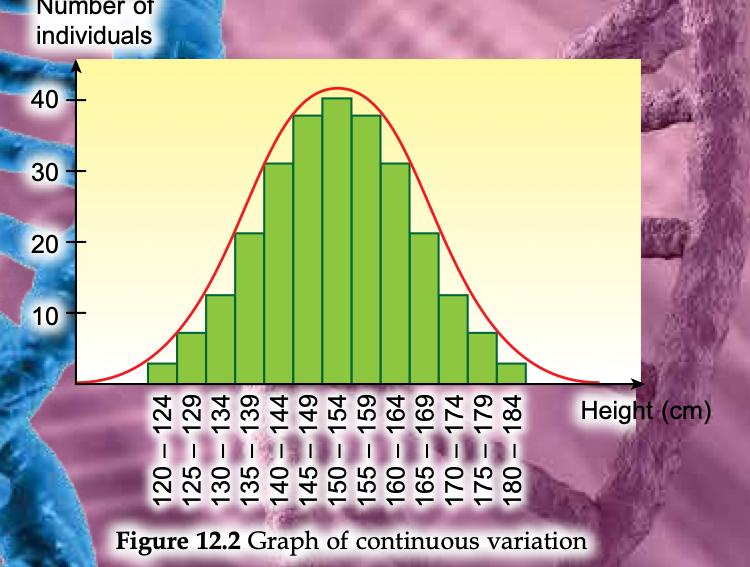
Textbook Figure 12.2, p. 258.
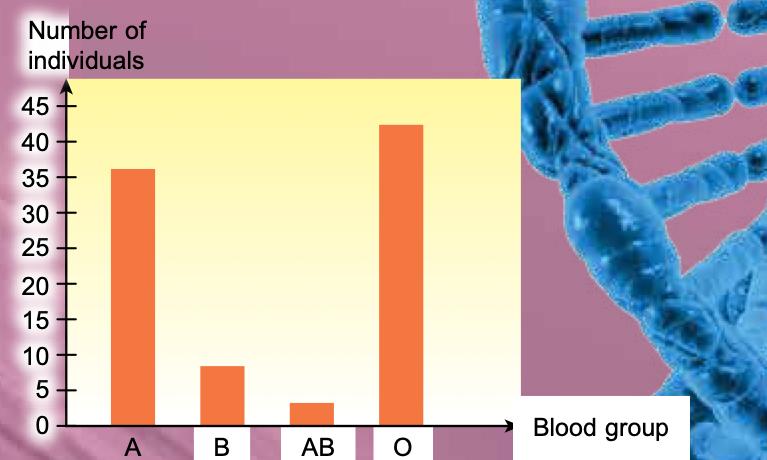
Textbook Figure 12.3, p. 259.
Show answerHide answer
Causes of variation
Continuous variation is caused by genetic and environmental factors together. Discontinuous variation is caused by genetic factors only.
| Genetic factor | What happens |
|---|---|
| Crossing over | Between non-sister chromatids of homologous chromosomes in prophase I of meiosis, at the chiasma. Segments are exchanged and give new combinations of genes. |
| Independent assortment of chromosomes | In metaphase I, homologous pairs line up randomly on the equator. Gametes get different mixes of maternal and paternal chromosomes. |
| Random fertilisation | Any sperm may fertilise the secondary oocyte, so the zygote has a new genetic combination different from both parents. |
| Mutation | A permanent, spontaneous change in genes or chromosomes that creates new genotypes. |
Environmental factors
Temperature, light and pH change the phenotype but not the genotype, so this variation is not inherited.
- Soil pH: Hydrangea flowers are blue in acidic soil (below pH 5.5) and pink in alkaline soil.
- Temperature: in a Siamese cat the enzyme for dark pigment works only below body temperature, so the cooler ears, face, tail and paws are dark.
- Light: ultraviolet rays in sunlight make skin produce more melanin, so a construction worker's skin becomes darker.
Show answerHide answer
12.2Variation in humans
A human trait is controlled by a pair of alleles. The dominant trait shows when at least one dominant allele is present; the recessive trait shows only when both alleles are recessive.
| Characteristic | Dominant trait | Recessive trait |
|---|---|---|
| Height | Tall | Short |
| Type of hair | Curly | Straight |
| Handedness | Right-handed | Left-handed |
| Dimples | Present | Absent |
| Rolling the tongue | Can roll | Cannot roll |
| Earlobes | Free | Attached |
In the class activity, height and body mass give bell-shaped graphs (continuous), while thumbprint pattern and PTC taste give separate bars (discontinuous).
Show answerHide answer
12.3Mutation
| Mutagen | Examples |
|---|---|
| Physical | Ultraviolet from the sun; ionising rays such as X-ray, alpha and beta rays |
| Chemical | Carcinogens in cigarette smoke, food preservatives, formaldehyde, benzene |
| Biological | Viruses, bacteria |
Gene mutation (point mutation)
A change in the base sequence of a gene alters the genetic code, so the amino acids and the protein change and the new protein may not work. It happens by base substitution, insertion or deletion. Insertion and deletion shift every codon after the point and change many amino acids; substitution changes at most one.
| Type | Example disease |
|---|---|
| Base substitution | Sickle cell anaemia (crescent-shaped red blood cells) |
| Base insertion | Cystic fibrosis |
| Base deletion | Thalassemia |
Albinism is due to a mutant gene for pigment of skin, hair and eyes, so no pigment forms.
Chromosomal mutation
Changes in chromosome structure (chromosomal aberration) or in chromosome number.
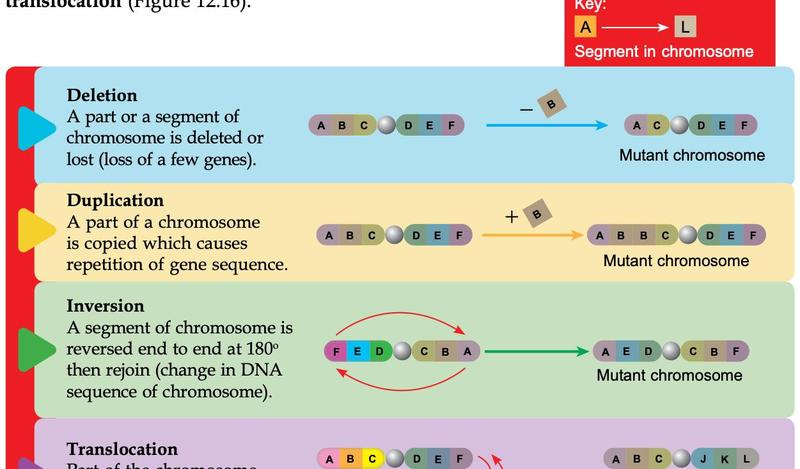
Textbook Figure 12.16, p. 271.
| Aberration | Change |
|---|---|
| Deletion | A segment is lost |
| Duplication | A segment is copied, so genes repeat |
| Inversion | A segment is reversed 180 degrees and rejoined |
| Translocation | A segment joins a non-homologous chromosome |
| Syndrome | Chromosomes | Features |
|---|---|---|
| Down | 47, three chromosome 21 (autosome) | Slanting eyes, flat nose, protruding tongue; usually mental retardation |
| Cri du chat | Partial deletion of the short arm of chromosome 5 | Cry like a kitten; delayed development; most die in childhood |
| Klinefelter | 47, 44 + XXY | Sterile man with small testes; woman-like voice and chest |
| Jacob | 47, 44 + XYY | Tall male; pimples; learning disability; weak muscles |
| Turner | 45, 44 + XO | Sterile female; undeveloped breasts and ovaries; webbed neck |
Mutation in somatic cells and gametes
| Somatic cells | Gametes (germ cells) | |
|---|---|---|
| Inherited? | No | Yes |
| Who is affected | Only the individual | The individual and the descendants |
| Example | Cancer from skin or bone marrow cells | Thalassemia and all inherited diseases |