Genetic Technology
What this chapter covers
- Define genetic engineering and explain how recombinant DNA technology produces genetically modified organisms (13.1.1)
- Describe GMO and GMF, with examples, and discuss their advantages and disadvantages (13.1.2)
- Outline how insulin is produced by transgenic bacteria (13.1.2)
- Define biotechnology and the main fields of biotechnology (13.2.1)
- Describe gene therapy, DNA profiling, insect tolerant plants and bioremediation (13.2.2)
- Explain the importance of biotechnology in agriculture, medicine, forensics and the environment (13.2.3)
13.1Genetic engineering
A DNA segment (a gene) is moved from one organism to another using recombinant DNA technology. An organism that contains recombinant DNA is a genetically modified organism (GMO), also called a transgenic organism.
- A goat with a human gene for a blood clotting factor. The factor is found in its milk and is purified to treat haemophilia.
- A cow whose milk lacks β-lactoglobulin, a protein that causes allergy in some children.
Genetically modified food (GMF)
GMF comes from crops or livestock that carry DNA from another species, for example paddy, oil palm, corn, soya bean, salmon and cattle. The modified traits include resistance to herbicide, disease or pests, tolerance to heavy metals, and uses in medicine.
| Advantages of GMF | Disadvantages of GMF |
|---|---|
| Helps overcome food shortage with high quality crops and livestock; lowers production cost; raises nutritional value; fewer pest problems; less pesticide used; more supply lowers price | May endanger natural species; a foreign gene (for example an antibiotic-resistance gene) might transfer to humans; may harm human health in ways not yet known |
- Bt corn: a gene from the bacterium Bacillus thuringiensis makes corn resistant to insect pests.
- Super Salmon: a growth hormone gene from Chinook salmon is inserted into Atlantic salmon, so it grows faster and can be produced all year.
- Frost-tolerant potato: a gene from Arabidopsis lets potato tolerate freezing.
Making insulin by genetic engineering
Insulin used to be extracted from cattle or pig pancreases. Today Escherichia coli is used to make human insulin for diabetes mellitus patients. Other products: hepatitis B vaccine, blood clotting factor and growth hormone.
- Cut the human insulin gene out of the DNA with restriction enzymes.
- Cut a bacterial plasmid (a circular DNA used as a cloning vector) with the same restriction enzymes.
- Join the insulin gene into the plasmid with DNA ligase to form a recombinant plasmid.
- Introduce the recombinant plasmid into a bacterium to give a transgenic bacterium.
- The bacterium multiplies as a clone and makes insulin.
- Extract and purify the insulin.
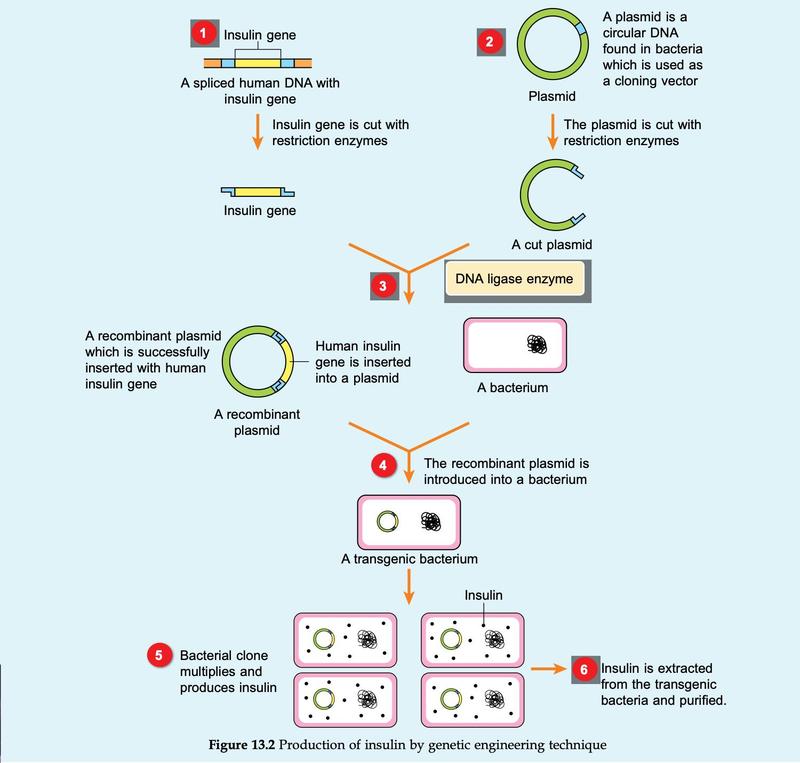
Textbook figure: Biology Form 5 (DLP), p. 283.
Show answerHide answer
13.2Biotechnology
It aims to improve livestock and crops and to apply microorganisms for specific purposes. Its fields are given colour codes. The main ones are green, white, yellow and blue biotechnology (p. 284). In Activity 13.3 you can visit FRIM, MPOC, MARDI or MRB to find out about yellow biotechnology.
Applications
| Application | What it does |
|---|---|
| Gene therapy | Treats or prevents genetic disease: a normal gene, carried by a virus, replaces the abnormal gene so the cell works normally. Examples: cystic fibrosis, muscular dystrophy, some cancers. |
| DNA profiling | Identifies a person from DNA in blood, semen or skin, because each person's DNA is unique except for identical twins. Used to identify criminals, settle paternity disputes, identify genetic disease and match organ donors. |
| Insect tolerant plants | Bt cotton, corn and brinjal carry the Bacillus thuringiensis toxin gene. The toxin harms the pest's digestive system, so less pesticide is used and yield rises. |
| Cleaning oil spills | Bioremediation uses bacteria such as Alcanivorax borkumensis, which feeds on oil, to break down oil pollution. |
Steps of DNA profiling
- Obtain a sample from the scene (blood, semen or skin) and extract the DNA.
- Cut the DNA into fragments with restriction enzymes.
- Separate the fragments by size using gel electrophoresis.
- Transfer the fragments from the gel to a nylon membrane.
- Add radioactive probes and place X-ray film on the membrane.
- Develop the film: the bands form the DNA profile.
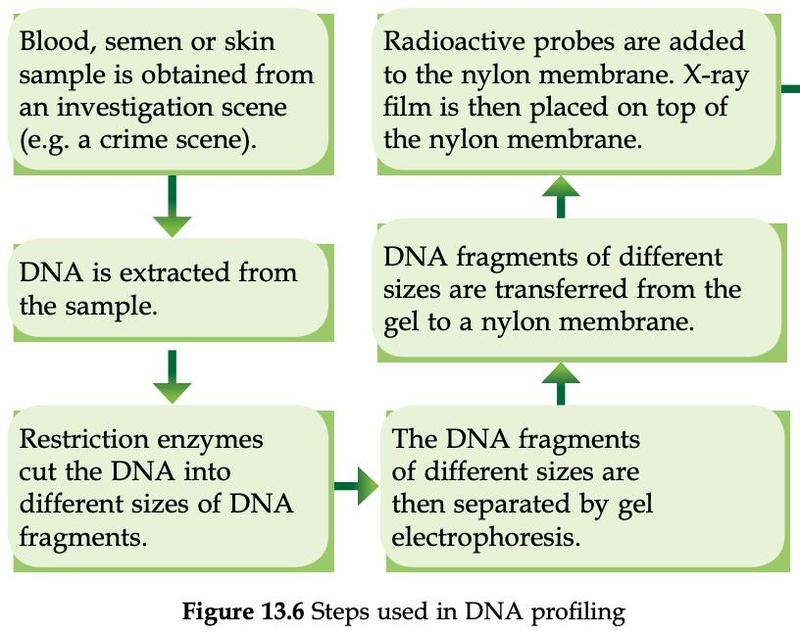
Textbook figure: Biology Form 5 (DLP), p. 287.
DNA profiling is strong evidence in a criminal case only if the sample is collected and processed correctly, the scientist tests and analyses it carefully and openly, the results are interpreted accurately, and the judge and jury receive an accurate report (p. 286).
Show answerHide answer
Importance of biotechnology
| Field | Contribution |
|---|---|
| Agriculture | Best livestock and crop breeds; tissue culture and cloning speed up reproduction; high-yield, fast-maturing paddy; disease-resistant clones |
| Medicine | Modifies genetic content; prevents inherited diseases and some cancers; helps mothers who find it hard to conceive |
| Forensic | Identifies a criminal from blood, semen, skin or hair follicle |
| Environment | Microbes speed up decay of waste and reduce pollution |
Biotechnology also strengthens a country's economy, especially industry. Dolly, the first cloned sheep, is a well known example of cloning (p. 288).