Carbon compound
What this chapter covers
- Classify carbon compounds as organic or inorganic, and hydrocarbons as saturated or unsaturated (2.1.1)
- Explain petroleum as the source of hydrocarbons, fractional distillation, cracking and alternative sources (2.1.2)
- Explain homologous series and construct molecular and structural formulae and IUPAC names (2.2.1, 2.2.2)
- Describe how physical properties change along a homologous series (2.2.3)
- Describe the chemical properties of alkanes, alkenes, alcohols, carboxylic acids and esters, and how they interconvert (2.3.1, 2.3.2)
- Describe structural isomerism and name isomers by IUPAC rules (2.4.1, 2.4.2)
- Explain the uses of each homologous series in daily life (2.4.3)
2.1Types of carbon compounds
| Compound | Elements | Type |
|---|---|---|
| Petrol, natural gas | C, H | Hydrocarbon |
| Starch, fat, alcohol | C, H, O | Non-hydrocarbon |
| CO2, PbCO3 | C, O (and Pb) | Inorganic carbon compound |
Petroleum: the main source of hydrocarbons
Petroleum (crude oil) is a mixture of hydrocarbons formed from the remains of marine plants and animals over millions of years. It must be refined in two stages.
Petroleum is heated and the vapours rise up a tower. Each fraction condenses at its own boiling point, so the fractions separate according to molecular size.
Long-chain hydrocarbons are broken into shorter molecules at high temperature and pressure with a catalyst (Al2O3 and SiO2).
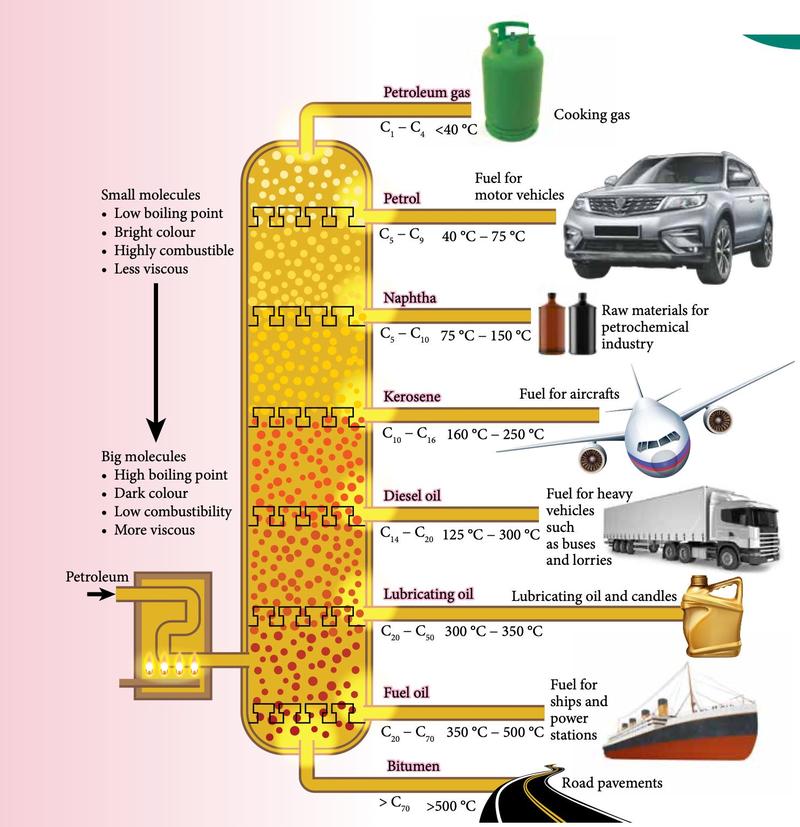
Fractional distillation diagram: Chemistry Form 5 (DLP) textbook, Figure 2.2, p. 67.
| Going down the tower | Trend |
|---|---|
| Size of molecules | Small to big |
| Boiling point | Low to high (van der Waals forces get stronger) |
| Colour | Bright to dark |
| Viscosity | Less viscous to more viscous |
| Flammability and sootiness | Highly flammable and clean to less flammable and sooty |
C10H22 → 2C5H10 + H2 (decane gives pentene and hydrogen).
Cracking is needed because fractional distillation alone cannot supply the large demand for small, easily burned hydrocarbons such as petrol. It also makes short alkenes and alkanes, the raw materials for polymers, medicines and detergents. When petroleum runs out, renewable alternative sources from biomass (bioethanol, biodiesel and biogas) can replace it.
Show answerHide answer
2.2Homologous series
The functional group is the group of atoms that decides the chemical properties and where the reactions happen.
| Series | General formula | Functional group | Suffix |
|---|---|---|---|
| Alkane | CnH2n+2, n = 1, 2, 3 ... | C–C single bond | -ane |
| Alkene | CnH2n, n = 2, 3 ... | C=C double bond | -ene |
| Alkyne | CnH2n−2, n = 2, 3 ... | C≡C triple bond | -yne |
| Alcohol | CnH2n+1OH, n = 1, 2 ... | Hydroxyl, –OH | -ol |
| Carboxylic acid | CnH2n+1COOH, n = 0, 1, 2 ... | Carboxyl, –COOH | -oic acid |
| Ester | CmH2m+1COOCnH2n+1 | Carboxylate, –COO– | -oate |
Naming (IUPAC)
A name = root (number of C in the longest chain) + suffix (the series).
| C atoms | 1 | 2 | 3 | 4 | 5 | 6 | 7 | 8 | 9 | 10 |
|---|---|---|---|---|---|---|---|---|---|---|
| Root | Meth | Eth | Prop | But | Pent | Hex | Hept | Oct | Non | Dec |
Alkene with 4 C: C4H8, butene. Alkyne with 2 C: C2H2, ethyne.
- Alcohol: take the alkane name, change -e to -ol (propane gives propanol, and the position of OH is a number: propan-1-ol).
- Carboxylic acid: change -e to -oic acid (CH3COOH is ethanoic acid). The COOH is always on carbon 1, which is why n starts at 0 (HCOOH, methanoic acid).
Physical properties
| Series | Properties |
|---|---|
| Alkane, alkene, alkyne | Covalent: insoluble in water, soluble in organic solvents, do not conduct electricity, less dense than water, low melting and boiling points |
| Alcohol, carboxylic acid | Boiling points higher than the alkene with the same C atoms; first members dissolve in water, but solubility decreases as molecules get bigger |
Across all series, as the number of carbon atoms increases the molecule gets bigger, van der Waals forces get stronger and the melting and boiling points increase. Examples of boiling points: CH4 −162 °C, C2H6 −89 °C, C3H8 −42 °C, C4H10 −0.5 °C, C5H12 36 °C, C6H14 69 °C. At room temperature (about 25–30 °C) the first four are gases and pentane onwards are liquids.
Show answerHide answer
2.3Chemical properties and interconversion
Alkane (saturated, unreactive)
- Complete combustion in excess O2: CH4 + 2O2 → CO2 + 2H2O. Incomplete combustion gives soot (C), poisonous CO and water.
- Substitution with Cl2 or Br2 in sunlight or UV: the hydrogen atoms are replaced one at a time. CH4 → CH3Cl → CH2Cl2 → CHCl3 → CCl4, with HCl formed at every stage.
C3H8 + 5O2 → 3CO2 + 4H2O
Alkene (unsaturated, reactive at C=C)
- Combustion: burns with a sootier flame than the alkane with the same number of C, because its percentage of carbon by mass is higher.
- Addition reactions: another atom is added to each carbon of the double bond, which becomes a single bond.
| Addition reaction | Conditions | Example (ethene) and product |
|---|---|---|
| Hydrogenation | H2, nickel catalyst, 180 °C | C2H4 + H2 → C2H6 (ethane); used to make margarine |
| Halogenation | Br2 or Cl2, room conditions | C2H4 + Br2 → C2H4Br2 (1,2-dibromoethane); brown bromine water is decolourised |
| Hydrogen halide | HBr or HCl, room temperature | C2H4 + HBr → C2H5Br (bromoethane) |
| Hydration | Steam, H3PO4, 300 °C, 60 atm | C2H4 + H2O → C2H5OH (ethanol) |
| Oxidation | Acidified KMnO4 | Purple solution decolourised; ethane-1,2-diol formed (two –OH added) |
- Addition polymerisation: many small alkene molecules (monomers) join into a long chain (polymer), e.g. ethene gives polythene at 200 °C and 1200 atm.
Comparing alkane and alkene
| Property | Hexane, C6H14 | Hexene, C6H12 |
|---|---|---|
| Bonding | Single bonds only (saturated) | C=C double bond (unsaturated) |
| Percentage of C by mass | 72 ÷ 86 × 100 = 83.72% | 72 ÷ 84 × 100 = 85.71% |
| Flame | Less sooty | More sooty |
| Bromine water | No change | Brown decolourised |
| Acidified KMnO4 | No change | Purple decolourised |
| Main reaction | Substitution | Addition |
Alcohol (CnH2n+1OH)
- Preparation of ethanol: fermentation of glucose with yeast (enzyme zymase) in the absence of oxygen, C6H12O6 → 2C2H5OH + 2CO2, then purification by fractional distillation (ethanol collected at 78 °C); or hydration of ethene.
- Combustion: burns with a blue, non-sooty flame, C2H5OH + 3O2 → 2CO2 + 3H2O.
- Oxidation to a carboxylic acid with acidified KMnO4 (purple to colourless) or acidified K2Cr2O7 (orange to green): C2H5OH + 2[O] → CH3COOH + H2O. Reflux makes sure the ethanol reacts completely.
- Dehydration: ethanol vapour passed over hot porcelain chips or alumina, or heated with concentrated H2SO4, loses water to give an alkene: C2H5OH → C2H4 + H2O.
Carboxylic acid
Ethanoic acid, CH3COOH, is a weak acid (it partly ionises in water). It reacts like other acids:
- Acid + metal: 2CH3COOH + Mg → (CH3COO)2Mg + H2
- Acid + metal oxide: 2CH3COOH + CuO → (CH3COO)2Cu + H2O
- Acid + carbonate: 2CH3COOH + Na2CO3 → 2CH3COONa + H2O + CO2 (limewater turns cloudy)
- Acid + alcohol: esterification, catalyst concentrated H2SO4, gives an ester and water.
Ester
The ester name has two parts: the first from the alcohol (-ol becomes -yl) and the second from the acid (-oic acid becomes -oate).
Propanoic acid + ethanol gives ethyl propanoate, shown below.
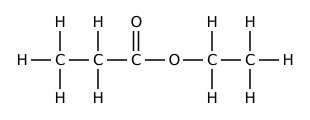
Simple esters are colourless liquids with a sweet, fruity smell, insoluble in water and less dense than water; they easily vaporise.
Show answerHide answer
2.4Isomers and uses of homologous series
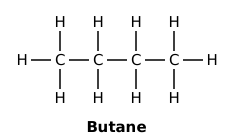
Straight chain
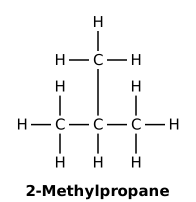
Branched chain
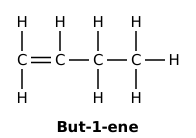
Double bond on C1
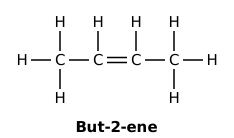
Double bond on C2
- Isomers have the same chemical properties (same functional group) but different physical properties. The more branches, the lower the melting and boiling points.
- Alkanes show chain isomerism only; alkenes, alkynes and alcohols show chain and position isomerism. CH4, C2H6 and C3H8 have no isomers; isomerism starts at butane. Propanol has 2 isomers and butanol has 4.
Naming a branched isomer
- Find the longest carbon chain (containing the functional group): this gives the root name.
- Number the chain so that the functional group gets the lowest number (for alkane, the branches get the lowest numbers).
- Name the branch (alkyl group: methyl, CH3; ethyl, C2H5) and give its position: the prefix.
- Write prefix + root + suffix: numbers are separated from words by hyphens, and from other numbers by commas.
Two methyl groups on C2 of a 3-carbon alkane chain: 2,2-dimethylpropane.
Uses in daily life
| Series | Uses |
|---|---|
| Alkane | Fuel (LNG, LPG, petrol) because of high heat of combustion; petrochemical raw material (ethane to ethene) |
| Alkene | Making polythene, PVC, polystyrene, synthetic rubber and ethanol |
| Alcohol | Fuel (gasohol), solvent for paints and perfumes, antiseptic and hand sanitiser, raw material for vinegar and perspex |
| Carboxylic acid | Ethanoic acid: food preservative (vinegar, sauces), dyes, paints; methanoic acid: coagulates latex; fatty acids: soap |
| Ester | Food flavouring, perfumes, solvent in nail varnish and glue, polyester fabric, oils and fats |