Chemistry questions, chapter 4
Nama / NameKelas / ClassTarikh / Date
Polymer
46 marks. Use Practice to check each answer as you go, or Exam to answer everything against the clock first.
Section A: objective questions
12 marksChoose the best answer for each question.
1
Question 1
What is a monomer?
Show answerHide answer
A
A monomer is the basic unit that combines to form a polymer.
2
Question 2
Which pair is a natural polymer and its monomer?
Show answerHide answer
B
Starch is natural and made from glucose. The polymers named in A, C and D are synthetic, and glucose is not the monomer of nylon.
3
Question 3
Which polymer is a thermoset?
Show answerHide answer
C
Bakelite (and melamine) cannot be remoulded after heating. The others are thermoplastics.
4
Question 4
Which monomer can undergo addition polymerisation?
Show answerHide answer
D
Addition polymerisation needs a C=C double bond. Ethane, propane and butane are saturated.
5
Question 5
Which by-product is formed when nylon is made from 1,6-hexanediamine and decanedioyl dichloride?
Show answerHide answer
C
The acid chloride loses Cl and the amine loses H, so HCl forms.
6
Question 6
A polymer has the repeat unit -CH2-CHCl-. What is the monomer?
Show answerHide answer
D
Put the double bond back: CH2=CHCl, chloroethene (vinyl chloride).
7
Question 7
Which action best reduces plastic waste in landfills?
Show answerHide answer
A
Additives let bacteria or light break plastic down, reducing waste.
8
Question 8
What is the IUPAC name of the monomer of natural rubber?
Show answerHide answer
B
Isoprene is 2-methylbut-1,3-diene.
9
Question 9
Why does latex coagulate when ethanoic acid is added?
Show answerHide answer
D
H+ neutralises the negative membrane, so particles no longer repel and clump together.
10
Question 10
Why is ammonia solution added to latex stored for making gloves?
Show answerHide answer
B
OH− neutralises the acid, so the membrane stays negative and the latex does not coagulate.
11
Question 11
What is formed between rubber chains during vulcanisation?
Show answerHide answer
A
Sulphur atoms bond at the C=C and link the chains.
12
Question 12
Which rubber is best for making a petrol hose, and why?
Show answerHide answer
C
Neoprene resists heat, oxidation and solvents; natural rubber reacts with organic solvents.
Section B: structured questions
34 marksAnswer all questions.
13
Question 13
Polymers can be natural or synthetic.
[1 mark]
(a)What is meant by a polymer?
Show answerHide answer
Tick each point you got.
[2 marks]
(b)Name one natural polymer and its monomer.
Show answerHide answer
Tick each point you got.
14
Question 14
The polymer PVC is made from chloroethene, CH2=CHCl.
[1 mark]
(a)Name the type of polymerisation.
Show answerHide answer
Tick each point you got.
[2 marks]
(b)Draw the repeat unit of PVC.
Show answerHide answer
Tick each point you got.
[2 marks]
(c)Explain why PVC can be recycled.
Show answerHide answer
Tick each point you got.
15
Question 15
Nylon is made by condensation polymerisation of 1,6-hexanediamine and decanedioyl dichloride.
[2 marks]
(a)State two differences between addition and condensation polymerisation.
Show answerHide answer
Tick each point you got.
[1 mark]
(b)Name the small molecule formed when nylon is made.
Show answerHide answer
Tick each point you got.
16
Question 16
Plastic bags are the polymer product most thrown away in Malaysia.
[1 mark]
(a)State one problem caused by disposing of plastic bags.
Show answerHide answer
Tick each point you got.
[2 marks]
(b)Suggest two ways to reduce this problem.
Show answerHide answer
Tick each point you got.
17
Question 17
Beaker A has latex with ethanoic acid, beaker B has latex with ammonia solution and beaker C has latex only.
[2 marks]
(a)State what is observed in beaker A and beaker B.
Show answerHide answer
Tick each point you got.
[3 marks]
(b)Explain the observation in beaker A.
Show answerHide answer
Tick each point you got.
18
Question 18
Diagram 1 shows the lengths of two rubber strips, M and N, of the same size. Each was stretched with a 50 g weight and then the weight was removed.
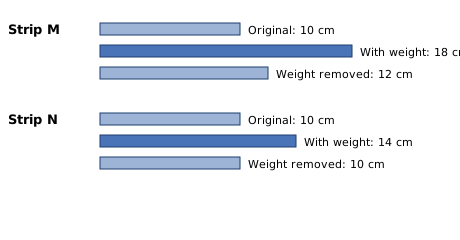
[1 mark]
(a)Calculate the extension of strip M with the weight.
Show answerHide answer
Tick each point you got.
[3 marks]
(b)Which strip is vulcanised rubber? Explain.
Show answerHide answer
Tick each point you got.
[1 mark]
(c)Which strip will snap first if the weight is increased?
Show answerHide answer
Tick each point you got.
19
Question 19
Vulcanisation improves the properties of natural rubber.
[2 marks]
(a)What is meant by vulcanisation?
Show answerHide answer
Tick each point you got.
[2 marks]
(b)Why does vulcanised rubber resist oxidation better?
Show answerHide answer
Tick each point you got.
[1 mark]
(c)State one advantage of vulcanisation by irradiation.
Show answerHide answer
Tick each point you got.
20
Question 20
Surgical gloves can be made from natural rubber or from a synthetic rubber such as nitrile rubber.
[1 mark]
(a)What is meant by synthetic rubber?
Show answerHide answer
Tick each point you got.
[1 mark]
(b)State one way synthetic rubber gloves differ from natural rubber gloves.
Show answerHide answer
Tick each point you got.
[3 marks]
(c)Justify the use of synthetic rubber, and state one drawback.
Show answerHide answer
Tick each point you got.