Polymer
What this chapter covers
- Explain polymer, monomer and polymerisation, and classify polymers by source and by type (4.1.1)
- Describe addition and condensation polymerisation using examples (4.1.2)
- Justify the use of polymers in daily life and explain their effect on the environment (4.1.3)
- Explain the structure, naming and properties of natural rubber (4.2.1)
- Explain how latex coagulates and how coagulation is prevented (4.2.2)
- Explain vulcanisation and compare vulcanised with unvulcanised rubber (4.2.3, 4.2.4)
- Explain synthetic rubber and justify the use of natural and synthetic rubber (4.3.1, 4.3.2)
4.1Polymer
Classifying polymers
| Polymer | Monomer | Source |
|---|---|---|
| Starch, cellulose | Glucose | Natural |
| Protein | Amino acid | Natural |
| Natural rubber | Isoprene | Natural |
| Polystyrene | Styrene | Synthetic |
| Polypropene | Propene | Synthetic |
| Polyvinyl chloride (PVC) | Vinyl chloride (chloroethene) | Synthetic |
| Type | Behaviour on heating | Examples |
|---|---|---|
| Thermoplastic | Softens when heated and hardens when cooled; can be remoulded and recycled | Polyethene, PVC, nylon |
| Thermoset | Cannot be remoulded; chars or burns; cannot be recycled | Melamine, bakelite |
| Elastomer | Stretches and returns to its original shape | Polyurethane, SBR |
Polymerisation reactions
Monomers each have a C=C double bond. The double bond opens and the monomers join in a chain. Only one product: the polymer.
n C2H4 → (−C2H4−)n
At least two different monomers, each with two functional groups. A small molecule (water or HCl) is lost as a by-product each time two units join.
| Monomer | Polymer | Property and use |
|---|---|---|
| Ethene | Polyethene | Durable, strong; plastic bags and bottles |
| Propene | Polypropene | Durable; toys, textiles, laboratory apparatus |
| Chloroethene | PVC | Strong, hard; water pipes, insulators |
| Styrene | Polystyrene | Light, heat insulator; food packaging |
| 1,2-ethanediol + terephthalic acid | Terylene (polyester) | Condensation; by-product water |
| 1,6-hexanediamine + decanedioyl dichloride | Nylon (polyamide) | Condensation; by-product HCl; ropes, clothes |
Show answerHide answer
Polymers and the environment
Synthetic polymers are light, strong, inert and good insulators, so they have many uses. But many do not decompose (non-biodegradable), so they build up in landfills and in the sea, where microplastics enter the food chain. Ways to reduce the problem: recycle, use biodegradable or photodegradable plastics (additives let bacteria or light break them down), and reduce single-use plastics.
Show answerHide answer
4.2Natural rubber
Latex is a colloid: rubber particles are dispersed (not dissolved) in water. Each particle has a negatively charged protein membrane, so particles repel and do not clump.
| Property of natural rubber | Reason / remark |
|---|---|
| Soft, elastic | Elastomeric polymer; returns to shape when released |
| Low heat resistance | Becomes soft and sticky when hot |
| Electrical insulator | Cannot conduct electricity |
| Easily oxidised | Air attacks the C=C double bonds |
| Reacts with acids, alkalis, organic solvents | Chemically reactive |
| Waterproof | Does not allow water through |
Coagulation of latex
- The negative protein membranes make the rubber particles repel each other.
- H+ ions from an acid neutralise the negative charge.
- Particles collide and the membranes break.
- Rubber polymers join together and the latex coagulates.
Air bacteria produce lactic acid, so latex left in the air coagulates by itself. Weak acids such as methanoic (formic) or ethanoic acid are used as coagulants; a strong acid is not normally used. To prevent coagulation, add an alkali such as ammonia solution: OH− neutralises the acid, the membrane stays negative and the particles keep repelling.
Vulcanisation
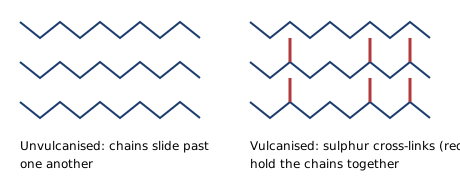
| Property | Vulcanised | Unvulcanised |
|---|---|---|
| Elasticity | More elastic | Less elastic |
| Hardness | Hard | Soft |
| Strength | High | Low |
| Heat resistance | High | Low |
| Oxidation | More resistant (fewer C=C) | Easily oxidised |
Alternative methods that avoid sulphur (peroxide, irradiation, metal oxide) are used for rubbers with no C=C, and give rubber free from sulphur that is more environmentally friendly.
Show answerHide answer
4.3Synthetic rubber
| Synthetic rubber | Key property | Use |
|---|---|---|
| Neoprene | Heat, oxidation and flame resistant | Conveyor belts, hoses, gloves |
| Styrene-butadiene rubber (SBR) | Abrasion and heat resistant | Tyres, shoe soles |
| Silicone rubber | High temperature resistant, inert | Medical implants, cooking utensils |
| Nitrile rubber, thiokol | Oil and solvent resistant | Gloves, sealants |
Why synthetic rubber is chosen: it can be mass-produced, does not depend on weather or tree disease, and resists heat and solvents better. Its drawback: it takes very long to decompose (waste tyres). Natural rubber decomposes faster but is less resistant to heat and solvents. Waste rubber can be recycled or reused, for example tyres burned as fuel for electricity.
Show answerHide answer
Summary
| Remember | Key fact |
|---|---|
| Addition polymerisation | C=C monomers; only the polymer is formed |
| Condensation polymerisation | Two functional groups; water or HCl also formed |
| Natural rubber | Polyisoprene; monomer 2-methylbut-1,3-diene |
| Coagulant / anti-coagulant | Weak acid / ammonia solution |
| Vulcanisation | Sulphur cross-links; harder, stronger, more elastic |