Chemistry notes, chapter 3
Thermochemistry
Textbook Chemistry Form 5 (DLP), pages 112–140
What this chapter covers
- Deduce exothermic and endothermic reactions from temperature changes in activities (3.1.1)
- Interpret and draw energy level diagrams, and relate bond breaking and bond making to heat change (3.1.2)
- Determine heat of precipitation and heat of displacement from experiment results (3.2.1, 3.2.2)
- Compare heat of neutralisation for strong and weak acids and alkalis (3.2.3)
- Compare heat of combustion of alcohols and calculate from Q = mcθ (3.2.4)
- State applications of exothermic and endothermic reactions and analyse fuel value (3.3.1, 3.3.2)
3.1Heat change in reactions
An exothermic reaction releases heat to the surroundings, so the temperature rises. An endothermic reaction absorbs heat from the surroundings, so the temperature falls.
| Exothermic | Endothermic | |
|---|---|---|
| Heat | Released to the surroundings | Absorbed from the surroundings |
| Temperature of mixture | Rises (container feels hot) | Falls (container feels cold) |
| ΔH | Negative | Positive |
| Examples | Respiration, rusting and other oxidation of metals, neutralisation, combustion of fuel, dissolving NaOH in water | Photosynthesis, heating a metal carbonate or nitrate until it decomposes, dissolving ammonium salts in water |
Dissolving solid ammonium nitrate in water makes the cup feel cold. Is it exothermic or endothermic?
Show answerHide answer
Endothermic: heat is absorbed from the water and the cup, so the temperature drops.
Energy level diagrams
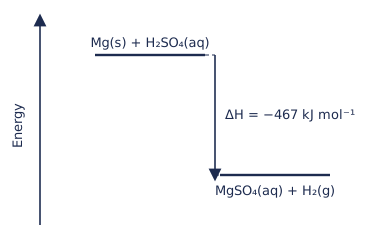
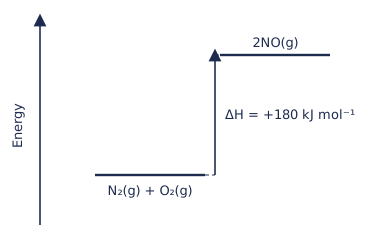
Heat of reaction, ΔH is the heat change when one mole of reactant reacts or one mole of product forms. Unit: kJ mol⁻¹. ΔH = H(products) − H(reactants).
How to draw one
1. Draw an upward arrow and label it "Energy".2. Draw two energy levels, the reactants and the products, at the correct heights.
3. Write the formulae on the levels, draw an arrow from reactants to products and write the value of ΔH.
Read ΔH off the arrow: arrow going down = heat released = −; arrow going up = heat absorbed = +.
A thermochemical equation is a balanced equation that also states ΔH, for example N₂(g) + O₂(g) → 2NO(g), ΔH = +180 kJ mol⁻¹. The value of ΔH refers to the moles shown in the equation.
Bond breaking and bond making
- Breaking bonds in the reactants absorbs heat. Forming bonds in the products releases heat.
- Exothermic: heat released in forming bonds is greater than heat absorbed in breaking bonds.
- Endothermic: heat absorbed in breaking bonds is greater than heat released in forming bonds.
H₂ + Cl₂ → 2HCl (bond energies: H–H 436, Cl–Cl 243, H–Cl 432 kJ mol⁻¹)
Absorbed to break bonds = 436 + 243 = 679 kJReleased on forming 2 H–Cl bonds = 2 × 432 = 864 kJ
ΔH = 679 − 864 = −185 kJ mol⁻¹ (exothermic)
Data and reaction: textbook Table 3.1 and Figure 3.3, p. 119.
Writing "energy is released when bonds break". Breaking a bond always needs energy; it is forming a bond that releases it.
3.2Heat of reaction
Calculating heat of reaction
- Find the number of moles, n = MV/1000 (V in cm³), of the substance named in the definition.
- Find the heat change, Q = mcθ (m = mass of solution in g, c = 4.2 J g⁻¹ °C⁻¹, θ = temperature change).
- Divide Q by n to get the heat per mole.
- Write ΔH with a sign (− if the temperature rose, + if it fell) and the unit kJ mol⁻¹.
Assumptions: the solution has density 1 g cm⁻³ and c = 4.2 J g⁻¹ °C⁻¹; no heat is lost to the surroundings or absorbed by the apparatus. Convert J to kJ by ÷ 1000. Mass m is the total volume after mixing.
| Type | Definition: heat change when… | n is the moles of |
|---|---|---|
| Precipitation | 1 mole of precipitate forms from its ions in solution | Precipitate formed |
| Displacement | 1 mole of a metal is displaced from its salt solution by a more electropositive metal | Metal displaced |
| Neutralisation | 1 mole of water forms from an acid and an alkali | Water formed |
| Combustion | 1 mole of a substance burns completely in excess oxygen | Fuel burnt |
Heat of precipitation
100 cm³ of 1.0 mol dm⁻³ Pb(NO₃)₂ + 100 cm³ of 1.0 mol dm⁻³ Na₂SO₄; temperature rises 30.0 → 33.0 °C
Pb²⁺ + SO₄²⁻ → PbSO₄: n(PbSO₄) = 1.0 × 100/1000 = 0.1 molQ = 200 g × 4.2 × 3.0 = 2520 J = 2.52 kJ
Per mole = 2.52 ÷ 0.1 = 25.2 kJ. Temperature rose, so ΔH = −25.2 kJ mol⁻¹
Worked example: textbook p. 122.
The calculation also runs backwards: given ΔH, find θ. Moles formed × |ΔH| = Q, then θ = Q ÷ (mc).
Heat of displacement
Excess Mg added to 50 cm³ of 0.25 mol dm⁻³ FeSO₄; temperature rises 4.0 °C
Mg + FeSO₄ → Fe + MgSO₄. n(Fe) = 0.25 × 50/1000 = 0.0125 molQ = 50 × 4.2 × 4.0 = 840 J = 0.84 kJ
Per mole = 0.84 ÷ 0.0125 = 67.2 kJ, so ΔH = −67.2 kJ mol⁻¹
Worked example: textbook p. 125.
The metal is used in excess so that all the salt solution reacts and the temperature rise comes from the full amount of the limiting solution.
Heat of neutralisation
- The ionic equation is always H⁺(aq) + OH⁻(aq) → H₂O(l).
- Strong acid + strong alkali: ΔH = −57 kJ mol⁻¹.
| Reactants | ΔH (kJ mol⁻¹) |
|---|---|
| Strong acid + strong alkali | −57 |
| Weak acid + strong alkali | −55 |
| Strong acid + weak alkali | −52 |
| Weak acid + weak alkali | −50 |
Table 3.3, p. 130.
Why weak is lower: a weak acid or alkali ionises only partially. Some of the heat released is used up to ionise it completely, so less heat is given out.
Sulphuric acid, a diprotic acid
H₂SO₄ + 2NaOH → Na₂SO₄ + 2H₂O releases 114 kJ because 2 mol of water form.Per mole of water: 114 ÷ 2 = 57 kJ mol⁻¹, the same as HCl.
Quoting −114 kJ mol⁻¹ as the heat of neutralisation of H₂SO₄. Heat of neutralisation is always per one mole of water.
Heat of combustion of alcohols
- Combustion is exothermic, so ΔH is negative. Complete combustion gives CO₂ and H₂O.
- Going from methanol to ethanol, propanol and butanol, the heat of combustion increases because each molecule has more carbon and hydrogen atoms and so forms more CO₂ and H₂O.
- Successive alcohols differ by one CH₂ group, so the increase is nearly constant.
- In the experiment, a copper can is used because copper conducts heat well. Wind shield and stirring reduce heat loss; the result is lower than the theoretical value because of heat loss and incomplete combustion (soot on the can).
C₂H₅OH + 3O₂ → 2CO₂ + 3H₂O, ΔH = −1376 kJ mol⁻¹. Mass of ethanol to heat 200 cm³ water by 50.0 °C? (M = 46)
Q = 200 × 4.2 × 50.0 = 42 000 J = 42 kJn = 42 ÷ 1376 = 0.0305 mol; mass = 0.0305 × 46 = 1.4 g
Worked example: textbook p. 135 (textbook rounds n to 0.03 mol, giving 1.38 g).
3.3Applications and fuel value
| Exothermic applications | Endothermic applications |
|---|---|
| Hot Can (self-heating food and drink), termite reaction for welding railway tracks, combustion of fuel for cooking, hot packs | Gel pads to relieve fever, self-cooling beverage cans, sorbet, cold packs |
Fuel value is the heat released when 1 g of fuel burns completely in excess oxygen. Unit: kJ g⁻¹.
Fuel value = heat of combustion (kJ mol⁻¹) ÷ molar mass (g mol⁻¹).
Fuel value = heat of combustion (kJ mol⁻¹) ÷ molar mass (g mol⁻¹).
Octane, C₈H₁₈: heat of combustion −5 500 kJ mol⁻¹
M = 8(12) + 18(1) = 114 g mol⁻¹. Fuel value = 5 500 ÷ 114 = 48.2 kJ g⁻¹| Fuel | Fuel value (kJ g⁻¹) |
|---|---|
| Wood | 20 |
| Methane | 27 |
| Charcoal | 30 |
| Ethanol | 30 |
| Petrol | 34 |
| Kerosene | 37 |
| Natural gas | 50 |
| Hydrogen | 143 |
Table 3.5, p. 138.
Choosing a fuel depends on its fuel value, its cost, its availability and source, and its effect on the environment (for example soot and carbon dioxide).
Hydrogen has the highest fuel value and burns to water only, but it is hard to store safely and costly to produce: always give a benefit and a drawback.
The heat of combustion of ethanol is −1376 kJ mol⁻¹ (M = 46). What is its fuel value?
Show answerHide answer
1376 ÷ 46 = 29.9 kJ g⁻¹ (about 30, matching the table).