Chemistry questions, chapter 3
Nama / NameKelas / ClassTarikh / Date
Thermochemistry
46 marks. Use Practice to check each answer as you go, or Exam to answer everything against the clock first.
Section A: objective questions
12 marksChoose the best answer for each question. Use c = 4.2 J g⁻¹ °C⁻¹ and density of solution = 1 g cm⁻³ where needed.
1
Question 1
Which describes an exothermic reaction?
Show answerHide answer
B
An exothermic reaction releases heat to the surroundings, so the mixture becomes hotter and ΔH is negative.
2
Question 2
Which of these is an endothermic reaction?
Show answerHide answer
C
Photosynthesis absorbs energy. The other three release heat.
3
Question 3
In a reaction, ΔH = −85 kJ mol⁻¹. What does the negative sign show?
Show answerHide answer
A
ΔH = H(products) − H(reactants). A negative value means the products are lower in energy, so heat is released (exothermic).
4
Question 4
The heat of precipitation is the heat change when
Show answerHide answer
D
A is the heat of neutralisation, B displacement and C combustion.
5
Question 5
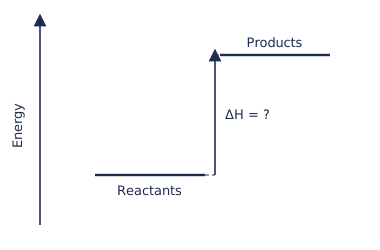
Diagram 1 shows an energy level diagram. Which statement is correct?
Show answerHide answer
C
The products are on the higher level, so heat is absorbed: endothermic, ΔH positive, and the temperature falls.
6
Question 6
A reaction is exothermic. What is true about the energy changes of the bonds?
Show answerHide answer
A
In an exothermic reaction, forming the new bonds releases more heat than breaking the old bonds absorbs.
7
Question 7
The heat of neutralisation of ethanoic acid with sodium hydroxide is lower than that of hydrochloric acid with sodium hydroxide. Why?
Show answerHide answer
D
Ethanoic acid ionises only partially. Part of the heat released is absorbed to ionise the remaining molecules, so less heat is given out.
8
Question 8
The reaction H₂SO₄ + 2NaOH → Na₂SO₄ + 2H₂O releases 114 kJ. What is the heat of neutralisation?
Show answerHide answer
B
Two moles of water form, so per mole of water = 114 ÷ 2 = 57 kJ, ΔH = −57 kJ mol⁻¹.
9
Question 9
50 g of a solution is heated so that its temperature rises by 6.0 °C. What is the heat absorbed?
Show answerHide answer
A
Q = mcθ = 50 × 4.2 × 6.0 = 1260 J.
10
Question 10
What is the unit of fuel value?
Show answerHide answer
D
Fuel value is the heat released per gram of fuel burnt, in kJ g⁻¹.
11
Question 11
The heat of combustion of ethanol, C₂H₅OH, is −1376 kJ mol⁻¹. [Relative atomic mass: H = 1, C = 12, O = 16] What is its fuel value?
Show answerHide answer
B
M = 46 g mol⁻¹. Fuel value = 1376 ÷ 46 = 29.9 kJ g⁻¹.
12
Question 12
The heat of combustion increases from methanol to ethanol to propanol. Which is the best explanation?
Show answerHide answer
C
More C and H atoms per molecule means more CO₂ and H₂O molecules form and more bonds are made, so more heat is released.
Section B: structured questions
34 marksAnswer all questions. Write your answers in the spaces provided. Use c = 4.2 J g⁻¹ °C⁻¹ and density of solution = 1 g cm⁻³.
13
Question 13
State whether each process is exothermic or endothermic.
[1 mark]
(a)Dissolving solid ammonium nitrate in water
Show answerHide answer
Endothermic
Ammonium salts dissolving absorb heat.
[1 mark]
(b)Neutralisation of hydrochloric acid with sodium hydroxide
Show answerHide answer
Exothermic
Neutralisation releases heat.
[1 mark]
(c)Heating copper(II) carbonate until it decomposes
Show answerHide answer
Endothermic
Decomposition of a metal carbonate on heating absorbs heat.
14
Question 14
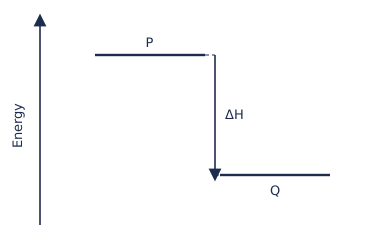
Diagram 2 shows the energy level diagram for a reaction in which P forms Q.
[2 marks]
(a)Is the reaction exothermic or endothermic? Give a reason.
Show answerHide answer
Tick each point you got.
[1 mark]
(b)State the sign of ΔH.
Show answerHide answer
Tick each point you got.
15
Question 15
The equation is H₂(g) + Br₂(g) → 2HBr(g). Bond energies: H–H 436, Br–Br 193, H–Br 366 kJ mol⁻¹.
[1 mark]
(a)Calculate the heat absorbed to break the bonds in the reactants.
Show answerHide answer
Tick each point you got.
[1 mark]
(b)Calculate the heat released when the bonds in the product form.
Show answerHide answer
Tick each point you got.
[2 marks]
(c)Calculate ΔH and state whether the reaction is exothermic or endothermic.
Show answerHide answer
Tick each point you got.
16
Question 16
50 cm³ of 2.0 mol dm⁻³ calcium chloride, CaCl₂, is added to 50 cm³ of 2.0 mol dm⁻³ sodium carbonate, Na₂CO₃. The temperature of the mixture falls from 27.0 °C to 23.0 °C.
[1 mark]
(a)Write the ionic equation for the precipitation of calcium carbonate.
Show answerHide answer
Tick each point you got.
[1 mark]
(b)Calculate the number of moles of calcium carbonate formed.
Show answerHide answer
Tick each point you got.
[1 mark]
(c)Calculate the heat absorbed.
Show answerHide answer
Tick each point you got.
[2 marks]
(d)Calculate the heat of precipitation of calcium carbonate.
Show answerHide answer
Tick each point you got.
17
Question 17
Excess magnesium powder is added to 50 cm³ of 0.25 mol dm⁻³ iron(II) sulphate solution at 29.0 °C. Mg(s) + Fe²⁺(aq) → Mg²⁺(aq) + Fe(s), ΔH = −80.6 kJ mol⁻¹.
[2 marks]
(a)Calculate the heat released.
Show answerHide answer
Tick each point you got.
[2 marks]
(b)Calculate the highest temperature reached.
Show answerHide answer
Tick each point you got.
18
Question 18
50 cm³ of 2.0 mol dm⁻³ hydrochloric acid is mixed with 50 cm³ of 2.0 mol dm⁻³ sodium hydroxide. The temperature rises from 30.0 °C to 43.5 °C.
[3 marks]
(a)Calculate the heat of neutralisation.
Show answerHide answer
Tick each point you got.
[1 mark]
(b)Write the thermochemical equation.
Show answerHide answer
Tick each point you got.
[2 marks]
(c)The experiment is repeated with ethanoic acid of the same volume and concentration. Predict how the temperature rise compares and explain.
Show answerHide answer
Tick each point you got.
19
Question 19
The heat of combustion of methanol, CH₃OH, is −725 kJ mol⁻¹. [Relative atomic mass: H = 1, C = 12, O = 16] In an experiment the flame of burning methanol heats 100 cm³ of water by 30.0 °C. Assume no heat loss.
[1 mark]
(a)Calculate the heat absorbed by the water.
Show answerHide answer
Tick each point you got.
[2 marks]
(b)Calculate the mass of methanol burnt.
Show answerHide answer
Tick each point you got.
[1 mark]
(c)Suggest why the mass of methanol burnt in a real experiment is greater than your answer.
Show answerHide answer
Tick each point you got.
20
Question 20
The fuel values of four fuels are: ethanol 30 kJ g⁻¹, petrol 34 kJ g⁻¹, natural gas 50 kJ g⁻¹ and hydrogen 143 kJ g⁻¹.
[1 mark]
(a)Which fuel releases the most heat per gram?
Show answerHide answer
Tick each point you got.
[1 mark]
(b)Give one environmental advantage of hydrogen compared with petrol.
Show answerHide answer
Tick each point you got.
[1 mark]
(c)Give one reason why hydrogen is still not widely used in vehicles.
Show answerHide answer
Tick each point you got.
[2 marks]
(d)State two factors, other than fuel value, in choosing a fuel for cooking.
Show answerHide answer
Tick each point you got.