Consumer and industrial chemistry
What this chapter covers
- Compare oils and fats, explain hydrogenation of unsaturated fats and justify the uses of oils and fats (5.1)
- Describe soaps and detergents, their preparation and cleansing action, and compare their effectiveness (5.2)
- Describe the types of food additives, their functions and examples, and justify their use (5.3)
- Explain types of traditional and modern medicines, their side effects, and cosmetics (5.4)
- Explain nanotechnology and graphene and describe applications of nanotechnology in daily life (5.5)
- Explain Green Technology and its application in waste and industrial wastewater management (5.6)
5.1Oils and fats
Fatty acids are long-chain carboxylic acids (examples: palmitic, stearic and linoleic acid). The type of fatty acid decides whether the product behaves as an oil or a fat.
| Aspect | Oils | Fats |
|---|---|---|
| Source | Plants | Animals |
| State at room temperature | Liquid | Solid |
| Melting point | Low | High |
| Fatty acids | High percentage of unsaturated fatty acids | High percentage of saturated fatty acids |
| Example | Palm oil | Butter |
Saturated and unsaturated
- Saturated fatty acids have only single C–C bonds (examples: palmitic, lauric, stearic acid).
- Unsaturated fatty acids have at least one C=C double bond (examples: oleic, linoleic, linolenic acid). The double bond lowers the melting point, so unsaturated fats are liquid.
Hydrogenation: unsaturated to saturated
Hot oil reacts with hydrogen gas, H2, using nickel as the catalyst. The C=C bonds open and hydrogen atoms are added to the chain.
Uses of oils and fats
| Use | How |
|---|---|
| Nutrition | Supply energy and help absorb vitamins A, D, E and K; insulate the body |
| Biofuel | Biodiesel for diesel engines |
| Soap and personal care | Main raw material of soap; used in moisturisers |
| Animal feed | Meets the nutritional needs of cattle |
Too much fat, especially saturated fat from animals, raises the risk of heart problems, obesity and hardening of the arteries (arteriosclerosis).
Show answerHide answer
5.2Cleaning agents
| Aspect | Soap | Detergent |
|---|---|---|
| Raw materials | Natural oils or fats and concentrated alkali | Petroleum fractions and concentrated sulphuric acid |
| Process | Saponification (alkaline hydrolysis) | Sulphonation, then neutralisation |
| Products | Soap + glycerol | Sodium alkyl sulphate or sodium alkylbenzene sulphonate + water |
| Examples | Sodium laurate, sodium palmitate | Sodium alkyl sulphate, ROSO3−Na+ |
Preparing soap: saponification
Sodium hydroxide gives sodium soap, potassium hydroxide gives potassium soap.
Stearic acid + NaOH → sodium stearate + H2O: C17H35COOH + NaOH → C17H35COONa + H2O (neutralisation of the fatty acid).
Preparing detergent
- Sulphonation: alkylbenzene (or long-chain alcohol) reacts with concentrated H2SO4 to give a sulphonic acid and water.
- Neutralisation: the acid reacts with NaOH to form the detergent salt and water.
Cleansing action
Soap and detergent anions have two ends: a hydrophilic part (dissolves in water) and a hydrophobic part (dissolves in oil or grease).
- The anions lower the surface tension of water, so water wets the cloth better.
- The hydrophobic parts dissolve in grease, the hydrophilic parts stay in water.
- Scrubbing pulls the grease off the cloth; it breaks into small droplets surrounded by anions.
- The droplets repel one another (negative charges), cannot re-attach and are suspended in water as an emulsion, which is rinsed away.
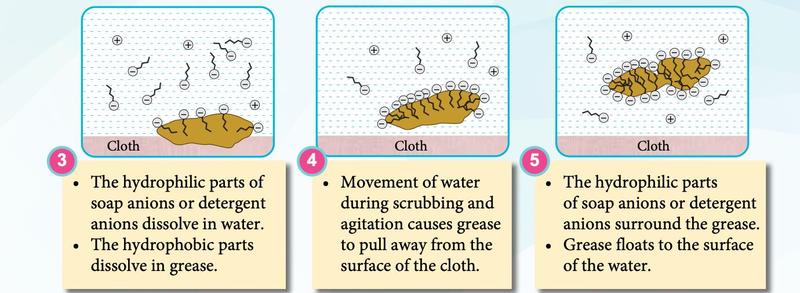
Textbook crop: Chemistry Form 5 (DLP), Figure 5.10, p. 174.
Soap versus detergent
| Water | Soap | Detergent |
|---|---|---|
| Soft water | Effective | Effective |
| Hard water (Ca2+, Mg2+) | Less effective: insoluble scum (e.g. calcium stearate) forms, wasting soap | Effective: calcium and magnesium salts of detergent are soluble |
| Acidic water | Not effective: insoluble fatty acid forms | Effective: the acid formed is soluble |
Additives in detergents
| Additive | Function | Example |
|---|---|---|
| Biological enzyme | Removes protein stains such as blood | Protease, lipase |
| Whitening agent | Changes dirt to a colourless substance | Sodium perborate |
| Optical whitener | Makes clothes whiter and brighter | Fluorescent dyes |
| Water softener (builder) | Softens water so the detergent works better | Sodium tripolyphosphate |
| Foam control agent | Controls foam | Alkyl monoethanolamide |
| Anti-suspension agent | Stops removed dirt redepositing on clothes | Sodium carboxymethylcellulose |
| Fragrance | Pleasant smell | Jasmine, lavender |
| Drying agent | Keeps powder dry | Sodium sulphate |
Show answerHide answer
5.3Food additives
| Type | Function | Examples |
|---|---|---|
| Preservatives | Prevent or delay growth of bacteria and fungi | Salt, sugar, vinegar, sodium benzoate, sodium nitrite |
| Antioxidants | Slow down oxidation of fats, prevent rancidity | Ascorbic acid, citric acid, tocopherol (vitamin E) |
| Flavourings | Add or restore flavour | MSG, aspartame, stevia, esters such as ethyl ethanoate |
| Stabilisers | Give a smooth, uniform texture | Pectin, agar |
| Emulsifiers | Let two immiscible liquids mix | Lecithin, monoglycerides |
| Thickeners | Thicken liquids | Starch, gelatine, xanthan gum |
| Dyes | Add or restore colour | Azo compounds, caramel |
Justifying the use of additives
- Food stays fresh and lasts longer; seasonal foods can be enjoyed all year; food looks better and tastes better.
- Taken in excess they may cause allergies, asthma, rashes, hyperactivity in children, nerve disorders and even cancer. Producers must follow the permitted amounts (Food Act 1983, Food Regulations 1985).
Show answerHide answer
5.4Medicines and cosmetics
Traditional medicines
Obtained from plants or animals without chemical processing. Examples: ginger (removes wind, warms the body), aloe vera (burns and skin diseases), ginseng (builds immunity, lowers blood pressure and cholesterol), tamarind (juice relieves coughs).
Modern medicines
| Type | Function and examples | Side effects and care |
|---|---|---|
| Analgesics | Relieve pain: aspirin, paracetamol, codeine | Aspirin is acidic and can cause stomach ulcers; paracetamol overdose damages the liver; codeine causes drowsiness |
| Antimicrobials | Antibiotics (penicillin, streptomycin) kill bacteria; antiseptics (iodine) for skin; disinfectants (alcohol) for objects | Complete the antibiotic course or bacteria become resistant; penicillin allergy can be fatal |
| Psychotic drugs | Treat psychosis: haloperidol, chlorpromazine | Involuntary body movements, stiffness, shakes |
| Anti-allergies | Relieve runny nose and itching: antihistamines | Drowsiness, dry mouth, blurred vision |
| Corticosteroids | Reduce swelling and inflammation (asthma, arthritis): prednisolone | Long-term use: moon face, high blood pressure, high blood sugar |
Medicines must be taken as prescribed. Misuse or abuse can be harmful, for traditional medicines too. Modern medicines pass clinical trials; many traditional ones lack data to prove effectiveness or the correct dose. The NPRA supervises drug safety and quality control of cosmetics.
Cosmetics
- Basic ingredients: water (solvent), emulsifiers, thickeners, dyes, moisturisers, preservatives, fragrances.
- Types: makeup (lipstick, powder), treatment (creams, moisturisers) and fragrances (perfume, deodorant).
- Harmful chemicals sometimes added illegally: mercury (kidney and nerve damage), hydroquinone (hypersensitive skin), betamethasone valerate, tretinoin (redness, peeling). Check that products are registered with NPRA.
- Homemade cosmetics are cheap and free of harmful chemicals; commercial ones may have side effects or misleading claims.
Show answerHide answer
5.5Nanotechnology in industry
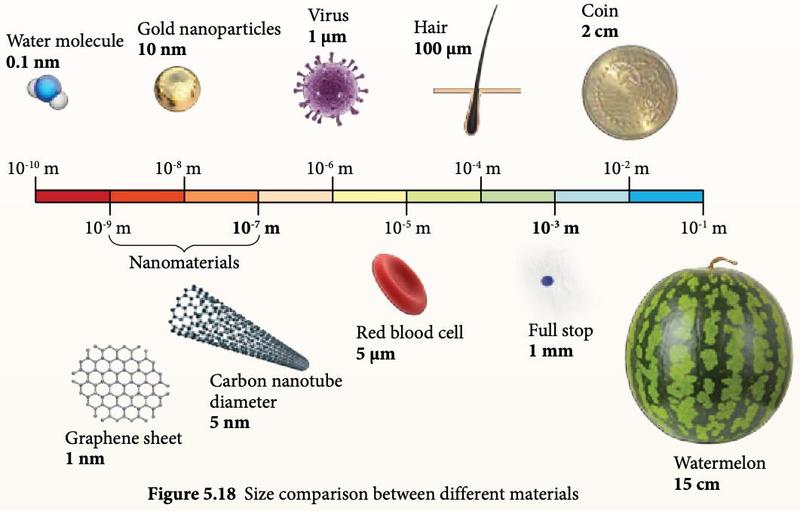
Textbook crop: Chemistry Form 5 (DLP), Figure 5.18, p. 187.
Applications
| Field | Examples |
|---|---|
| Semiconductors and electronics | Smaller, more efficient chips; highly conductive wiring |
| Energy | More efficient solar cells, long-lasting batteries |
| Textile | Water-, fire- and dirt-resistant, anti-wrinkle, UV-protective fabric |
| Medical | Sensitive testing devices, better drug delivery |
| Agriculture | More effective pesticides and fertilisers |
| Food | Nanoscale additives, anti-microbial packaging |
| Cosmetics | Particles penetrate skin easily and coat the surface evenly |
Graphene
Graphene is a single sheet of carbon atoms, an allotrope of carbon (with diamond and graphite). It was isolated in 2004 by Andre Geim and Konstantin Novoselov (Nobel Prize 2010).
- Physical properties: strong and hard, transparent, elastic, impermeable, good conductor of heat and electricity (very low electrical resistance).
- Chemical properties: burns at a lower temperature than graphite; the most reactive carbon allotrope; graphene oxide is used as a catalyst.
- Uses: electronics, polymer composites (strength), sensors (high surface area), membranes for water filtration, biomedicine, energy storage.
Show answerHide answer
5.6Green Technology in industrial waste management
Sectors: energy supply (solar, hydro, wind), transportation (alternative fuels), buildings, waste and wastewater management, agriculture and forestry (compost), industry (energy-efficient tools).
Waste management
Solid waste is collected, sorted and recycled, composted (organic waste), incinerated or sent to landfill. Green Technology is used for composting, recycling, methane recovery and treating leachate (contaminated liquid from water leaching through solid waste).
Industrial wastewater
Industrial wastewater may contain toxic substances such as acrylonitrile, methylbenzene and heavy metals (arsenic, mercury, lead) that decompose poorly, so it needs systematic treatment.
Steps: pump in wastewater, screen solid waste, electrocoagulation, settling, collect sludge, further treatment, discharge effluent.
Importance
Cleaner energy, more effective waste management, slower global warming (lower greenhouse gas and carbon footprint), innovation, better living standards and new jobs.