Congruency, Enlargement and Combined Transformations
What this chapter covers
- Differentiate between congruent and non-congruent shapes based on sides and angles (5.1.1)
- Make and verify the conjecture of triangle congruency (SSS, SAS, ASA, AAS) and solve problems involving congruency (5.1.2, 5.1.3)
- Explain similarity of geometric objects and connect it to enlargement, describing enlargement by centre and scale factor (5.2.1, 5.2.2)
- Determine the image and object of an enlargement and use area of image = k² × area of object (5.2.3, 5.2.4, 5.2.5)
- Determine the image and object of a combined transformation and test the commutative law (5.3.1, 5.3.2)
- Describe a combined transformation and solve problems involving it (5.3.3, 5.3.4)
- Explain tessellation and design tessellations using isometric transformations (5.4.1, 5.4.2)
5.1Congruency
To test two polygons, work out every missing side and angle first, then compare each corresponding pair. If one pair is different, the shapes are not congruent. Congruent triangles are written with the symbol ≅, for example △ABC ≅ △PQR (textbook p. 125-126).
Conditions for congruent triangles
| Rule | What must be equal | Works alone? |
|---|---|---|
| SSS | All three pairs of sides | Yes |
| SAS | Two pairs of sides and the angle between them | Yes |
| ASA | Two pairs of angles and the side between them | Yes |
| AAS | Two pairs of angles and a side that is not between them | Yes |
| AAA | All three pairs of angles | No: same shape, different size |
| SSA | Two pairs of sides and an angle that is not between them | No |
AAA and SSA only prove congruency when the two triangles are also known to have the same area (p. 128-129). For right-angled triangles, RHS (equal hypotenuse and one other side) is a special case of SSA that does work (p. 130).
Two sides and the angle between them are equal, so the rule is SAS.
If instead ∠EGF = ∠KML, ∠EFG = ∠KLM and EF = KL, then two angles and a side that is not between them are equal, so the rule is AAS.
Solving problems with congruency
• PR = QR (given)
• ∠PRB = ∠QRA (the same angle R)
• BR = AR (halves of equal sides)
Two sides and the included angle are equal, so △PBR ≅ △QAR by SAS.
Show answerHide answer
5.2Enlargement
Similar objects
For triangles, equal angles are enough (the sides then follow). For shapes with more than three sides, check both: two rectangles need equal side ratios as well, because all their angles are 90° anyway (p. 135).
A rectangle 12 cm × 6 cm compared with 6 cm × 4 cm gives 12 ÷ 6 = 2 but 6 ÷ 4 = 1.5. Not similar.
Enlargement, centre and scale factor
Scale factor k = distance of image point from the centre ÷ distance of object point from the centre = length of image side ÷ length of object side.
| Scale factor | Size of image | Position |
|---|---|---|
| k > 1 | Larger | Same side of the centre |
| 0 < k < 1 | Smaller | Same side of the centre |
| k = 1 | Same size | Same place |
| −1 < k < 0 | Smaller | Opposite side, inverted |
| k = −1 | Same size | Opposite side, inverted |
| k < −1 | Larger | Opposite side, inverted |
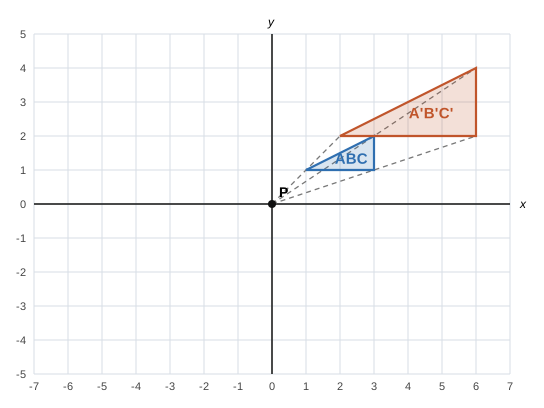
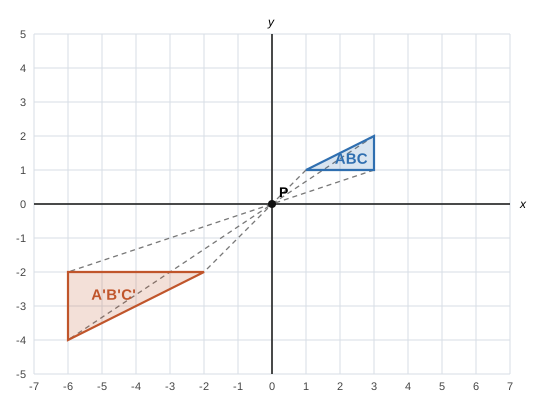
If a side of 3 units becomes 6 units but the image is on the opposite side, k = −(6 ÷ 3) = −2.
Area of the image
(b) Object 100 m², k = −4: image = (−4)² × 100 = 1 600 m². The negative sign disappears when squaring.
(c) k = 1/2, image 7 cm²: object = 7 ÷ (1/4) = 28 cm².
Show answerHide answer
5.3Combined transformation
| Transformation | What to give | Property of the image |
|---|---|---|
| Translation | Vector | Congruent, same orientation |
| Reflection | Line (mirror line) | Congruent, inverted |
| Rotation | Centre, angle, direction | Congruent, turned |
| Enlargement | Centre, scale factor | Similar, different size |
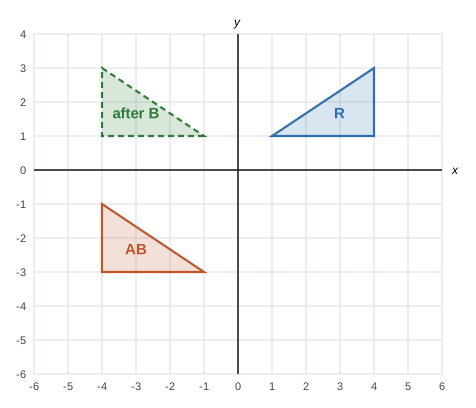
B first: P(2, 3) → P′(2, −3).
Then A: P′ → (2 + 3, −3 − 1) = (5, −4).
Finding the object
To find the object when the image is given, reverse the order and undo each step: translation by the opposite vector, rotation in the opposite direction, enlargement with the reciprocal scale factor. A reflection in the same line undoes itself (p. 150-153).
Commutative law
Combined transformation AB satisfies the commutative law if AB and BA give the same image. This is true only for some pairs (p. 155-156).
TM: M gives (−3, 1), then T gives (−1, 1).
MT: T gives (5, 1), then M gives (−5, 1).
The images are different, so TM does not satisfy the commutative law.
In contrast, a rotation of 180° at the origin and M give (3, −1) in either order, so they commute.
Describing a combined transformation
- Congruent, same orientation, every point moved the same distance: translation.
- Congruent, inverted: reflection. Congruent, turned: rotation.
- Similar but a different size: enlargement.
- For an image under ST, describe T (the first step) before S.
Not every combination equals a single transformation. When it does, check the result by following one vertex through the steps (p. 157-158).
Show answerHide answer
5.4Tessellation
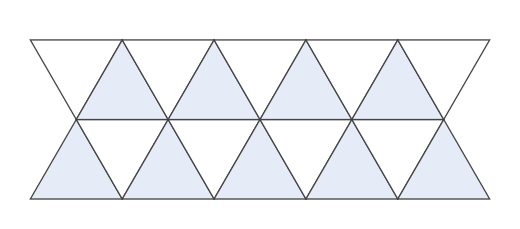
- A tessellation may use one shape or a combination, for example squares with regular octagons.
- Extra check (not in the textbook): shapes meeting at a point must have angles adding up to 360°. Regular triangles (60°), squares (90°) and regular hexagons (120°) work alone. A regular pentagon (108°) does not, because 360 ÷ 108 is not a whole number.
- A tessellation can be built from one shape using the isometric transformations: translation, reflection and rotation. These give congruent images, so every shape in the pattern is congruent to the others (p. 164).
The next triangle with the same orientation in the same row is the image of P under a translation of one side length along the row.
Notes follow Mathematics Form 5 (DLP), Chapter 5, p. 124-171. Figures are redrawn with new numbers.