Mathematics questions, chapter 5
Nama / NameKelas / ClassTarikh / Date
Congruency, Enlargement and Combined Transformations
40 marks. Use Practice to check each answer as you go, or Exam to answer everything first. Show your working for Section B.
Section A: objective questions
12 marksChoose the correct answer. Each question carries 1 mark.
1
Question 1
Which statement about two congruent polygons is correct?
Show answerHide answer
B
Congruent shapes have the same shape and size, so every corresponding side and every corresponding angle is equal. Equal angles with sides in a ratio describe similar shapes.
2
Question 2
Which condition is not enough, by itself, to show that two triangles are congruent?
Show answerHide answer
C
AAA only gives triangles of the same shape; they may be different in size. SSS, SAS and ASA each prove congruency on their own.
3
Question 3
In triangles ABC and PQR, AB = PQ = 7 cm, BC = QR = 9 cm and ∠ABC = ∠PQR = 52°. Which rule shows that the triangles are congruent?
Show answerHide answer
A
The two pairs of equal sides, AB, PQ and BC, QR, have the equal angle B and Q between them, so the rule is Side-Angle-Side. SSA needs the angle not between the sides.
4
Question 4
△ABC ≅ △PQR with AB = PQ. Given ∠B = 50° and ∠C = 70°, what is the size of ∠P?
Show answerHide answer
D
∠A = 180° − 50° − 70° = 60°. A corresponds to P, so ∠P = 60°. 50° and 70° are the angles that correspond to Q and R.
5
Question 5
Which pair of rectangles is similar?
Show answerHide answer
B
10 ÷ 4 = 2.5 and 15 ÷ 6 = 2.5, so the sides are in the same ratio. Rectangles always have equal angles, so the ratios must also be equal; the other pairs give 2.5 and 2, 2 and 2.33, 1.5 and 1.33.
6
Question 6
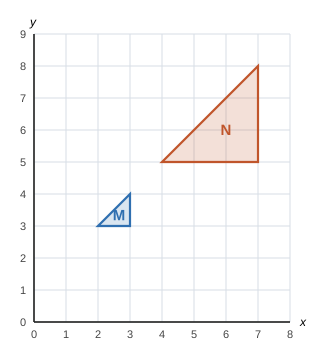
Diagram 1 shows triangle N, the image of triangle M under an enlargement. What is the centre and scale factor of the enlargement?
Show answerHide answer
C
Join each object point to its image point: the lines meet at (1, 2). M has a base of 1 unit and N has a base of 3 units, so k = 3. Using the point (2, 3) as centre is a common slip of picking an object vertex.
7
Question 7
The image of a triangle of area 6 cm² under an enlargement with scale factor −3 has an area of
Show answerHide answer
D
Area of image = k² × area of object = (−3)² × 6 = 54 cm². An area is never negative; 18 comes from multiplying by 3 instead of 9.
8
Question 8
An enlargement has a scale factor of −12. The image is
Show answerHide answer
A
|k| = 1/2 is less than 1, so the image is smaller. The negative sign puts it on the opposite side of the centre, inverted.
9
Question 9
The area of an object is 3 cm² and the area of its image is 75 cm² under an enlargement. Which of these could be the scale factor?
Show answerHide answer
C
k² = 75 ÷ 3 = 25, so k = 5 or −5. 25 is k², not k. The image is larger, so k cannot be 1/5.
10
Question 10
B is a reflection on the x-axis and A is a translation 3−1. What is the image of point P(2, 3) under the combined transformation AB?
Show answerHide answer
D
AB means B first: (2, 3) → (2, −3). Then A: (2 + 3, −3 − 1) = (5, −4). Doing A first gives (5, 2) and then (5, −2), which is the order BA mistake. (−1, 4) subtracts the vector.
11
Question 11
The image of K under combined transformation VT is (−6, 8). T is an enlargement at the origin with scale factor 2 and V is a reflection on the y-axis. What is K?
Show answerHide answer
B
VT: T first, then V. To find K undo V first: (−6, 8) → (6, 8). Then undo T with k = 1/2: (3, 4). (−3, 4) forgets the reflection; (−12, 16) enlarges instead of reducing.
12
Question 12
Which of the following is not an isometric transformation used to design a tessellation?
Show answerHide answer
A
An isometric transformation gives an image that is congruent with the object. Translation, reflection and rotation do, but an enlargement changes the size of the object (unless k = 1 or k = −1).
Section B: structured questions
28 marksAnswer all questions. Show your working.
13
Question 13
State the triangle congruence rule that proves △ABC ≅ △PQR in each case.
[1 mark]
(a)AB = PQ, ∠ABC = ∠PQR and BC = QR
Show answerHide answer
Tick each point you got.
[1 mark]
(b)∠BAC = ∠QPR, ∠ABC = ∠PQR and BC = QR
Show answerHide answer
The equal side BC is not between the two equal angles A and B.
Tick each point you got.
[1 mark]
(c)AB = PQ, BC = QR and AC = PR
Show answerHide answer
Tick each point you got.
14
Question 14
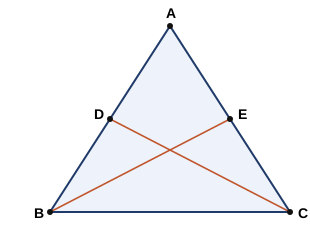
Diagram 2 shows an isosceles triangle ABC with AB = AC. D and E are the midpoints of AB and AC. Show that triangle DBC and triangle ECB are congruent.
[4 marks]
(a)State the three facts about the triangles that are needed and the rule used.
Show answerHide answer
Tick each point you got.
15
Question 15
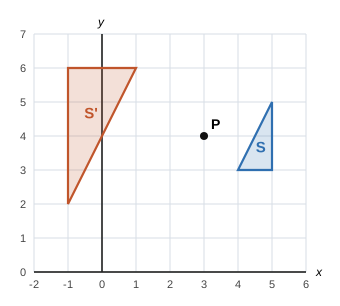
Diagram 3 shows triangle S and its image S′ under an enlargement at centre P(3, 4). S has area 1 unit².
[3 marks]
(a)Describe the enlargement in full.
Show answerHide answer
Tick each point you got.
[1 mark]
(b)Calculate the area of S′.
Show answerHide answer
Tick each point you got.
16
Question 16
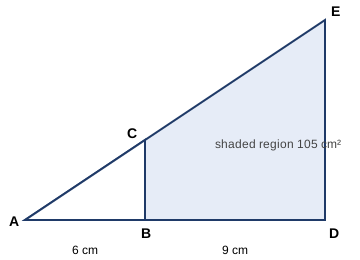
In Diagram 4, triangle ADE is the image of triangle ABC under an enlargement at centre A. AB = 6 cm, BD = 9 cm and the area of the shaded region is 105 cm².
[1 mark]
(a)Calculate the scale factor of the enlargement.
Show answerHide answer
Tick each point you got.
[2 marks]
(b)Calculate the area of triangle ABC.
Show answerHide answer
Tick each point you got.
[1 mark]
(c)Calculate the area of triangle ADE.
Show answerHide answer
Check: 125 − 20 = 105.
Tick each point you got.
17
Question 17
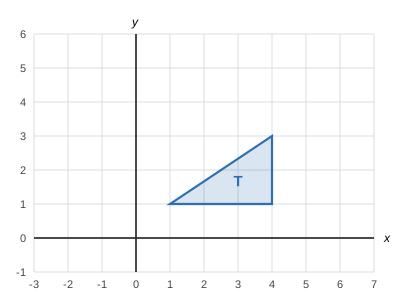
Diagram 5 shows triangle T on a Cartesian plane. A is a translation −32 and B is a reflection on the line y = x.
[3 marks]
(a)Write the coordinates of the vertices of the image of T under the combined transformation AB.
Show answerHide answer
Tick each point you got.
18
Question 18
M is a reflection on the y-axis, T is a translation 20. A point has coordinates (3, 1).
[2 marks]
(a)Find the image of the point under TM and under MT.
Show answerHide answer
Tick each point you got.
[1 mark]
(b)Does the combined transformation TM satisfy the commutative law? Give a reason.
Show answerHide answer
Tick each point you got.
19
Question 19
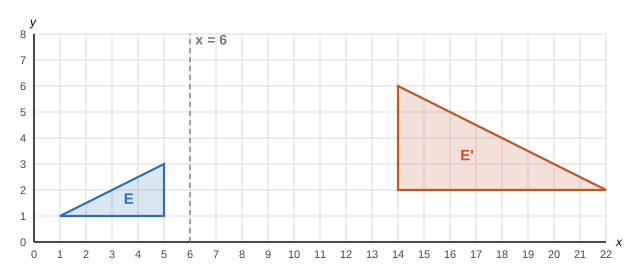
Diagram 6 shows triangle E and its image E′ under the combined transformation ST. T is a reflection on the line x = 6.
[2 marks]
(a)Write the coordinates of the image of E under T.
Show answerHide answer
Tick each point you got.
[2 marks]
(b)Describe the transformation S in full.
Show answerHide answer
Tick each point you got.
20
Question 20
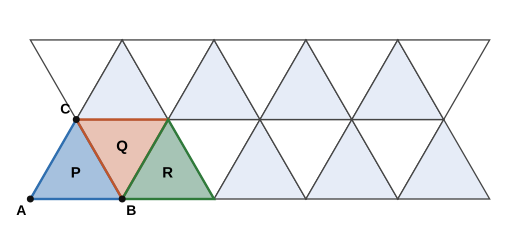
Diagram 7 shows a tessellation of equilateral triangles with sides of 2 units. Triangle Q is the image of P under an isometric transformation.
[2 marks]
(a)State two different transformations that map P onto Q.
Show answerHide answer
Tick each point you got.
[1 mark]
(b)Describe the translation that maps P onto R.
Show answerHide answer
Tick each point you got.