Mathematics questions, chapter 6
Nama / NameKelas / ClassTarikh / Date
Ratios and Graphs of Trigonometric Functions
45 marks. Use Practice to check each answer as you go, or Exam to answer everything first. Show your working for Section B. Use a calculator in Deg mode where needed.
Section A: objective questions
12 marksChoose the correct answer. Each question carries 1 mark.
1
Question 1
What is the corresponding reference angle of 238°?
Show answerHide answer
B
238° is in quadrant III, so α = 238° − 180° = 58°. 122° comes from 360° − 238° (a quadrant IV formula), and 32° is not related to 238° by any formula.
2
Question 2
In quadrant III, which trigonometric ratio is positive?
Show answerHide answer
C
A-S-T-C: All in quadrant I, Sin in II, Tan in III, Cos in IV. In quadrant III, sine and cosine are negative and tangent is positive.
3
Question 3
Which expression is equal to sin 160°?
Show answerHide answer
A
160° is in quadrant II with α = 180° − 160° = 20°. Sine is positive in quadrant II, so sin 160° = + sin 20°.
4
Question 4
Without using a calculator, sin 240° = ______
Show answerHide answer
C
240° is in quadrant III, α = 60°. Sine is negative there: sin 240° = −sin 60° = −√32. −12 would be −sin 30° or −cos 60°.
5
Question 5
Given sin θ = 0.5 and 0° < θ < 360°, the values of θ are ______
Show answerHide answer
D
Sine is positive in quadrants I and II. sin⁻¹ 0.5 = 30°, so θ = 30° or 180° − 30° = 150°. 210° and 330° are the angles where sine is −0.5.
6
Question 6
Given cos θ = −0.7071 and 0° < θ < 360°, the values of θ are ______
Show answerHide answer
A
Cosine is negative in quadrants II and III. cos⁻¹ 0.7071 = 45°, so θ = 180° − 45° = 135° or 180° + 45° = 225°.
7
Question 7
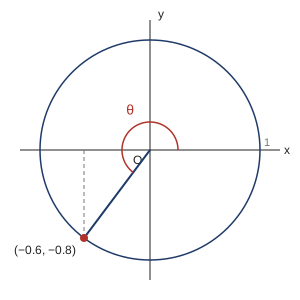
Diagram 1 shows a unit circle. P is the point (−0.6, −0.8). What is the value of tan θ?
Show answerHide answer
C
tan θ = y ÷ x = (−0.8) ÷ (−0.6) = 43. Both coordinates are negative, so the quotient is positive, as expected in quadrant III. 34 is x ÷ y.
8
Question 8
What are the amplitude and the period of y = 3 sin 2x + 1?
Show answerHide answer
D
Amplitude = a = 3. Period = 360° ÷ b = 360° ÷ 2 = 180°. The +1 only moves the graph up.
9
Question 9
What is the period of y = tan 3x?
Show answerHide answer
B
The period of a tangent function is 180° ÷ b = 180° ÷ 3 = 60°. 120° comes from using 360° ÷ 3.
10
Question 10
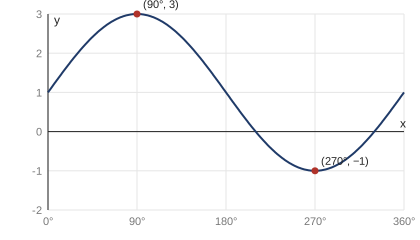
Diagram 2 shows the graph of a trigonometric function for 0° ≤ x ≤ 360°. Which function does it show?
Show answerHide answer
A
Maximum 3, minimum −1: amplitude = (3 − (−1)) ÷ 2 = 2 and c = (3 + (−1)) ÷ 2 = 1. The graph starts on the centre line and rises, so it is a sine graph: y = 2 sin x + 1.
11
Question 11
How many times does the graph of y = cos 2x cut the x-axis for 0° ≤ x ≤ 360°?
Show answerHide answer
B
The period is 180°, so there are two cycles, each cutting the axis twice (cos 2x = 0 at x = 45°, 135°, 225°, 315°). y = cos x itself cuts the axis only 2 times.
12
Question 12
Farah writes sin 200° = sin 20° because 20° is the corresponding reference angle. Which statement is correct?
Show answerHide answer
D
200° is in quadrant III where only tangent is positive. The reference angle is right (20°) but the sign is missing: sin 200° = −sin 20° = −0.3420.
Section B: structured questions
33 marksAnswer all questions. Show your working.
13
Question 13
Use the corresponding reference angle to answer this question.
[2 marks]
(a)State the quadrant and the corresponding reference angle of 147°.
Show answerHide answer
Tick each point you got.
[2 marks]
(b)Find the value of cos 251°.
Show answerHide answer
Tick each point you got.
[2 marks]
(c)Find the value of tan 305°.
Show answerHide answer
Tick each point you got.
14
Question 14
Calculate the values of θ for 0° < θ < 360°. Give answers to 1 decimal place where needed.
[2 marks]
(a)sin θ = −0.5
Show answerHide answer
Tick each point you got.
[2 marks]
(b)tan θ = −1.5
Show answerHide answer
Tick each point you got.
15
Question 15
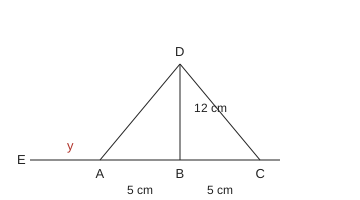
In Diagram 3, EABC is a straight line, AB = BC = 5 cm and BD = 12 cm. Angle y is the obtuse angle EAD.
[1 mark]
(a)Calculate the length of AD.
Show answerHide answer
Tick each point you got.
[2 marks]
(b)Find cos y.
Show answerHide answer
Tick each point you got.
[2 marks]
(c)Find tan y.
Show answerHide answer
Tick each point you got.
16
Question 16
A function is y = 2 sin 3x + 1 for 0° ≤ x ≤ 360°.
[1 mark]
(a)State the amplitude.
Show answerHide answer
Tick each point you got.
[1 mark]
(b)Find the period of the function.
Show answerHide answer
Tick each point you got.
[2 marks]
(c)State the maximum value and the minimum value.
Show answerHide answer
Tick each point you got.
17
Question 17
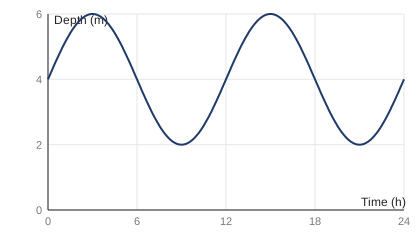
Diagram 4 shows the depth of water, y metres, in a harbour x hours after midnight. The depth is modelled by y = a sin bx + c.
[2 marks]
(a)State the values of a and c.
Show answerHide answer
Tick each point you got.
[2 marks]
(b)Find the value of b.
Show answerHide answer
Tick each point you got.
[1 mark]
(c)Calculate the depth of water at 1 a.m.
Show answerHide answer
Tick each point you got.
18
Question 18
The height above the ground of a rider on a Ferris wheel is recorded as in part (a). The wheel turns steadily.
[1 mark]
(a)The heights are 20, 31, 20, 9, 20 m at times 0, 2, 4, 6, 8 minutes. The height starts at the centre line and then goes up. The graph is that of a ______ function.
Show answerHide answer
sine
A sine graph starts on its centre line and rises. A cosine graph would start at its maximum.
[2 marks]
(b)State the amplitude and the value of c.
Show answerHide answer
Tick each point you got.
[2 marks]
(c)Find the period and the value of b.
Show answerHide answer
Tick each point you got.
[1 mark]
(d)Write the function for the height, y m, after x minutes.
Show answerHide answer
Tick each point you got.
19
Question 19
Sketch the graph of y = 3 cos 2x for 0° ≤ x ≤ 360°.
[3 marks]
(a)Sketch the graph. Mark the maximum and minimum values and the x-intercepts.
Show answerHide answer
Tick each point you got.