Mathematics notes, chapter 6
Ratios and Graphs of Trigonometric Functions
Textbook Mathematics Form 5 (DLP), pages 172–195
What this chapter covers
- Find the quadrant and corresponding reference angle of an angle between 0° and 360°, and relate sin, cos and tan of the angle to those of its reference angle (6.1)
- Use the unit circle to define sin θ, cos θ and tan θ and state their signs in each quadrant (6.1)
- Find the values of sine, cosine and tangent of angles in quadrants II, III and IV, with a calculator and without one for 30°, 45° and 60° (6.1)
- Find the angle when the value of sine, cosine or tangent is given, and solve problems (6.1)
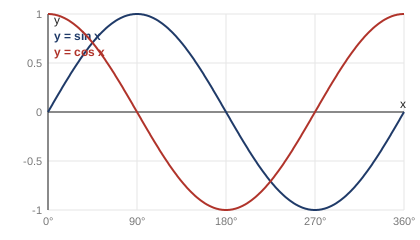
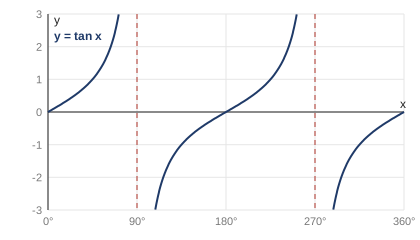
- Describe the graphs of y = sin x, y = cos x and y = tan x for 0° ≤ x ≤ 360° (6.2)
- Explain the effects of a, b and c on y = a sin bx + c, y = a cos bx + c and y = a tan bx + c, sketch the graphs and solve problems (6.2)
6.1Sine, cosine and tangent for 0° < θ < 360°
A unit circle has radius 1 unit and its centre at the origin O. A point P moves round it and θ is the angle from the positive x-axis to OP, measured anticlockwise. The x-axis and y-axis split the circle into quadrants I, II, III and IV.
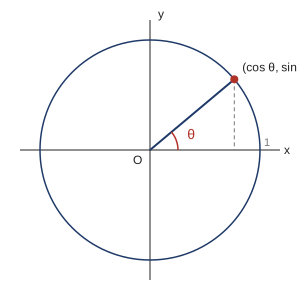
- sin θ = y-coordinate of P
- cos θ = x-coordinate of P
- tan θ = yx = y-coordinate ÷ x-coordinate (undefined when x = 0, at 90° and 270°)
| Quadrant | Angle θ | Reference angle α |
|---|---|---|
| I | 0° < θ < 90° | α = θ |
| II | 90° < θ < 180° | α = 180° − θ |
| III | 180° < θ < 270° | α = θ − 180° |
| IV | 270° < θ < 360° | α = 360° − θ |
The corresponding reference angle α is the acute angle between OP and the x-axis. It is always less than 90°.
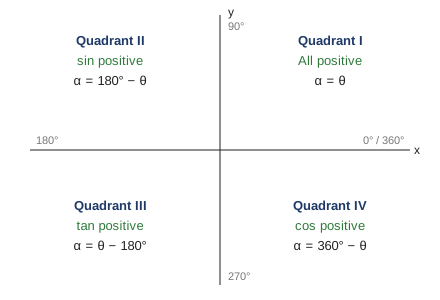
Remember the signs as A-S-T-C, going anticlockwise from quadrant I: All, Sin, Tan, Cos. Only the named ratio is positive in that quadrant, the other two are negative.
The value of a ratio is the value for the reference angle, with the sign of the quadrant.
| Quadrant | sin θ | cos θ | tan θ |
|---|---|---|---|
| II | + sin α | − cos α | − tan α |
| III | − sin α | − cos α | + tan α |
| IV | − sin α | + cos α | − tan α |
Example 1 and 2 (textbook p. 176-177): quadrant, reference angle and relationship
138° is in quadrant II, α = 180° − 138° = 42°.239° is in quadrant III, α = 239° − 180° = 59°.
312° is in quadrant IV, α = 360° − 312° = 48°.
So sin 167° = sin 13°, cos 258° = − cos 78° and tan 349° = − tan 11°.
Do not use θ − 180° in quadrant II or 180° − θ in quadrant III. Sketch the quadrant first, then choose the formula. For an angle above 360°, subtract 360° first (498° is the same direction as 138°).
Finding a value from the reference angle
- Find the quadrant and the reference angle α.
- Decide the sign from A-S-T-C.
- Calculate the ratio of α with the calculator in Deg mode.
Example 4 (textbook p. 179): values with a calculator
sin 104° = + sin 76° = 0.9703cos 208.2° = − cos 28.2° = −0.8813
tan 318°17′ = − tan 41°43′ = −0.8915
On the calculator, a minute sign is entered with the degrees key. Always check that the display shows Deg and not Rad.
Special angles without a calculator
| Angle | sin | cos | tan |
|---|---|---|---|
| 30° | 12 | √32 | 1√3 |
| 45° | 1√2 | 1√2 | 1 |
| 60° | √32 | 12 | √3 |
Example 5 (textbook p. 180): without a calculator
cos 150° = − cos 30° = −√32tan 225° = + tan 45° = 1
sin 300° = − sin 60° = −√32
Quick check. Without a calculator, find sin 210° and cos 315°.
Show answer
210° is in quadrant III, α = 30°, sin is negative: sin 210° = −12.
315° is in quadrant IV, α = 45°, cos is positive: cos 315° = 1√2 = √22.
315° is in quadrant IV, α = 45°, cos is positive: cos 315° = 1√2 = √22.
Finding the angle from a value
- The sign tells you the two quadrants.
- Get α from the inverse key, using the value without its sign.
- Write both angles using the quadrant formulas.
| Value | Quadrants | Angles |
|---|---|---|
| sin θ = 0.6157 | I and II | 38° or 180° − 38° = 142° |
| cos θ = −0.4226 | II and III | 180° − 65° = 115° or 180° + 65° = 245° |
| tan θ = −1.4826 | II and IV | 180° − 56° = 124° or 360° − 56° = 304° |
Values from Example 6, textbook p. 181.
If you type sin⁻¹ (−0.5) you get a negative angle. Use the positive value to get α, then place α in the right quadrants.
Problems with sin, cos and tan
Draw the situation, use Pythagoras' theorem to complete the right-angled triangle, then give the ratio of the reference angle with the sign of the quadrant.
Example 7 (textbook p. 182): signs in a diagram
QRS is a straight line with QS = 8 cm and QR = RS. P is 3 cm from Q and PQ is perpendicular to QS.QR = 8 ÷ 2 = 4 cm, so PR = √(3² + 4²) = 5 cm.
Angle x is in quadrant IV, so cos x = + cos ∠QPR = + 35.
Angle y is in quadrant II, so tan y = − tan ∠PRQ = − 34 (negative because y is in quadrant II).
Quick check. Given sin θ = 35 and 90° < θ < 180°, find cos θ and tan θ.
Show answer
The triangle is 3, 4, 5, so α has cos α = 45 and tan α = 34. In quadrant II, cos and tan are negative: cos θ = −45, tan θ = −34.
6.2Graphs of sine, cosine and tangent
| y = sin x | y = cos x | y = tan x | |
|---|---|---|---|
| Maximum value | 1 at 90° | 1 at 0° and 360° | none (∞) |
| Minimum value | −1 at 270° | −1 at 180° | none (−∞) |
| x-intercepts | 0°, 180°, 360° | 90°, 270° | 0°, 180°, 360° |
| y-intercept | 0 | 1 | 0 |
| Period | 360° | 360° | 180° |
Characteristics from textbook p. 185-186 and the summary on p. 192.
A periodic function repeats its graph over a fixed interval, the period. The amplitude is the greatest distance from the centre line: 12 (maximum − minimum).
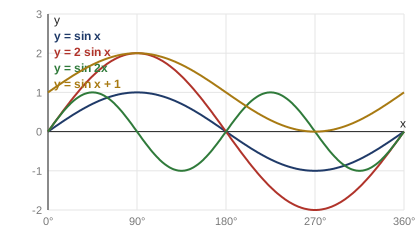
y = a sin bx + c (a > 0, b > 0)
| Constant | What it does |
|---|---|
| a | Sets the amplitude = a. The maximum and minimum change. (Tangent has no amplitude; a changes how steep it is.) |
| b | Changes the period. For sine and cosine, period = 360°b. For tangent, period = 180°b. A larger b squeezes the graph. |
| c | Moves the graph up (c > 0) or down (c < 0) by |c| units. The centre line is y = c. |
Example 10 (textbook p. 189): sketch y = 2 cos x + 1
a = 2, so amplitude is 2. b = 1, so the period is 360°. c = +1, so the centre line is y = 1.Maximum = 1 + 2 = 3 at 0° and 360°. Minimum = 1 − 2 = −1 at 180°. y-intercept = 3.
Maximum and minimum values are c + a and c − a, not a and −a. The period of y = sin 2x is 180°, not 720°: divide, do not multiply.
To write a model y = a sin bx + c from a graph: a = 12(max − min), c = 12(max + min), then b = 360°period.
Example 11 (textbook p. 190-191): breathing cycle
Air flow velocity has amplitude 0.6 and repeats every 5 seconds, with no vertical shift. a = 0.6, b = 360 ÷ 5 = 72, c = 0, so y = 0.6 sin 72x. At x = 7: y = 0.6 sin 504° = 0.6 sin 144° = 0.35 litres per second.Quick check. State the amplitude, period, maximum and minimum of y = 3 cos 2x − 1.
Show answer
Amplitude 3. Period = 360° ÷ 2 = 180°. Maximum = −1 + 3 = 2. Minimum = −1 − 3 = −4.