Mathematics questions, chapter 8
Nama / NameKelas / ClassTarikh / Date
Mathematical Modeling
44 marks. Use Practice to check each answer as you go, or Exam to answer everything first. Show your working for Section B.
Section A: objective questions
12 marksChoose the correct answer. Each question carries 1 mark.
1
Question 1
What is a mathematical model?
Show answerHide answer
B
A model represents a real-world situation by a mathematical relation, such as I = Prt. A model is a simplification, so it is not always correct for every situation.
2
Question 2
Which of the following is not a component of the mathematical modeling process?
Show answerHide answer
C
The six components are: identify and define the problem; make assumptions and identify variables; apply mathematics; verify and interpret; refine the model; report the findings.
3
Question 3
Which question is an open-ended problem that needs mathematical modeling?
Show answerHide answer
A
The oil spill question does not give enough information; we must make assumptions and find data. The other three give all the information and have one correct answer.
4
Question 4
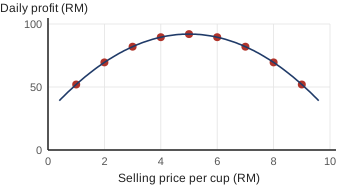
Diagram 1 shows the daily profit of a drinks stall at different selling prices. Which function is a suitable model for the data?
Show answerHide answer
D
The profit rises and then falls in the shape of a parabola, which is the pattern of a quadratic function. A linear graph is a straight line; an exponential graph keeps rising or falling at a sharp rate.
5
Question 5
The number of bacteria in a dish is 3, 6, 12, 24 and 48 at the end of hours 0, 1, 2, 3 and 4. Which model fits best?
Show answerHide answer
B
The number doubles every hour, so it is multiplied by the same factor 2 each time: y = 3(2)x. Linear growth would add the same amount each hour.
6
Question 6
A car uses 45 litres of petrol for 405 km. Assuming the petrol used varies directly with the distance, how many litres are needed for 270 km?
Show answerHide answer
C
y = kx, so k = 45 ÷ 405 = 19. For x = 270, y = 19 × 270 = 30 litres.
7
Question 7
Mariam saves RM5 000 at 6% per annum, compounded once a year. How much will she have after 2 years?
Show answerHide answer
A
A = 5 000(1.06)2 = 5 000 × 1.1236 = RM5 618.00. RM5 600 is the simple interest answer, which gives no interest on interest.
8
Question 8
RM10 000 is saved for 1 year at 6% per annum, compounded semi-annually. The amount at the end of the year is
Show answerHide answer
D
n = 2, rate per period = 3%, periods = 2: A = 10 000(1.03)2 = RM10 609.00. RM10 600 is compounding once a year.
9
Question 9
A shop 12 km farther away sells a pack of rice for RM16.50 instead of RM18.90. Rani buys 3 packs. Her car uses 1 litre per 15 km and petrol costs RM2.00 per litre. Using S = (P1 − P2)n and T = sm × H × 2, what is her net saving by driving to the farther shop?
Show answerHide answer
C
S = (18.90 − 16.50) × 3 = RM7.20. T = 1215 × 2.00 × 2 = RM3.20. Net saving = 7.20 − 3.20 = RM4.00. RM7.20 ignores the petrol; RM3.20 is the petrol only.
10
Question 10
In the petrol model y = 19x, the 405 km route is through towns and the 198 km route is on a highway. Why might the model be unsuitable?
Show answerHide answer
A
Direct variation assumes one constant rate. Town driving uses more petrol per km than highway driving, so the assumption fails when the solution is verified in the real situation.
11
Question 11
An amount is invested at 8% per annum compounded quarterly for t years. Which model gives the amount, A(t)?
Show answerHide answer
D
The rate per period is 8% ÷ 4 = 2% and there are 4t periods, so A(t) = P(1 + 0.02)4t.
12
Question 12
The model y = 5(3)x is written in the form y = Cax. What does C = 5 represent?
Show answerHide answer
B
When x = 0, y = 5(3)0 = 5. C is the initial value; a = 3 is the factor by which y is multiplied for each increase of 1 in x.
Section B: structured questions
32 marksAnswer all questions. Show your working clearly.
13
Question 13
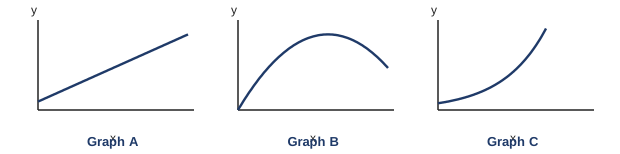
Diagram 2 shows three graphs, A, B and C, that are drawn for three sets of data.
[3 marks]
(a)State the type of function that models each graph: A, B and C.
Show answerHide answer
Tick each point you got.
[1 mark]
(b)The function for graph C is written as y = Cax. State what C represents.
Show answerHide answer
Tick each point you got.
14
Question 14
A canal has a width of 20 m. The depth, y m, is measured at distance x m from one bank: y = 0 at x = 0, y = 2.4 at x = 10 and y = 0 at x = 20. The data suggest a quadratic model y = ax2 + bx + c.
[1 mark]
(a)State the value of c. Give a reason.
Show answerHide answer
Tick each point you got.
[3 marks]
(b)Find the values of a and b.
Show answerHide answer
Tick each point you got.
[1 mark]
(c)Use your model to find the depth of the canal 5 m from the bank.
Show answerHide answer
Tick each point you got.
15
Question 15
Encik Hamid saves RM15 000 in an account with an interest rate of 5% per annum. The interest is compounded once a year.
[1 mark]
(a)Write a model for his savings, A(t), after t years.
Show answerHide answer
Tick each point you got.
[2 marks]
(b)Calculate his savings after 3 years.
Show answerHide answer
Tick each point you got.
[2 marks]
(c)How much more interest does he earn in 3 years than from simple interest at the same rate?
Show answerHide answer
Tick each point you got.
16
Question 16
Lina saves RM8 000 at 6% per annum, compounded quarterly, for 2 years.
[2 marks]
(a)State the interest rate per period and the number of periods.
Show answerHide answer
Tick each point you got.
[2 marks]
(b)Calculate the total savings at the end of 2 years.
Show answerHide answer
Tick each point you got.
17
Question 17
A market 9 km farther away sells chicken at RM11.80 per pack instead of RM13.50 at the nearby shop. Kamal buys 4 packs. His car travels 12 km per litre and petrol costs RM2.05 per litre. The model is S = (P1 − P2)n and T = sm × H × 2.
[1 mark]
(a)Calculate S, the saving on the chicken.
Show answerHide answer
Tick each point you got.
[2 marks]
(b)Calculate T, the extra petrol cost.
Show answerHide answer
Tick each point you got.
[1 mark]
(c)Is it worth driving to the market? Give a reason.
Show answerHide answer
Tick each point you got.
[2 marks]
(d)Find the greatest extra distance s for which the trip is still worth it.
Show answerHide answer
Tick each point you got.
18
Question 18
A hot sample at 200°C is left to cool. The temperature is 200°C at t = 0 s, 140°C at 40 s, 100°C at 80 s and 75°C at 120 s. The room temperature is 25°C.
[2 marks]
(a)Explain why a linear model is not suitable.
Show answerHide answer
Tick each point you got.
[2 marks]
(b)Which is a better model: quadratic or exponential? Explain.
Show answerHide answer
Tick each point you got.
19
Question 19
A runner trains 32 km per week. He plans to increase his weekly distance by 10% each week. Let D(x) km be the weekly distance after x weeks of increases.
[2 marks]
(a)Derive a mathematical model for D(x).
Show answerHide answer
Tick each point you got.
[1 mark]
(b)Calculate his weekly distance after 4 weeks of increases. Give your answer to 2 decimal places.
Show answerHide answer
Tick each point you got.
[1 mark]
(c)State one weakness of this model.
Show answerHide answer
Tick each point you got.