Force and Motion II
What this chapter covers
- Determine the resultant of forces acting on a point, in a line, at right angles or at an angle (1.1)
- Draw free body diagrams and use F = ma for objects that are stationary, at constant velocity or accelerating (1.1)
- Resolve a force into horizontal and vertical components, and on an inclined plane (1.2)
- Explain forces in equilibrium and use the triangle of forces to find unknown forces (1.3)
- State Hooke's law, find the spring constant and elastic potential energy from a graph (1.4)
- Solve problems on springs in series and in parallel (1.4)
1.1Resultant force
| Situation | How to find the resultant, F | Example |
|---|---|---|
| Same direction | Add the magnitudes. Direction is the same as the forces. | 6 N and 8 N to the right: F = 14 N to the right |
| Opposite directions | Subtract. Direction is that of the larger force. | 8 N left and 6 N right: F = 2 N to the left |
| Perpendicular | Pythagoras: F = √(F₁² + F₂²). Angle: tan θ = F₂ ÷ F₁. | 8 N and 6 N: F = 10 N, θ = 36.9° |
| At any other angle | Scaled drawing: triangle of forces or parallelogram of forces. Measure F and θ. | Choose a scale, e.g. 1 cm = 10 N |
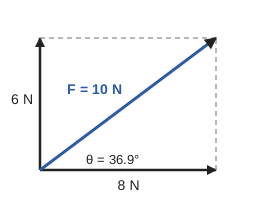
Methods: textbook Activity 1.2 and Table 1.2, pp. 4–6.
Resultant force and motion
A free body diagram shows only the forces acting on the object. Newton's second law, F = ma, links the resultant force to acceleration.
| State of motion | Acceleration | Resultant force | Forces |
|---|---|---|---|
| Stationary | a = 0 | F = 0 | Balanced (weight = normal reaction) |
| Constant velocity | a = 0 | F = 0 | Engine thrust = friction |
| Accelerating | a ≠ 0 | F ≠ 0, in the direction of acceleration | Thrust > friction |
Stationary or constant velocity: R = W = 588.6 N.
Accelerating upwards at 1.2 m s⁻²: R − W = ma, so R = 588.6 + 60 × 1.2 = 660.6 N.
Accelerating downwards at 1.2 m s⁻²: W − R = ma, so R = 588.6 − 72 = 516.6 N.
Show answerHide answer
1.2Resolution of forces
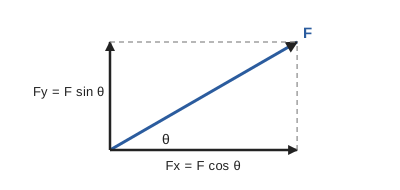
Tx = 36 cos 30° = 31.18 N (right). Ty = 36 sin 30° = 18.00 N (up).
Vertical: 18 + 5.5 − 23.5 = 0, so no vertical motion.
Horizontal resultant: 31.18 − 20 = 11.18 N. a = 11.18 ÷ 2.4 = 4.66 m s⁻².
Inclined plane
On a slope of angle θ, resolve the weight W into a component parallel to the plane, W sin θ, and a component perpendicular to the plane, W cos θ. The angle between the weight and the perpendicular to the plane equals the angle of the slope.
| Component of the weight | Formula | Role |
|---|---|---|
| Parallel to the plane | W sin θ | Pulls the object down the slope |
| Perpendicular to the plane | W cos θ | Balanced by the normal reaction, R = W cos θ |
Show answerHide answer
Worked examples follow textbook pp. 15–17.
1.3Forces in equilibrium
When three forces are in equilibrium and are drawn head to tail, they form a closed triangle of forces. A lamp hung from two strings has weight W = 4 N and tensions P = 3 N (horizontal) and T = 5 N.
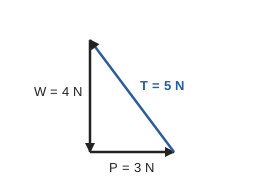
Two ways to solve problems
- Resolve and balance: horizontal forces sum to zero and vertical forces sum to zero. This is more accurate.
- Scaled triangle of forces: choose a scale, draw the known forces head to tail, close the triangle and measure. Alternatively use the sine rule or cosine rule.
Show answerHide answer
1.4Elasticity
The extension of a spring is x = l − l₀, the increase in length. A spring is permanently stretched if it passes its elastic limit.
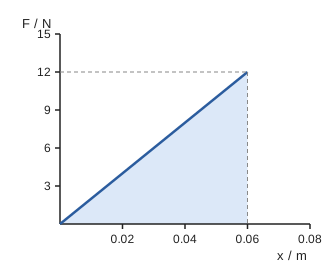
Elastic potential energy
The work done to stretch a spring is stored as elastic potential energy. It equals the area under the F–x graph:
What changes the spring constant
| Factor | Change | Effect on k |
|---|---|---|
| Length of spring | Shorter | Higher (stiffer) |
| Diameter of spring | Smaller | Higher |
| Thickness of wire | Thicker | Higher |
| Material | Different material | Depends on the material |
Springs in series and in parallel
For identical springs, each with a force F on the system and extension x for a single spring:
| Arrangement | Tension in each spring | Total extension |
|---|---|---|
| Series (end to end) | F (the full force on each) | 2x for two springs: it stretches more, so it is softer |
| Parallel (side by side) | F ÷ 2 (shared equally) | x ÷ 2 for two springs: it stretches less, so it is stiffer |