Physics questions, chapter 1
Nama / NameKelas / ClassTarikh / Date
Force and Motion II
42 marks. Use Practice to check each answer as you go, or Exam to answer everything against the clock first. Take g = 9.81 m s⁻².
Section A: objective questions
10 marksChoose the best answer for each question.
1
Question 1
What is the resultant force on an object?
Show answerHide answer
B
The resultant force is the single force equal to the vector sum of all forces on the object (textbook p. 3).
2
Question 2
A force of 9 N to the right and a force of 5 N to the left act on the same point. What is the resultant force?
Show answerHide answer
A
The forces are in opposite directions, so subtract: 9 − 5 = 4 N, in the direction of the larger force (right).
3
Question 3
Two forces of 12 N and 5 N act on an object at right angles to each other. What is the magnitude of the resultant force?
Show answerHide answer
D
F = √(12² + 5²) = √169 = 13 N.
4
Question 4
A car moves along a straight road with a constant velocity of 20 m s⁻¹. Which statement about the forces on the car is correct?
Show answerHide answer
C
Constant velocity means a = 0, so the resultant force is zero. The engine thrust balances the friction and air resistance.
5
Question 5
A passenger of mass 50 kg is in a lift that accelerates upwards at 2.0 m s⁻². What is the normal reaction on the passenger from the floor of the lift?
Show answerHide answer
C
R − W = ma, so R = mg + ma = 50 × 9.81 + 50 × 2.0 = 490.5 + 100 = 590.5 N.
6
Question 6
A force of 50 N acts at 30° above the horizontal. What is the horizontal component of the force?
Show answerHide answer
B
Fx = F cos θ = 50 cos 30° = 43.3 N. (25.0 N is the vertical component, 50 sin 30°.)
7
Question 7
A block of weight 20 N rests on a smooth slope inclined at 30° to the horizontal. What is the component of the weight parallel to the slope?
Show answerHide answer
A
Parallel component = W sin θ = 20 sin 30° = 10 N. The perpendicular component is 20 cos 30° = 17.3 N.
8
Question 8
Which statement describes an object in equilibrium of forces?
Show answerHide answer
D
In equilibrium the resultant force is zero, so a = 0. The object may be stationary or moving with constant velocity.
9
Question 9
A spring extends by 4.0 cm when a force of 10 N is applied. Assuming the elastic limit is not exceeded, what is the extension when a force of 25 N is applied?
Show answerHide answer
B
Extension is directly proportional to force: 4.0 × (25 ÷ 10) = 10.0 cm.
10
Question 10
A spring has a spring constant of 200 N m⁻¹. What is the elastic potential energy stored when it is stretched by 0.10 m?
Show answerHide answer
C
Ep = ½kx² = ½ × 200 × 0.10² = 1.0 J.
Section B: structured questions
32 marksAnswer all questions. Show your working.
11
Question 11
A passenger of mass 60 kg stands in a lift.
[2 marks]
(a)Calculate the normal reaction on the passenger when the lift moves upwards with a constant velocity of 8.0 m s⁻¹.
Show answerHide answer
Tick each point you got.
[3 marks]
(b)The lift then moves downwards with an acceleration of 1.5 m s⁻². Calculate the normal reaction on the passenger.
Show answerHide answer
Tick each point you got.
12
Question 12
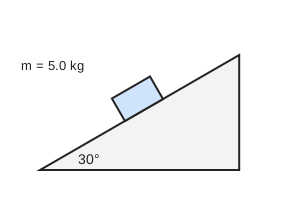
Diagram 1 shows a block of mass 5.0 kg sliding down a smooth slope inclined at 30° to the horizontal.
[1 mark]
(a)Calculate the weight of the block.
Show answerHide answer
Tick each point you got.
[2 marks]
(b)Calculate the component of the weight parallel to the slope.
Show answerHide answer
Tick each point you got.
[2 marks]
(c)Calculate the acceleration of the block down the slope.
Show answerHide answer
On a smooth slope a = g sin θ, independent of mass.
Tick each point you got.
13
Question 13
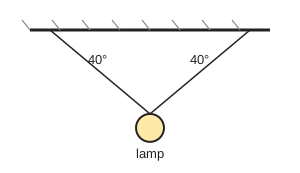
Diagram 2 shows a lamp of weight W hanging at rest from two identical strings. Each string has tension T and makes an angle of 40° with the horizontal. The weight of the lamp is 10 N.
[1 mark]
(a)State the resultant force on the lamp.
Show answerHide answer
Tick each point you got.
[3 marks]
(b)Calculate the tension T in each string.
Show answerHide answer
Tick each point you got.
[1 mark]
(c)What happens to T if the strings are pulled so that they become closer to the horizontal? Give a reason.
Show answerHide answer
Tick each point you got.
14
Question 14
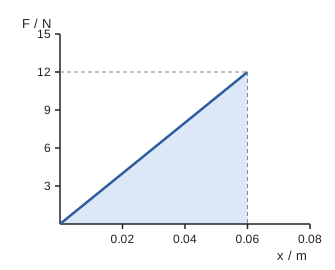
Diagram 3 shows the graph of force F against extension x for a spring.
[2 marks]
(a)Does the spring obey Hooke's law? Give a reason.
Show answerHide answer
Tick each point you got.
[2 marks]
(b)Calculate the spring constant.
Show answerHide answer
Tick each point you got.
[2 marks]
(c)Calculate the elastic potential energy stored when the extension is 0.06 m.
Show answerHide answer
Tick each point you got.
15
Question 15
A spring with a spring constant of 4 N cm⁻¹ is used to build two arrangements from identical springs. Each arrangement carries a load of 8 N.
[2 marks]
(a)Two springs are arranged in series. Calculate the total extension.
Show answerHide answer
Tick each point you got.
[2 marks]
(b)Two springs are arranged in parallel. Calculate the total extension.
Show answerHide answer
Tick each point you got.
[1 mark]
(c)Which arrangement is stiffer?
Show answerHide answer
Parallel
The same load gives a smaller extension (1 cm compared with 4 cm).
16
Question 16
Two forces of 17 N and 13 N act on a point. Aini says that the resultant force cannot be smaller than 4 N or larger than 30 N.
[2 marks]
(a)Justify Aini's statement.
Show answerHide answer
Tick each point you got.
[1 mark]
(b)Is a resultant of 22 N possible? Explain.
Show answerHide answer
Tick each point you got.
17
Question 17
A workshop platform must support a load of 2 400 N and the springs may compress by at most 3.0 cm. Spring X has k = 400 N cm⁻¹. Suggest a design using spring X.
[1 mark]
(a)Calculate the minimum total spring constant needed.
Show answerHide answer
Tick each point you got.
[2 marks]
(b)State the number of springs and how they should be arranged. Justify your design.
Show answerHide answer
Tick each point you got.