Physics questions, chapter 2
Nama / NameKelas / ClassTarikh / Date
Pressure
45 marks. Use Practice to check each answer as you go, or Exam to answer everything against the clock first. Take g = 9.81 m s⁻² unless told otherwise.
Section A: objective questions
14 marksChoose the best answer for each question.
1
Question 1
Which three factors affect the pressure in a liquid?
Show answerHide answer
B
Liquid pressure P = hρg depends on the depth, the density of the liquid and g. Mass, volume, surface area and container shape have no effect.
2
Question 2
A wide tank and a narrow tube are both filled with water to a depth of 0.5 m. Compare the pressure at their bases.
Show answerHide answer
D
P = hρg. The cross-sectional area and shape do not affect liquid pressure (Activity 2.2).
3
Question 3
What is the pressure due to the water at a depth of 2.5 m in a pool? [Density of water = 1 000 kg m⁻³]
Show answerHide answer
B
P = hρg = 2.5 × 1 000 × 9.81 = 24 525 Pa ≈ 24.5 kPa.
4
Question 4
In a U-tube, a column of oil 15.0 cm high balances a column of water 12.0 cm high (both measured from the same boundary level). What is the density of the oil? [Density of water = 1 000 kg m⁻³]
Show answerHide answer
A
h₁ρ₁ = h₂ρ₂ gives 15.0 × ρ = 12.0 × 1 000, so ρ = 800 kg m⁻³.
5
Question 5
Why is the wall of a dam built thicker at the base?
Show answerHide answer
C
Pressure increases with depth (P = hρg), so the lower part of the wall must withstand a greater force.
6
Question 6
A student blows across the top surface of a piece of paper held at her lips and the paper rises. Why does this happen?
Show answerHide answer
C
By Bernoulli's principle, fast air has lower pressure. The higher pressure below pushes the paper up.
7
Question 7
A mercury barometer is carried from sea level to the top of a mountain. What happens to the height of the mercury column?
Show answerHide answer
A
Air is thinner at high altitude, so the atmospheric pressure supporting the column is lower and the column is shorter.
8
Question 8
A pressure of 0.50 m Hg equals how many pascals? [Density of mercury = 13 600 kg m⁻³]
Show answerHide answer
D
P = hρg = 0.50 × 13 600 × 9.81 = 66 708 Pa ≈ 6.67 × 10⁴ Pa.
9
Question 9
A water manometer has one arm connected to a gas supply and the other arm open to the air. The water level in the arm connected to the gas is 0.20 m lower than in the open arm. Atmospheric pressure is 10.3 m H₂O. What is the gas pressure?
Show answerHide answer
C
The gas pushes its own level down, so the gas pressure is greater than atmospheric pressure: 10.3 + 0.20 = 10.5 m H₂O.
10
Question 10
In a hydraulic system, a force of 20 N acts on an input piston of area 2.0 cm². What force acts on an output piston of area 40 cm²?
Show answerHide answer
B
F₂ = (A₂ ÷ A₁) × F₁ = (40 ÷ 2.0) × 20 = 400 N.
11
Question 11
Which property must a hydraulic fluid have?
Show answerHide answer
D
An incompressible fluid transmits the pressure fully. A compressible fluid (or one with air bubbles) wastes the movement of the input piston.
12
Question 12
A solid object of volume 2.0 × 10⁻³ m³ is fully immersed in water. What is the buoyant force on it? [Density of water = 1 000 kg m⁻³]
Show answerHide answer
C
F_B = ρVg = 1 000 × 2.0 × 10⁻³ × 9.81 = 19.6 N.
13
Question 13
A loaded ship sails from the sea into a river where the water is less dense. What happens to the ship?
Show answerHide answer
A
The ship floats, so F_B = W, which does not change. With a smaller ρ, the displaced volume V must be larger (ρVg = W), so the ship sits lower.
14
Question 14
Diagram 1 shows liquid X and water drawn up into two tubes from beakers, after some air is sucked out of the top. Which statement is correct?
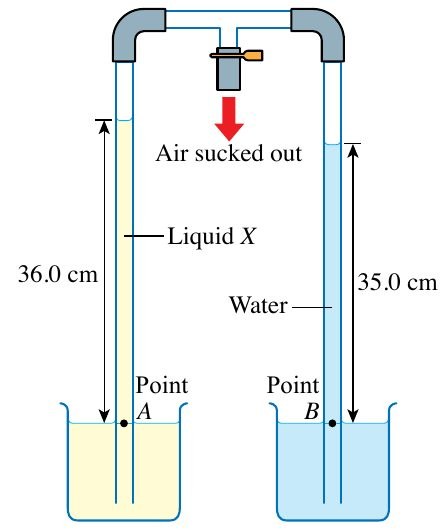
Show answerHide answer
B
The air pressure above both columns is the same and atmospheric pressure pushes both up, so h_X ρ_X = h_w ρ_w. X is higher (36.0 cm against 35.0 cm), so ρ_X is smaller: ρ_X = 35.0 × 1 000 ÷ 36.0 = 972 kg m⁻³.
Section B: structured questions
31 marksAnswer all questions. Show your working.
15
Question 15
A diver dives to a depth of 35 m in the sea. The density of sea water is 1 060 kg m⁻³ and the atmospheric pressure is 100 kPa.
[2 marks]
(a)Calculate the pressure on the diver due to the sea water.
Show answerHide answer
Tick each point you got.
[1 mark]
(b)Calculate the actual pressure acting on the diver.
Show answerHide answer
Tick each point you got.
[2 marks]
(c)A diver must rise to the surface slowly. Explain why.
Show answerHide answer
Tick each point you got.
16
Question 16
Diagram 2 shows a mercury manometer connected to a flask of compressed gas. The atmospheric pressure is 76 cm Hg and the density of mercury is 13 600 kg m⁻³.
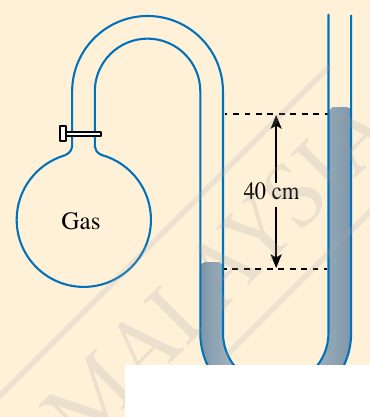
[1 mark]
(a)What is the gas pressure in cm Hg?
Show answerHide answer
Tick each point you got.
[2 marks]
(b)Convert the gas pressure to pascals.
Show answerHide answer
Tick each point you got.
[2 marks]
(c)Why is mercury, and not water, used for measuring this pressure?
Show answerHide answer
Tick each point you got.
17
Question 17
Diagram 4 shows a hydraulic system. The input piston has an area of 4.0 cm² and the output piston has an area of 100 cm². A force of 30 N acts on the input piston.
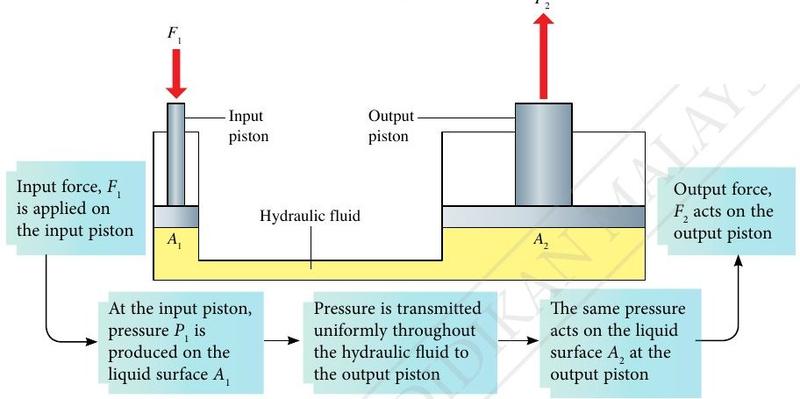
[1 mark]
(a)State the principle applied in this system.
Show answerHide answer
Tick each point you got.
[1 mark]
(b)Calculate the multiplying factor.
Show answerHide answer
Tick each point you got.
[1 mark]
(c)Calculate the output force.
Show answerHide answer
Tick each point you got.
[2 marks]
(d)Calculate the pressure transmitted through the fluid, in pascals.
Show answerHide answer
Tick each point you got.
18
Question 18
A wooden block of mass 0.60 kg and volume 8.0 × 10⁻⁴ m³ is held fully under water and then released. The density of water is 1 000 kg m⁻³.
[2 marks]
(a)Calculate the buoyant force on the block when it is fully immersed.
Show answerHide answer
Tick each point you got.
[1 mark]
(b)Calculate the weight of the block.
Show answerHide answer
Tick each point you got.
[2 marks]
(c)Describe the motion of the block immediately after it is released. Give a reason.
Show answerHide answer
Tick each point you got.
[2 marks]
(d)The block comes to rest floating on the surface. Calculate the volume of the block that is below the water.
Show answerHide answer
Tick each point you got.
19
Question 19
An aeroplane is taking off. The air flows over its aerofoil-shaped wings.
[1 mark]
(a)Compare the speed of the air flowing above and below the wing.
Show answerHide answer
Tick each point you got.
[2 marks]
(b)Compare the air pressure above and below the wing and state the direction of the resultant force.
Show answerHide answer
Tick each point you got.
[1 mark]
(c)State the principle that explains your answers in (b).
Show answerHide answer
Tick each point you got.
[2 marks]
(d)In a Venturi tube, which section of the tube has the lowest pressure? Explain.
Show answerHide answer
Tick each point you got.
20
Question 20
A driver finds that the hydraulic brake pedal of a car feels soft and has to be pushed much harder and further to stop the car. A mechanic finds air bubbles in the brake fluid.
[1 mark]
(a)Explain why the air bubbles make the brakes less effective.
Show answerHide answer
Tick each point you got.
[2 marks]
(b)Suggest two changes to the design of the braking system so that the car can be stopped with a greater braking force.
Show answerHide answer
Any 2 points
Tick each point you got.