Pressure
What this chapter covers
- Explain liquid pressure and the factors that affect it; use P = hρg and compare densities with a U-tube (2.1)
- Explain atmospheric pressure, how a barometer measures it, and its effects at high altitude and at depth (2.2)
- Use a manometer to find gas pressure and convert between Pa, mm Hg, m H₂O and mbar (2.3)
- State Pascal's principle and solve problems on hydraulic systems as force multipliers (2.4)
- State Archimedes' principle, relate buoyant force to floating and sinking, and solve buoyancy problems (2.5)
- State Bernoulli's principle and explain lift force, aerofoils and their applications (2.6)
2.1Pressure in liquids
The pressure at the base of a liquid column comes from the weight of the liquid above it. Using weight = ρVg and V = Ah, the pressure at depth h is:
h = depth (m), ρ = density of the liquid (kg m⁻³), g = 9.81 m s⁻².
What affects liquid pressure
| Factor | Effect |
|---|---|
| Depth, h | Deeper means higher pressure (a dam wall is thicker at the base) |
| Density, ρ | A denser liquid gives a higher pressure at the same depth |
| Gravitational acceleration, g | Larger g gives a higher pressure |
| Mass, volume, shape or cross-section of the container | No effect |
Comparing densities with a U-tube
Two liquids that do not mix balance in a U-tube. Points A and B at the same level have equal pressure, so h₁ρ₁g = h₂ρ₂g, which gives h₁ρ₁ = h₂ρ₂. Measure both heights from the level of the boundary between the liquids.
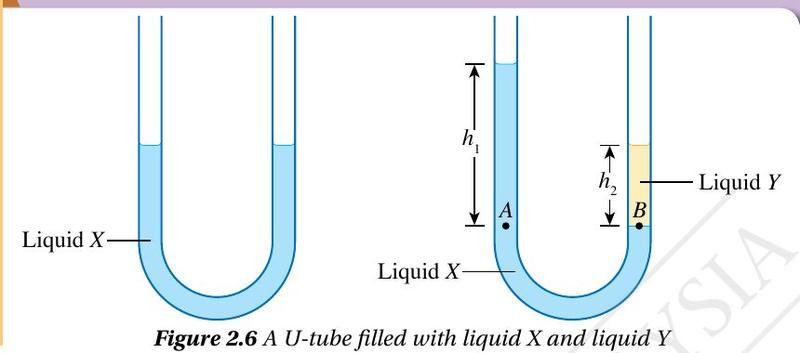
Figure: Physics Form 5 (DLP) textbook, Figure 2.6, p. 45.
Actual pressure
The surface of a liquid is also pushed by the air, so the actual pressure at depth h is P = hρg + Patm.
Water pressure = 1.5 × 1 050 × 9.81 = 15 451 Pa ≈ 15.5 kPa. Actual pressure = 15.5 + 100 = 115.5 kPa.
Applications
- Water tank placed high in a house: the large height difference gives high pressure at the tap.
- Intravenous drip bag hung above the patient: pressure from the liquid column pushes liquid into the vein.
- Dam: thicker wall at the base, and the penstock to the turbines is low so the water is fast.
- Siphon: transfers liquid from a higher container to a lower one; atmospheric pressure pushes liquid up into the tube.
Show answerHide answer
2.2Atmospheric pressure
It is like water pressure on a diver, except the weight is that of the column of air. It is about 100 kPa at sea level and is lower at high altitude because the air is thinner.
Barometers
In a mercury barometer a tube of mercury is inverted in a bowl of mercury. The column falls until its height is about 760 mm and the space above is a vacuum. The atmospheric pressure on the bowl surface supports the column, so Patm = 760 mm Hg = 0.76 × 13 600 × 9.81 ≈ 1.01 × 10⁵ Pa.
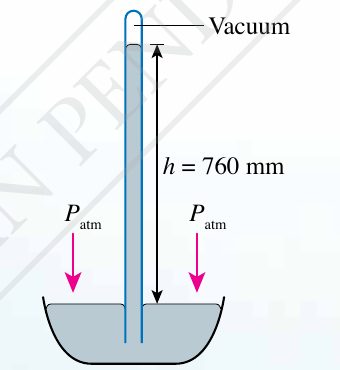
Figure: Physics Form 5 (DLP) textbook, Figure 2.11, p. 50.
| Fortin barometer | Aneroid barometer | |
|---|---|---|
| Works by | Height of mercury column | Changes in the shape of a partial-vacuum metal box |
| Size | Large, not portable | Small, portable |
| Accuracy | Higher (±0.1 mm Hg) | Lower (±1 mm Hg) |
| Reading | Slower | Quick, direct reading |
Units of pressure
| Unit | Use | Conversion |
|---|---|---|
| pascal (Pa) | S.I. unit; use in formulae | 1 Pa = 1 N m⁻² |
| mm Hg | Medicine, meteorology, aviation | P = hρg with ρ = 13 600 kg m⁻³ |
| m H₂O | Water in the sea, reservoirs and dams | P = hρg with ρ = 1 000 kg m⁻³ |
| millibar (mbar) | Weather forecasts | 1 mbar = 1 hPa = 100 Pa |
At high altitude and at depth
| High altitude | Extreme depth in the sea | |
|---|---|---|
| Pressure | Lower (thin air, less oxygen) | Increases by about 1 atmosphere every 10 m |
| Effects on people | Faster breathing, less oxygen absorbed, dehydration, unclear thinking | Nitrogen dissolves in blood; bubbles form if pressure drops too fast |
| What is done | Climb slowly, drink water; aircraft cabins are pressurised | Ascend slowly; submarines have strong round hulls and controlled cabin pressure |
Show answerHide answer
2.3Gas pressure
A manometer is a U-tube of liquid that measures gas pressure. The gas pressure is compared with atmospheric pressure at the same level in the liquid:
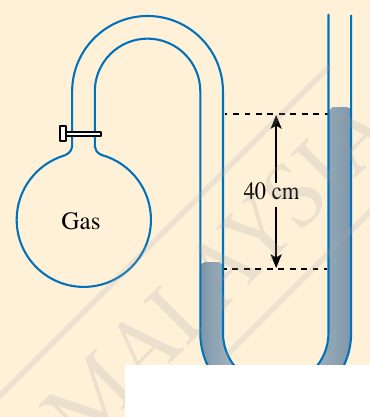
Figure: Physics Form 5 (DLP) textbook, Figure 2.19, p. 58.
Mercury is used for higher gas pressures because it is dense, so the column is short. It is toxic, so digital manometers with pressure transducers are now more common.
Show answerHide answer
2.4Pascal's principle
In a hydraulic system the same pressure acts on both pistons: F₁ ÷ A₁ = F₂ ÷ A₂, so F₂ = (A₂ ÷ A₁) × F₁. The ratio A₂ ÷ A₁ is the multiplying factor. A large output piston gives a large output force.
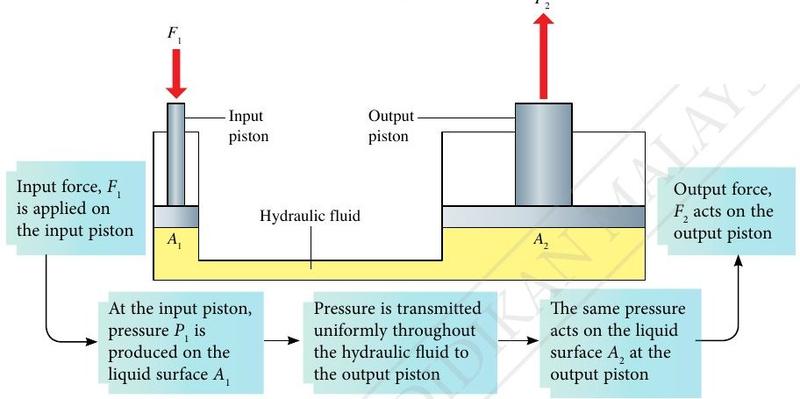
Figure: Physics Form 5 (DLP) textbook, Figure 2.23, p. 62.
- Hydraulic brake: force on the pedal pushes fluid from the master cylinder to the slave cylinders, which press the brake pads.
- Hydraulic jack: small pumping force on the small piston lifts a heavy load on the large piston; valves let the fluid move one way only.
- Hydraulic fluid must be incompressible, with a high boiling point and a low freezing point, and should not corrode (water does not suit).
Show answerHide answer
2.5Archimedes' principle
Buoyant force arises because pressure at the bottom of an object is greater than pressure at the top. It also equals the apparent loss in weight: FB = weight in air − weight in liquid. Here ρ is the density of the fluid and V is the volume of fluid displaced (the immersed volume).
Floating and sinking
| Condition | Resultant force | What happens |
|---|---|---|
| W = FB | Zero (balanced) | Stationary: floating or suspended |
| W > FB | Downwards | Sinks with acceleration |
| W < FB | Upwards | Rises with acceleration to the surface |
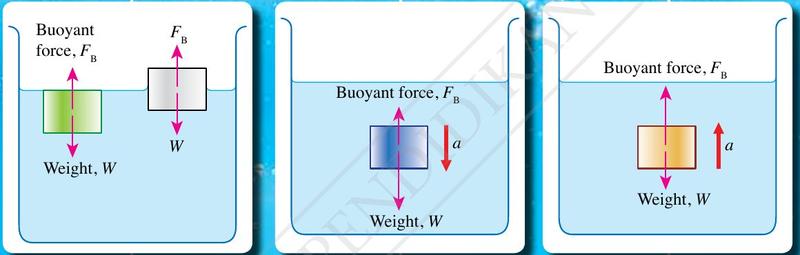
Figure: Physics Form 5 (DLP) textbook, Figure 2.31, p. 70.
A floating object displaces fluid with the same weight as the object.
Applications
- Ship: hollow shape displaces a lot of water; the Plimsoll line shows the safe load for the water density.
- Hydrometer: floats lower in a less dense liquid; reads density directly, with the smaller values at the top of the scale.
- Submarine: ballast tanks filled with water sink it and emptied with compressed air let it rise.
- Hot air balloon: heating the air makes the balloon's weight less than the buoyant force, so it rises; letting hot air out makes it descend.
Show answerHide answer
2.6Bernoulli's principle
Fast-moving air has low pressure, so the higher pressure of the still air around pushes things towards the fast stream. Blowing across the top of a paper lifts it; blowing between two hanging balloons makes them move together.
In a Venturi tube the water moves fastest in the narrow section, so the pressure there is lowest and the water column in the tube above it is the shortest.
Lift force and the aerofoil
An aeroplane wing (aerofoil) is shaped so air flows faster over the top surface. The top has low pressure and the bottom has higher pressure, so there is a resultant lift force upwards. The tilt of the wing, the angle of attack, deflects air downwards, and by Newton's third law the reaction adds to the lift.
| Application | How Bernoulli's principle is used |
|---|---|
| Bunsen burner | Fast gas at the narrow jet has low pressure and draws air in through the air hole |
| Racing car spoiler | Inverted aerofoil: air is faster below, so a downforce presses the tyres to the road |
| Curving football | Spin makes air faster on one side, so pressure differs and the ball curves |
| Aeroplane wing | Aerofoil shape and angle of attack produce lift |