Physics questions, chapter 3
Nama / NameKelas / ClassTarikh / Date
Electricity
45 marks. Use Practice to check each answer as you go, or Exam to answer everything against the clock first.
Section A: objective questions
11 marksChoose the best answer for each question.
1
Question 1
What is an electric field?
Show answerHide answer
B
An electric field is the region around a charged particle where any electric charge experiences an electric force (textbook p. 94). The other options describe a conductor, e.m.f. and current.
2
Question 2
Which is the S.I. unit of electric field strength?
Show answerHide answer
A
E = F / q, so the unit is newton per coulomb (N C⁻¹), which equals V m⁻¹. J C⁻¹ is the volt and C s⁻¹ is the ampere.
3
Question 3
A candle flame is placed between two charged metal plates. The flame spreads out more towards the negative plate than towards the positive plate. What is the reason?
Show answerHide answer
C
The hot flame ionises the air. Positive ions go to the negative plate and are larger and heavier than the negative ions, so the flame spreads more in that direction.
4
Question 4
A potential difference of 500 V is applied across two parallel metal plates that are 2.0 cm apart. What is the electric field strength between the plates?
Show answerHide answer
D
E = V / d = 500 ÷ 0.020 = 25 000 V m⁻¹. The distance must be in metres (2.0 cm = 0.020 m).
5
Question 5
The graph of potential difference against current for a filament bulb is a curve. Why does the filament not obey Ohm's law?
Show answerHide answer
D
Ohm's law holds only at constant temperature. As the current increases the filament becomes hotter and its resistance increases, so the graph of V against I curves.
6
Question 6
A 6.0 Ω resistor and a 3.0 Ω resistor are connected in parallel. This pair is then connected in series with a 4.0 Ω resistor. What is the effective resistance of the circuit?
Show answerHide answer
B
Parallel: 1/R = 1/6 + 1/3 = 1/2, so R = 2.0 Ω. In series with 4.0 Ω: 2.0 + 4.0 = 6.0 Ω.
7
Question 7
A wire has resistance R. A second wire is made of the same material, but it is twice as long and has half the diameter. What is the resistance of the second wire?
Show answerHide answer
D
R = ρl / A. Doubling the length doubles R. Halving the diameter makes the area A one quarter, which multiplies R by 4. So R becomes 2 × 4 = 8R.
8
Question 8
Which property is needed for the material of a heating element?
Show answerHide answer
A
A heating element must produce a lot of heat (high resistivity) and must not melt when it is hot (high melting point), for example nichrome.
9
Question 9
A voltmeter is connected across a dry cell. Which statement is correct?
Show answerHide answer
B
With the switch open no current flows, so there is no voltage drop across the internal resistance and the voltmeter reads the e.m.f. When the switch is closed the reading falls to the terminal potential difference.
10
Question 10
A cell of e.m.f. 3.0 V and internal resistance 1.2 Ω is connected to a 4.8 Ω resistor. What is the potential difference across the resistor?
Show answerHide answer
C
I = ε / (R + r) = 3.0 ÷ (4.8 + 1.2) = 0.50 A. V = IR = 0.50 × 4.8 = 2.4 V.
11
Question 11
An electric heater of power 2 kW is switched on for 3 hours. The cost of electricity is 30 sen per unit. What is the cost?
Show answerHide answer
A
Energy = 2 kW × 3 h = 6 kWh = 6 units. Cost = 6 × RM0.30 = RM1.80.
Section B: structured questions
34 marksAnswer all questions. Write your answers in the spaces provided.
12
Question 12
A bulb labelled 12 V, 0.50 A is switched on for 10 minutes.
[1 mark]
(a)Calculate the charge that flows through the bulb.
Show answerHide answer
Tick each point you got.
[1 mark]
(b)Calculate the electrical energy transferred in the bulb.
Show answerHide answer
Tick each point you got.
[1 mark]
(c)State what is meant by potential difference.
Show answerHide answer
Tick each point you got.
13
Question 13
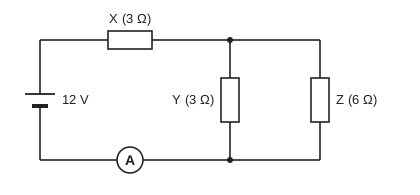
Diagram 1 shows three bulbs X, Y and Z connected to a 12 V supply.
[2 marks]
(a)Calculate the effective resistance of the circuit.
Show answerHide answer
Tick each point you got.
[1 mark]
(b)What is the reading of the ammeter?
Show answerHide answer
Tick each point you got.
[1 mark]
(c)Calculate the potential difference across bulb X.
Show answerHide answer
Tick each point you got.
[1 mark]
(d)Which is brighter, bulb Y or bulb Z? Give a reason.
Show answerHide answer
Tick each point you got.
14
Question 14
A nichrome wire has resistivity 1.1 × 10⁻⁶ Ω m, length 2.0 m and diameter 0.40 mm.
[2 marks]
(a)Calculate the cross-sectional area of the wire.
Show answerHide answer
Tick each point you got.
[2 marks]
(b)Calculate the resistance of the wire.
Show answerHide answer
Tick each point you got.
15
Question 15
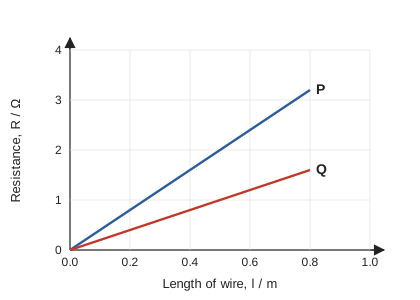
Diagram 2 shows graphs of resistance R against length l for two wires P and Q. Both wires have the same diameter and the same temperature.
[1 mark]
(a)Calculate the gradient of the graph for wire P.
Show answerHide answer
Tick each point you got.
[2 marks]
(b)Which wire has the greater resistivity? Give a reason.
Show answerHide answer
Tick each point you got.
[1 mark]
(c)State the relationship between the gradient of the graph and the resistivity of the wire.
Show answerHide answer
Tick each point you got.
16
Question 16
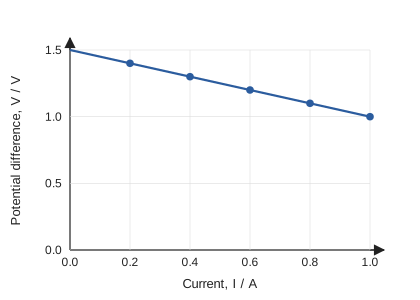
A student uses a rheostat to obtain a graph of potential difference V against current I for a dry cell, as shown in Diagram 3.
[2 marks]
(a)State the e.m.f. of the dry cell. Explain how you obtain it from the graph.
Show answerHide answer
Tick each point you got.
[2 marks]
(b)Calculate the internal resistance of the dry cell.
Show answerHide answer
Tick each point you got.
[1 mark]
(c)Explain why V decreases when I increases.
Show answerHide answer
Tick each point you got.
17
Question 17
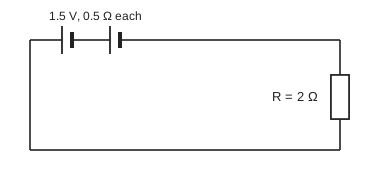
Diagram 4 shows two dry cells connected in series and in parallel to a 2.0 Ω resistor. Each cell has e.m.f. 1.5 V and internal resistance 0.50 Ω.
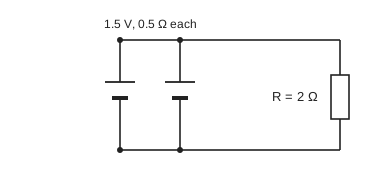
[2 marks]
(a)Calculate the current in the series arrangement.
Show answerHide answer
Tick each point you got.
[2 marks]
(b)Calculate the current in the parallel arrangement.
Show answerHide answer
Tick each point you got.
[1 mark]
(c)Which arrangement is better for a torch bulb that needs a large current? Give a reason.
Show answerHide answer
Tick each point you got.
18
Question 18
An electric kettle is labelled 240 V, 2000 W.
[1 mark]
(a)Calculate the current when the kettle works normally.
Show answerHide answer
Tick each point you got.
[2 marks]
(b)Calculate the resistance of the heating element.
Show answerHide answer
Tick each point you got.
[2 marks]
(c)Calculate the cost of using the kettle for 15 minutes if 1 unit costs 21.8 sen.
Show answerHide answer
Tick each point you got.
19
Question 19
A company wants to design a portable electric kettle that boils water quickly and safely from a 240 V supply.
[3 marks]
(a)Suggest three features of the heating element and explain each.
Show answerHide answer
Any 3 points
Tick each point you got.