Physics questions, chapter 4
Nama / NameKelas / ClassTarikh / Date
Electromagnetism
45 marks. Use Practice to check each answer as you go, or Exam to answer everything against the clock first.
Section A: objective questions
11 marksChoose the best answer for each question.
1
Question 1
What produces the force on a current-carrying conductor in a magnetic field?
Show answerHide answer
B
The two magnetic fields combine into a catapult field, which exerts the force (p. 137).
2
Question 2
A straight wire lies between the N pole (on the left) and the S pole (on the right) of a magnet. The current flows into the plane of the paper. What is the direction of the force on the wire?
Show answerHide answer
C
Field to the right (N to S), current into the page. Fleming's left-hand rule gives the force downwards. (With current out of the page the force is upwards, as in Figure 4.3.)
3
Question 3
Which change will NOT increase the magnitude of the force on a current-carrying conductor in a magnetic field?
Show answerHide answer
A
Reversing the current only reverses the direction of the force. The force grows with a larger current and a stronger field.
4
Question 4
What is the function of the commutator in a direct current motor?
Show answerHide answer
C
The split ring commutator reverses the current in the coil every half rotation, so the coil keeps rotating in the same direction.
5
Question 5
Which is an advantage of a brushless motor compared with a brushed motor?
Show answerHide answer
A
A brushless motor has no carbon brushes or commutator, so there is no wear and no sparking, and it is quieter (Table 4.2).
6
Question 6
What is electromagnetic induction?
Show answerHide answer
D
Electromagnetic induction is the production of an induced e.m.f. in a conductor when there is relative motion between the conductor and a magnetic field, or the conductor is in a changing field.
7
Question 7
A bar magnet and a solenoid are connected to a galvanometer. In which situation does the galvanometer show NO deflection?
Show answerHide answer
C
There must be relative motion. When both are stationary no magnetic flux is cut, so no e.m.f. is induced.
8
Question 8
The north pole of a bar magnet is pushed towards one end of a solenoid. What is the polarity induced at that end of the solenoid?
Show answerHide answer
A
By Lenz's law the induced current opposes the motion, so the end becomes a north pole and repels the approaching north pole.
9
Question 9
Which part makes an a.c. generator give alternating current in the external circuit?
Show answerHide answer
D
The ends of the coil connect to two slip rings, so the external current alternates. A d.c. generator uses a split-ring commutator.
10
Question 10
A transformer has 200 turns in the primary coil and 1 000 turns in the secondary coil. The primary voltage is 12 V. What is the secondary voltage?
Show answerHide answer
C
VS = 12 × 1000 / 200 = 60 V (a step-up transformer).
11
Question 11
Why is electrical energy transmitted at a very high voltage?
Show answerHide answer
B
For the same power, a higher voltage gives a smaller current, so I²R heating loss in the cables is reduced.
Section B: structured questions
34 marksAnswer all questions. Write your answers in the spaces provided.
12
Question 12
A direct current motor has a rectangular coil, a split-ring commutator and carbon brushes.
[2 marks]
(a)Explain why the coil rotates when current flows through it.
Show answerHide answer
Tick each point you got.
[2 marks]
(b)Why is the commutator split into two halves?
Show answerHide answer
Tick each point you got.
[3 marks]
(c)State three ways to make the motor rotate faster.
Show answerHide answer
Tick each point you got.
13
Question 13
A bar magnet is pushed quickly, north pole first, into a solenoid connected to a sensitive galvanometer.
[2 marks]
(a)Explain why the galvanometer pointer deflects.
Show answerHide answer
Tick each point you got.
[1 mark]
(b)State the polarity at the end of the solenoid nearest the magnet.
Show answerHide answer
Tick each point you got.
[2 marks]
(c)Name the law that explains your answer in (b) and state it.
Show answerHide answer
Tick each point you got.
14
Question 14
A transformer, assumed ideal, changes 230 V to 11.5 V. The secondary coil has 100 turns and delivers 23 W to a lamp.
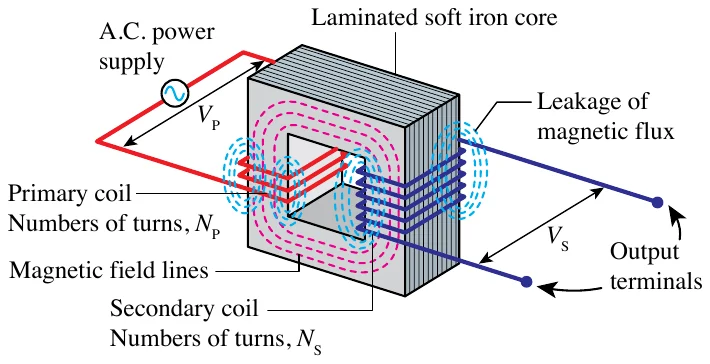
[1 mark]
(a)Is this a step-up or a step-down transformer?
Show answerHide answer
Tick each point you got.
[2 marks]
(b)Calculate the number of turns of the primary coil.
Show answerHide answer
Tick each point you got.
[2 marks]
(c)Calculate the current in the secondary coil.
Show answerHide answer
Tick each point you got.
[2 marks]
(d)Calculate the current in the primary coil.
Show answerHide answer
Tick each point you got.
15
Question 15
A pupil tests a transformer. The primary voltage is 240 V and the primary current is 0.50 A. The secondary voltage is 12 V and the secondary current is 8.5 A.
[3 marks]
(a)Calculate the efficiency of the transformer.
Show answerHide answer
Tick each point you got.
[2 marks]
(b)Explain why the transformer is not ideal. State two causes.
Show answerHide answer
Tick each point you got.
[2 marks]
(c)Suggest two improvements to the design to increase the efficiency.
Show answerHide answer
Tick each point you got.
16
Question 16
A power station delivers 50 kW through cables of total resistance 0.50 Ω.
[1 mark]
(a)Calculate the current in the cables if the power is transmitted at 250 V.
Show answerHide answer
Tick each point you got.
[1 mark]
(b)Calculate the current if a step-up transformer raises the voltage to 25 kV.
Show answerHide answer
Tick each point you got.
[2 marks]
(c)Calculate the power lost in the cables (P = I²R) in each case.
Show answerHide answer
Tick each point you got.
17
Question 17
Two identical metal balls look the same. One is a neodymium magnet and the other is a steel ball. A long copper tube is available.
[2 marks]
(a)Describe an activity to identify the magnet.
Show answerHide answer
Tick each point you got.
[2 marks]
(b)Explain the physics principle used.
Show answerHide answer
Tick each point you got.