Physics questions, chapter 5
Nama / NameKelas / ClassTarikh / Date
Electronics
44 marks. Use Practice to check each answer as you go, or Exam to answer everything against the clock first.
Section A: objective questions
12 marksChoose the best answer for each question. Charge of an electron e = 1.6 × 10⁻¹⁹ C; mass of an electron m = 9.11 × 10⁻³¹ kg.
1
Question 1
What is thermionic emission?
Show answerHide answer
A
Heating a metal gives its free electrons enough kinetic energy to leave the surface. This is thermionic emission.
2
Question 2
What are cathode rays?
Show answerHide answer
B
Cathode rays are fast electron beams in a vacuum. They are negatively charged, so they are attracted to the anode.
3
Question 3
A Maltese cross tube produces a sharp shadow of the cross on the fluorescent screen. What does this show about cathode rays?
Show answerHide answer
C
An object that blocks the rays gives a sharp shadow because the rays travel in straight lines.
4
Question 4
An electron is accelerated from rest through a potential difference of 250 V in a vacuum. What is its maximum velocity?
Show answerHide answer
D
eV = ½mv², so v = √(2 × 1.6 × 10⁻¹⁹ × 250 / 9.11 × 10⁻³¹) = √(8.78 × 10¹³) = 9.4 × 10⁶ m s⁻¹.
5
Question 5
What is the function of a semiconductor diode?
Show answerHide answer
D
A diode conducts when forward biased and blocks when reverse biased.
6
Question 6
What happens to the depletion layer of a diode when it is forward biased?
Show answerHide answer
B
In forward bias the holes and electrons move towards the junction, so the depletion layer becomes thinner and the diode has very small resistance.
7
Question 7
An a.c. supply is connected in series with a single diode and a resistor. Which describes the potential difference across the resistor?
Show answerHide answer
C
The diode conducts only in the positive half cycle (half-wave rectification), so the output is pulsating d.c. with gaps.
8
Question 8
In a bridge rectifier, diodes D₁ and D₂ conduct during the positive half cycle. Which diodes conduct during the negative half cycle?
Show answerHide answer
A
The pairs alternate: D₁ and D₂ in the positive half cycle, D₃ and D₄ in the negative half cycle. The current through the load keeps the same direction.
9
Question 9
A capacitor is connected in parallel with the load of a rectifier. How does it make the output smoother?
Show answerHide answer
B
The capacitor charges as the potential difference rises and discharges as it falls, so the output does not drop to zero.
10
Question 10
Which terminal of a transistor is a thin layer that controls the flow of charge carriers from the emitter to the collector?
Show answerHide answer
A
The base is the thin middle layer. A small base current controls the large collector current.
11
Question 11
A transistor circuit is changed from an npn transistor to a pnp transistor. What else must change for the circuit to work?
Show answerHide answer
D
For a pnp transistor the polarity of the base and collector batteries is reversed, so the directions of IB, IC and IE are also reversed.
12
Question 12
A light-controlled switch uses an npn transistor. A fixed resistor and an LDR form a potential divider, with the LDR as the lower resistor, and the voltage across the LDR is applied to the base. Why does the lamp light up in the dark?
Show answerHide answer
C
In the dark the LDR has a high resistance, so it takes a larger share of the supply voltage. When VLDR is more than VBE, IB flows and turns on the collector circuit.
Section B: structured questions
32 marksAnswer all questions. Show your working for calculations.
13
Question 13
Diagram 1 shows a vacuum tube in which an electron beam is produced. The extra high tension (E.H.T.) supply is 2 000 V.
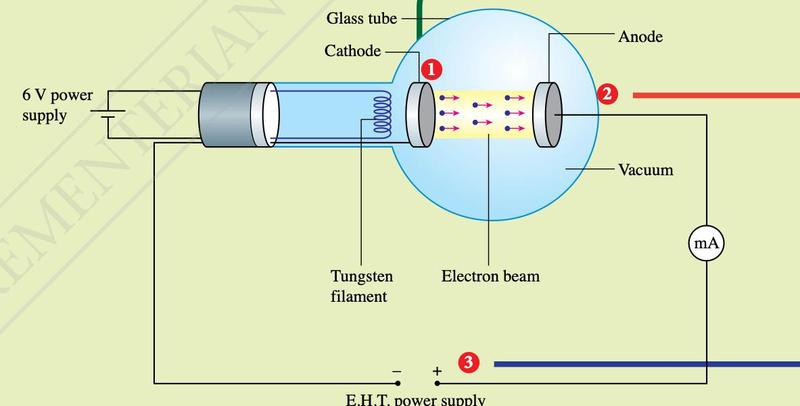
[1 mark]
(a)Name the process by which electrons leave the hot filament.
Show answerHide answer
Tick each point you got.
[1 mark]
(b)Why must the tube be in a vacuum?
Show answerHide answer
Tick each point you got.
[1 mark]
(c)Calculate the kinetic energy of an electron when it reaches the anode.
Show answerHide answer
Tick each point you got.
[2 marks]
(d)Calculate the maximum velocity of the electron. [m = 9.11 × 10⁻³¹ kg]
Show answerHide answer
Tick each point you got.
14
Question 14
A student uses a deflection tube and a Maltese cross tube to study cathode rays.
[1 mark]
(a)When the plates of a deflection tube are connected to an E.H.T. supply, the beam bends towards the positive plate. What is the charge on cathode rays?
Show answerHide answer
Negative
[2 marks]
(b)In a Maltese cross tube, a bar magnet is brought near the tube. State what happens to the shadow and what this shows.
Show answerHide answer
Tick each point you got.
15
Question 15
Diagram 2 shows a rectifier circuit during the positive half cycle of the a.c. input.
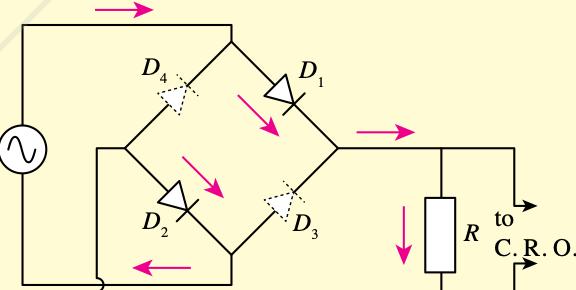
[1 mark]
(a)Name the arrangement of four diodes in this circuit.
Show answerHide answer
Tick each point you got.
[1 mark]
(b)Which diodes are forward biased in the positive half cycle?
Show answerHide answer
Tick each point you got.
[1 mark]
(c)State one advantage of this circuit over a single-diode circuit.
Show answerHide answer
Any 1 points
Tick each point you got.
[1 mark]
(d)Name the component that should be connected in parallel with R to give a smooth output.
Show answerHide answer
Tick each point you got.
16
Question 16
Diagram 3 shows the output of a half-wave rectifier and of a full-wave rectifier, each with a capacitor in parallel with the load.
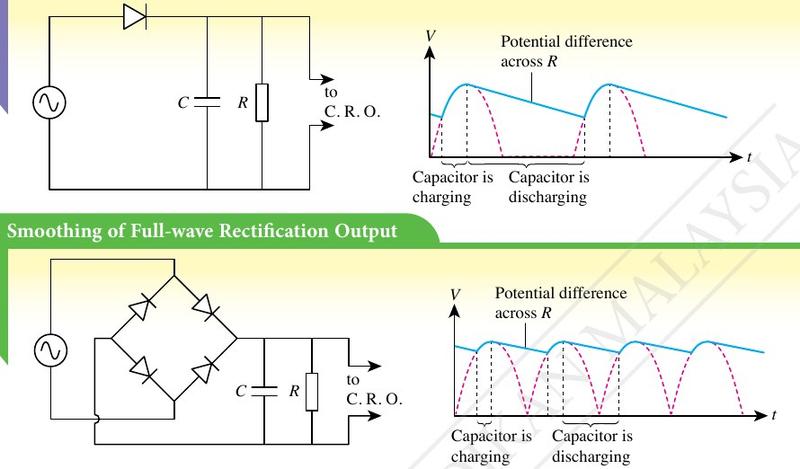
[1 mark]
(a)What does the capacitor do while the potential difference across R is falling?
Show answerHide answer
Tick each point you got.
[2 marks]
(b)Which output is smoother, half-wave or full-wave? Explain.
Show answerHide answer
Tick each point you got.
[1 mark]
(c)State one way to make the output smoother still.
Show answerHide answer
Tick each point you got.
17
Question 17
A student sets up an npn transistor circuit as an amplifier and records the base current IB and collector current IC.
| IB / mA | 0.10 | 0.20 | 0.30 | 0.40 | 0.50 |
|---|---|---|---|---|---|
| IC / mA | 15.6 | 31.2 | 46.8 | 62.4 | 78.0 |
[1 mark]
(a)State the relationship between IC and IB.
Show answerHide answer
Tick each point you got.
[2 marks]
(b)Calculate the amplification factor β of the transistor.
Show answerHide answer
Tick each point you got.
[1 mark]
(c)Predict IC when IB = 0.35 mA.
Show answerHide answer
Tick each point you got.
[1 mark]
(d)State the role of the transistor in this circuit.
Show answerHide answer
Tick each point you got.
18
Question 18
Diagram 4 shows a light-controlled switch for a street lamp. The supply is 6 V and the fixed resistor is 10 kΩ. In the dark the LDR is 100 kΩ; in bright light it is 0.5 kΩ. The transistor needs VBE of at least 0.7 V.
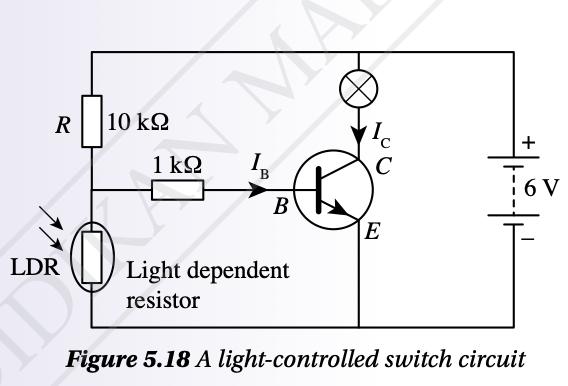
[2 marks]
(a)Calculate the voltage across the LDR in the dark.
Show answerHide answer
Tick each point you got.
[1 mark]
(b)Calculate the voltage across the LDR in bright light.
Show answerHide answer
Tick each point you got.
[2 marks]
(c)Does the lamp light up in bright light? Explain.
Show answerHide answer
Tick each point you got.
19
Question 19
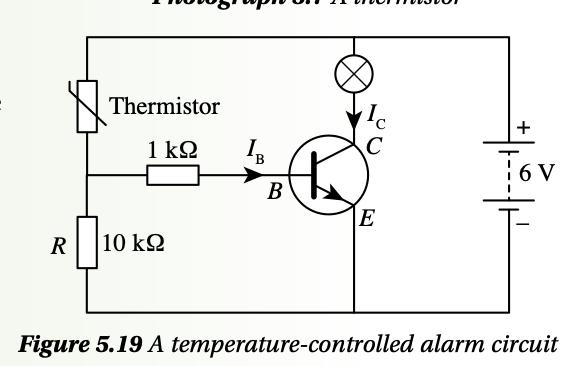
Diagram 5 shows a temperature-controlled alarm circuit. The supply is 6 V, the resistor R is 10 kΩ and the transistor is silicon.
[3 marks]
(a)Explain how the circuit switches on the alarm when the temperature rises.
Show answerHide answer
Tick each point you got.
[2 marks]
(b)Calculate the largest resistance of the thermistor at which the transistor turns on. Ignore the base current.
Show answerHide answer
Tick each point you got.
[1 mark]
(c)Suggest a change to make this a frost alarm that rings when the temperature falls.
Show answerHide answer
Tick each point you got.