Physics questions, chapter 6
Nama / NameKelas / ClassTarikh / Date
Nuclear Physics
46 marks. Use Practice to check each answer as you go, or Exam to answer everything against the clock first. Take c = 3.00 × 10⁸ m s⁻¹ and 1 amu = 1.66 × 10⁻²⁷ kg.
Section A: objective questions
14 marksChoose the best answer for each question.
1
Question 1
What is radioactive decay?
Show answerHide answer
C
An unstable nucleus emits radioactive radiation (α, β or γ) to become more stable (textbook p. 200). Options A and B describe fission and fusion.
2
Question 2
An alpha particle is the same as
Show answerHide answer
A
An alpha particle is a helium nucleus of 2 protons and 2 neutrons. A fast electron is a beta particle; a gamma ray is an electromagnetic wave.
3
Question 3
Radium-226 (²²⁶₈₈Ra) decays by emitting an alpha particle. What is the daughter nucleus?
Show answerHide answer
B
An α-particle takes away 4 nucleons and 2 protons: A = 226 − 4 = 222 and Z = 88 − 2 = 86, which is radon-222.
4
Question 4
A nucleus of ²⁴₁₁Na undergoes beta decay. What are the nucleon number and proton number of the new nucleus?
Show answerHide answer
D
In β-decay a neutron changes to a proton: the nucleon number is unchanged (24) and the proton number rises by 1 (12). The nucleus is magnesium-24.
5
Question 5
What happens to a nucleus when it emits a gamma ray?
Show answerHide answer
C
Gamma rays carry away excess energy only. They have no mass and no charge, so A and Z stay the same.
6
Question 6
A sample of a radioactive substance is heated to a much higher temperature. What happens to its rate of decay?
Show answerHide answer
B
Radioactive decay is random and spontaneous and is not influenced by temperature, pressure or other physical factors.
7
Question 7
The half-life of a radioactive substance is the time taken for
Show answerHide answer
D
Half-life is the time for the number of undecayed nuclei (and the activity) to fall to half of its initial value.
8
Question 8
A radioactive source has an activity of 800 s⁻¹ and a half-life of 3 minutes. What is its activity after 12 minutes?
Show answerHide answer
A
n = 12 ÷ 3 = 4 half-lives. A = (½)⁴ × 800 = 800 ÷ 16 = 50 s⁻¹.
9
Question 9
Two rock samples contain uranium-238 and its final product lead-206. Which rock is the oldest?
Show answerHide answer
C
The longer the uranium has been decaying, the more lead-206 has formed, so a higher ratio of lead-206 to uranium-238 means an older rock.
10
Question 10
Which statement describes nuclear fission?
Show answerHide answer
B
Fission is the splitting of a heavy nucleus (such as uranium-235) into two or more lighter nuclei with the release of a large amount of energy.
11
Question 11
In a nuclear reaction the total mass of the products is less than the total mass of the reactants. The missing mass
Show answerHide answer
D
The mass defect is converted to energy: E = mc² (textbook p. 211).
12
Question 12
A nuclear reaction has a mass defect of 2.0 × 10⁻²⁹ kg. What is the energy released? [c = 3.00 × 10⁸ m s⁻¹]
Show answerHide answer
A
E = mc² = 2.0 × 10⁻²⁹ × (3.00 × 10⁸)² = 2.0 × 10⁻²⁹ × 9.0 × 10¹⁶ = 1.8 × 10⁻¹² J.
13
Question 13
What is the function of the control rods in a nuclear reactor?
Show answerHide answer
B
Control rods (boron or cadmium) absorb neutrons. The moderator slows neutrons; concrete walls stop radiation leaking.
14
Question 14
Which sequence shows the energy changes in a nuclear power station?
Show answerHide answer
C
Fission gives heat that makes steam, the steam turns the turbine (kinetic energy), and the generator produces electrical energy (textbook p. 214).
Section B: structured questions
32 marksAnswer all questions. Show your working.
15
Question 15
Complete each decay equation by identifying A, B and C.
[2 marks]
(a)²²⁸₈₈Ra → A + ⁰₋₁e
Show answerHide answer
Tick each point you got.
[1 mark]
(b)²⁰⁹₈₄Po → ²⁰⁵₈₂Pb + B
Show answerHide answer
Tick each point you got.
[1 mark]
(c)C → ¹₁p + ⁰₋₁e
Show answerHide answer
Tick each point you got.
16
Question 16
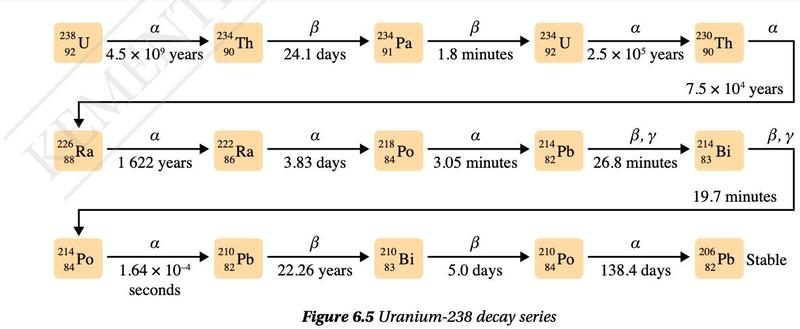
Diagram 1 shows the uranium-238 decay series, which ends with stable lead-206.
[1 mark]
(a)State the half-life of radium-226.
Show answerHide answer
Tick each point you got.
[4 marks]
(b)Calculate the number of alpha particles and beta particles emitted in the decay of ²³⁸₉₂U to ²⁰⁶₈₂Pb.
Show answerHide answer
Tick each point you got.
[2 marks]
(c)The ratio of uranium-238 to lead-206 is 5 : 1 in rock A and 7 : 1 in rock B. Which rock is older? Explain.
Show answerHide answer
Tick each point you got.
17
Question 17
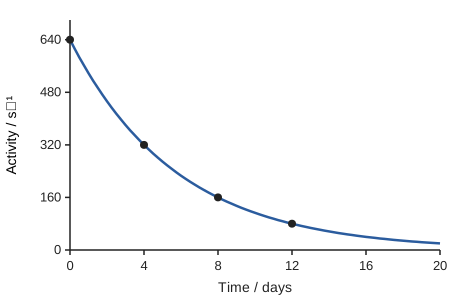
Diagram 2 shows how the activity of a radioactive source changes with time.
[1 mark]
(a)Determine the half-life of the source.
Show answerHide answer
Tick each point you got.
[3 marks]
(b)Calculate the activity after 20 days.
Show answerHide answer
Tick each point you got.
[2 marks]
(c)How long does it take for the activity to fall to 12.5% of its initial value?
Show answerHide answer
Tick each point you got.
18
Question 18
A uranium-235 nucleus absorbs a neutron: ²³⁵₉₂U + ¹₀n → ¹⁴¹₅₅Cs + ⁹³₃₇Rb + 2 ¹₀n + energy. The mass defect is 0.19585 amu.
[1 mark]
(a)Name this type of nuclear reaction.
Show answerHide answer
Tick each point you got.
[3 marks]
(b)Calculate the energy released, in joules.
Show answerHide answer
Tick each point you got.
[2 marks]
(c)Express your answer to (b) in MeV. [1 MeV = 1.6 × 10⁻¹³ J]
Show answerHide answer
Tick each point you got.
19
Question 19
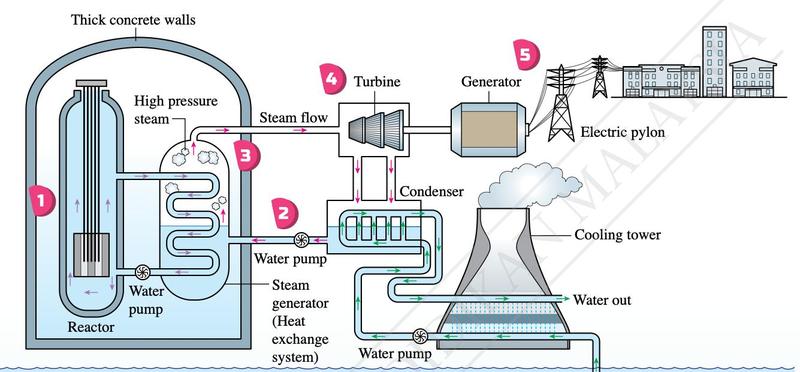
Diagram 3 shows a nuclear power station.
[1 mark]
(a)What nuclear reaction takes place in the reactor?
Show answerHide answer
Tick each point you got.
[2 marks]
(b)Describe the chain reaction in the reactor.
Show answerHide answer
Tick each point you got.
[2 marks]
(c)State the function of the control rods and the material they are made of.
Show answerHide answer
Tick each point you got.
[2 marks]
(d)State the energy changes from the reactor to the electrical output.
Show answerHide answer
Tick each point you got.
[2 marks]
(e)A coal-fired power station and a nuclear power station both generate electricity. State one advantage and one disadvantage of using nuclear energy.
Show answerHide answer
Tick each point you got.