Physics questions, chapter 7
Nama / NameKelas / ClassTarikh / Date
Quantum Physics
46 marks. Use Practice to check each answer as you go, or Exam to answer everything against the clock first. Use h = 6.63 × 10⁻³⁴ J s, c = 3.00 × 10⁸ m s⁻¹, e = 1.60 × 10⁻¹⁹ C and electron mass 9.11 × 10⁻³¹ kg.
Section A: objective questions
13 marksChoose the best answer for each question.
1
Question 1
What is a black body?
Show answerHide answer
B
A black body absorbs all radiation that falls on it and also emits thermal radiation that depends on its temperature.
2
Question 2
A black body is heated from 4 000 K to 7 000 K. Which change happens to the radiation graph?
Show answerHide answer
C
As temperature rises, the wavelength at maximum intensity becomes shorter and the intensity increases.
3
Question 3
Why can a line spectrum be used to identify an element?
Show answerHide answer
A
The wavelengths of the lines are unique to each element.
4
Question 4
The frequency of a light wave is doubled. What happens to the energy of each photon?
Show answerHide answer
D
E = hf, so photon energy is directly proportional to frequency.
5
Question 5
What is the energy of a photon of light with a wavelength of 500 nm?
Show answerHide answer
B
E = hc ÷ λ = (6.63 × 10⁻³⁴)(3.00 × 10⁸) ÷ (500 × 10⁻⁹) = 3.98 × 10⁻¹⁹ J. Remember to convert nm to m.
6
Question 6
Four particles move with the same speed. Which has the shortest de Broglie wavelength?
Show answerHide answer
D
λ = h ÷ mv. For the same speed the particle with the greatest mass has the shortest wavelength, which is the alpha particle.
7
Question 7
The intensity of light shining on a metal above its threshold frequency is increased. What happens?
Show answerHide answer
C
More photons arrive each second, so more photoelectrons are emitted. Kinetic energy depends on frequency, not intensity.
8
Question 8
A metal has a threshold frequency of 6.0 × 10¹⁴ Hz. Which light, in a vacuum, will cause photoelectric emission?
Show answerHide answer
A
The threshold wavelength is λ₀ = c ÷ f₀ = 3.00 × 10⁸ ÷ 6.0 × 10¹⁴ = 500 nm. Only a wavelength shorter than 500 nm (frequency above f₀) works.
9
Question 9
A metal has a threshold frequency of 5.0 × 10¹⁴ Hz. What is its work function?
Show answerHide answer
C
W = hf₀ = 6.63 × 10⁻³⁴ × 5.0 × 10¹⁴ = 3.32 × 10⁻¹⁹ J.
10
Question 10
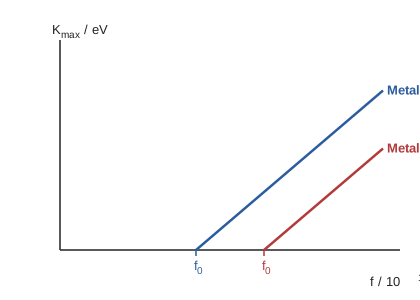
Diagram 1 shows graphs of the maximum kinetic energy Kmax against frequency f for metals A and B. Which statement is correct?
Show answerHide answer
B
W = hf₀ and f₀ of B is greater. The gradient of Kmax against f is h for every metal, so the lines are parallel.
11
Question 11
Light of frequency 7.5 × 10¹⁴ Hz shines on a metal of work function 3.0 × 10⁻¹⁹ J. What is the maximum kinetic energy of a photoelectron?
Show answerHide answer
D
hf = 6.63 × 10⁻³⁴ × 7.5 × 10¹⁴ = 4.97 × 10⁻¹⁹ J. Kmax = hf − W = 4.97 × 10⁻¹⁹ − 3.0 × 10⁻¹⁹ = 1.97 × 10⁻¹⁹ J.
12
Question 12
A lamp emits 2.0 W of light of wavelength 600 nm. How many photons are emitted per second?
Show answerHide answer
A
n = Pλ ÷ hc = (2.0)(600 × 10⁻⁹) ÷ (6.63 × 10⁻³⁴ × 3.00 × 10⁸) = 6.03 × 10¹⁸ per second.
13
Question 13
Which device works by the photoelectric effect?
Show answerHide answer
C
The light beam and photocell act as a switch; breaking the beam stops the photoelectric current and the door opens.
Section B: structured questions
33 marksAnswer all questions. Show your working.
14
Question 14
The violet line of a mercury vapour lamp has a frequency of 7.41 × 10¹⁴ Hz.
[2 marks]
(a)Calculate the energy of one photon of this line.
Show answerHide answer
Tick each point you got.
[2 marks]
(b)Calculate its wavelength in nm.
Show answerHide answer
Tick each point you got.
[1 mark]
(c)Why can this line spectrum be used to show that mercury is present in a lamp?
Show answerHide answer
Tick each point you got.
15
Question 15
An electron of mass 9.11 × 10⁻³¹ kg moves at 2.0 × 10⁶ m s⁻¹. A ball of mass 0.15 kg moves at 20 m s⁻¹.
[2 marks]
(a)Calculate the de Broglie wavelength of the electron.
Show answerHide answer
Tick each point you got.
[2 marks]
(b)Calculate the de Broglie wavelength of the ball.
Show answerHide answer
Tick each point you got.
[1 mark]
(c)Why can wave behaviour not be observed for the ball?
Show answerHide answer
Tick each point you got.
16
Question 16
A green laser pointer emits light of wavelength 532 nm with an output power of 1.0 mW.
[2 marks]
(a)Calculate the energy of one photon.
Show answerHide answer
Tick each point you got.
[2 marks]
(b)Calculate the number of photons emitted per second.
Show answerHide answer
Tick each point you got.
17
Question 17
A metal has a threshold frequency of 5.5 × 10¹⁴ Hz. Violet light (7.5 × 10¹⁴ Hz) and a bright red light (4.3 × 10¹⁴ Hz) are shone separately on the metal.
[1 mark]
(a)Which light causes photoelectric emission?
Show answerHide answer
Violet light
Only its frequency is above the threshold frequency.
[2 marks]
(b)Explain why the bright red light does not emit photoelectrons.
Show answerHide answer
Tick each point you got.
[2 marks]
(c)The intensity of the violet light is increased. State what happens to the number of photoelectrons per second and to their maximum kinetic energy.
Show answerHide answer
Tick each point you got.
18
Question 18
The work function of sodium is 2.28 eV. Use hc = 1.243 × 10³ eV nm, 1 eV = 1.60 × 10⁻¹⁹ J and electron mass 9.11 × 10⁻³¹ kg.
[2 marks]
(a)Will red light of wavelength 680 nm cause photoelectric emission from sodium? Show by calculation.
Show answerHide answer
Tick each point you got.
[2 marks]
(b)Calculate the threshold wavelength of sodium.
Show answerHide answer
Tick each point you got.
[2 marks]
(c)Violet light of wavelength 400 nm shines on sodium. Calculate the maximum kinetic energy of a photoelectron in joules.
Show answerHide answer
Tick each point you got.
19
Question 19
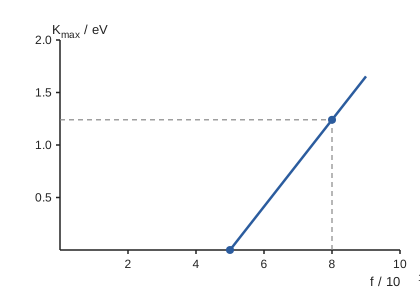
Diagram 2 shows the graph of the maximum kinetic energy Kmax of photoelectrons against the frequency f of light for a metal.
[1 mark]
(a)State the threshold frequency of the metal.
Show answerHide answer
Tick each point you got.
[3 marks]
(b)Calculate the gradient of the graph in J s. State what it represents.
Show answerHide answer
Tick each point you got.
[1 mark]
(c)Calculate the work function of the metal in eV.
Show answerHide answer
Tick each point you got.
20
Question 20
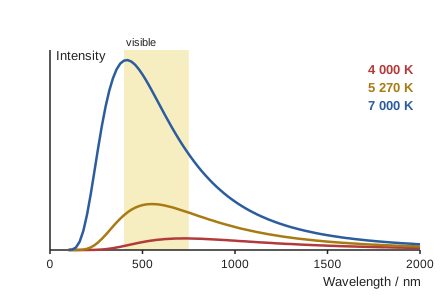
Diagram 3 shows the radiation from black bodies at 4 000 K (which looks red), 5 270 K (white) and 7 000 K (blue).
[2 marks]
(b)Describe how the wavelength of maximum intensity and the colour change as a black body is heated from 4 000 K to 7 000 K.
Show answerHide answer
Tick each point you got.
[1 mark]
(c)Classical physics predicted that the intensity would increase without limit at short wavelength. What do the curves show?
Show answerHide answer
Tick each point you got.