Quantum Physics
What this chapter covers
- Explain a black body and why classical physics could not explain black-body radiation (7.1)
- Describe quantum of energy, photon energy E = hf and the line spectrum (7.1)
- Explain wave-particle duality and use de Broglie's wavelength λ = h/p (7.1)
- Solve problems on photon energy and the number of photons per second from the power (7.1)
- Describe the photoelectric effect and its four characteristics (7.2)
- State Einstein's photoelectric equation, work function and threshold frequency (7.3)
- Solve problems with hf = W + Kmax and interpret the Kmax–f graph (7.3)
- Describe photocells and applications of the photoelectric effect (7.3)
7.1Quantum theory of light
A large cavity with a small hole acts as a black body: light entering the hole is reflected again and again inside and is absorbed, so almost none escapes. The ear cavity is a natural example.
Why classical physics failed
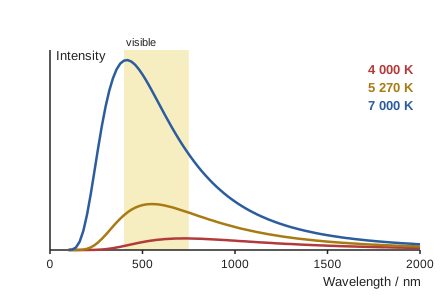
Classical theory said that the vibrating electrons in a hot object can have any energy, so the intensity should keep growing without limit at high frequency. Experiments showed that it does not: each curve comes back down on the left. This conflict started quantum theory.
Quantum of energy and photons
| Physicist | Contribution |
|---|---|
| Max Planck (1900) | Radiation is emitted in discrete packets called quanta; the energy of one quantum is proportional to the frequency |
| Albert Einstein (1905) | Light travels as particles called photons; explained the photoelectric effect |
| Niels Bohr | Line spectrum of hydrogen from electrons moving between energy levels |
| Louis de Broglie (1924) | All particles have wave properties |
A continuous spectrum (white light through a prism, 400–750 nm) has no gaps. A line spectrum from excited atoms is a set of coloured lines with wavelengths unique to each element, so it identifies the element.
400 nm: E = (6.63 × 10⁻³⁴)(3.00 × 10⁸) ÷ (400 × 10⁻⁹) = 4.97 × 10⁻¹⁹ J.
750 nm: E = 2.65 × 10⁻¹⁹ J. The shorter wavelength has the higher energy.
Photons per second from power
If a source of power P emits n photons every second, each of energy hf = hc ÷ λ, then
Wave-particle duality
Light shows wave properties (diffraction, interference) and particle properties (photons). De Broglie proposed that moving particles such as electrons also behave as waves with wavelength
Electron diffraction through a thin graphite layer (1927) confirmed this. Because h is so small, the wavelength of a large object is far too short to detect. An electron beam has a wavelength thousands of times shorter than light, so an electron microscope gives a much higher magnification than an optical microscope.
Show answerHide answer
7.2The photoelectric effect
In a photocell the illuminated metal (cathode) emits photoelectrons, which are attracted to the positive anode. They flow round the circuit and the milliammeter shows a photoelectric current.
Four characteristics found by experiment
| Observation | Classical wave theory predicted |
|---|---|
| Kinetic energy of photoelectrons rises with the frequency of the light | Frequency should not matter |
| No emission below a threshold frequency f₀, however bright | Any frequency should work if bright enough |
| Kinetic energy does not depend on intensity; brighter light gives more photoelectrons per second, not faster ones | Brighter light should give faster electrons |
| Emission is instantaneous, even for dim light | Dim light should need time to build up energy |
Show answerHide answer
7.3Einstein's photoelectric theory
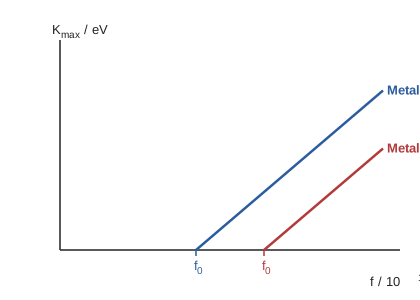
Einstein (1905) explained all four characteristics: each photon of energy hf is absorbed completely by one electron. Part of the energy frees the electron and the rest is its kinetic energy.
Work function W is the minimum energy needed to release an electron from the metal. Threshold frequency f₀: W = hf₀ = hc ÷ λ₀.
| Condition | Result |
|---|---|
| f < f₀ (hf < W) | No photoelectrons |
| f = f₀ | Electrons just escape, Kmax = 0 |
| f > f₀ | Kmax = hf − W |
hf = 6.63 × 10⁻³⁴ × 6.67 × 10¹⁴ = 4.42 × 10⁻¹⁹ J.
Kmax = 4.42 × 10⁻¹⁹ − 3.43 × 10⁻¹⁹ = 9.92 × 10⁻²⁰ J.
Photocells and applications
A photocell has a light-sensitive cathode and an anode in a vacuum tube; a higher light intensity gives a larger photoelectric current. A metal with a higher work function has a shorter threshold wavelength, which is the longest wavelength that still releases electrons (caesium 579 nm, lithium 496 nm).
- Solar cells, solar power plants and solar panels (such as on the ISS)
- Light detectors in automatic doors: a broken beam cuts the photocell current
- Image sensors in digital cameras