Nuclear Physics
What this chapter covers
- Describe radioactive decay as a random and spontaneous process, and write decay equations for alpha, beta and gamma decay (6.1.1)
- Explain half-life and the uranium-238 decay series, and how they are used to estimate the age of rocks and the Earth (6.1.2)
- Determine half-life from a decay curve and use N = (1/2)^n N0 to solve problems (6.1.3, 6.1.4)
- Describe nuclear fission and nuclear fusion, and explain mass defect and E = mc² (6.2.1, 6.2.2)
- Calculate the nuclear energy released in radioactive decay and nuclear reactions (6.2.3)
- Explain how a nuclear reactor generates electricity, the chain reaction, and how the reaction is controlled safely (6.2.4)
- Discuss nuclear energy as an alternative source of electrical energy (6.2.5)
6.1Radioactive decay
There are three kinds of radiation: alpha particles (α), beta particles (β) and gamma rays (γ). In a decay equation the nucleon number A (top) and the proton number Z (bottom) must each add up to the same total on both sides.
| Decay | What is emitted | General equation | Example |
|---|---|---|---|
| Alpha | A helium nucleus (2 protons, 2 neutrons) | ᴬZX → ᴬ⁻⁴Z−2Y + ⁴2He | ²¹⁰84Po → ²⁰⁶82Pb + ⁴2He |
| Beta | A fast electron; a neutron in the nucleus changes to a proton plus an electron (n → p + e) | ᴬZX → ᴬZ+1Y + ⁰−1e | ²⁴11Na → ²⁴12Mg + ⁰−1e |
| Gamma | A high-frequency electromagnetic wave with no mass and no charge; the nucleus loses excess energy | ᴬZX → ᴬZX + γ | ⁶⁰27Co* → ⁶⁰27Co + γ |
Half-life and the decay series
The activity of a sample (decays per second) is proportional to the number of undecayed nuclei, so the activity also halves every half-life. A shorter half-life means a faster decay and a steeper curve.
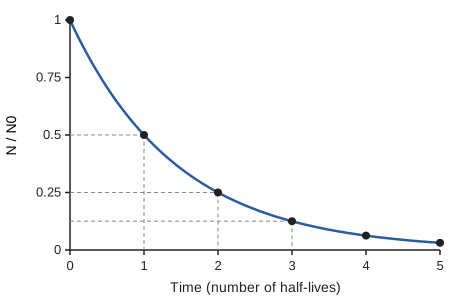
| Half-lives passed | 0 | 1 | 2 | 3 | 4 | 5 |
|---|---|---|---|---|---|---|
| Fraction left | 1 | ½ | ¼ | ⅛ | 1/16 | 1/32 |
n = 30 ÷ 6 = 5. A = (½)⁵ × 480 = 480 ÷ 32 = 15 s⁻¹.
A new nucleus formed by decay may itself be unstable, so the decay continues in a decay series until a stable nucleus forms. In the uranium-238 series the end product is stable lead-206, through 8 α-decays and 6 β-decays.
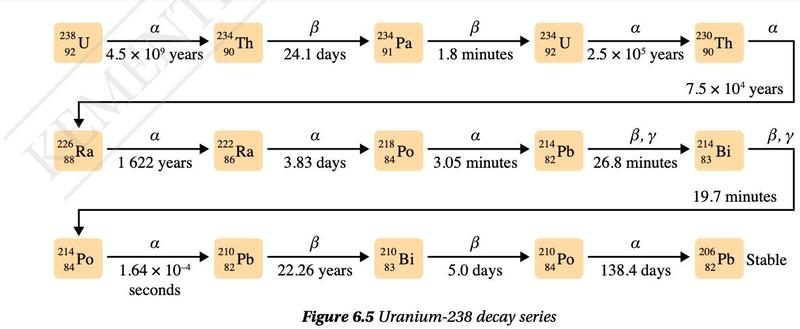
Figure: Physics Form 5 (DLP) textbook, Figure 6.5, p. 202.
Dating rocks
Uranium-238 has a very long half-life (about 4.5 × 10⁹ years) and is trapped when a rock forms. By measuring the ratio of lead-206 to uranium-238 in a sample, geologists estimate how old the rock is. The higher the ratio, the older the rock. The same method gives the age of the Earth.
Ratio 1 : 1 after one half-life, 3 : 1 after two (¾ decayed, ¼ left). Age = 2 × 1 250 = 2 500 million years.
Show answerHide answer
6.2Nuclear energy
Nuclear fission
A heavy nucleus splits into two or more lighter nuclei and releases a large amount of energy.
²³⁵92U + ¹0n → ¹⁴¹56Ba + ⁹²36Kr + 3 ¹0n + energy
Nuclear fusion
Small, light nuclei join to form a heavier nucleus and release a large amount of energy. It needs extremely high temperature and pressure, as in the core of the Sun.
²1H + ³1H → ⁴2He + ¹0n + energy
Mass defect and E = mc²
One atomic mass unit is 1/12 of the mass of a carbon-12 atom: 1 amu = 1.66 × 10⁻²⁷ kg. Nuclear energy is also given in megaelectronvolts: 1 MeV = 1.6 × 10⁻¹³ J.
m = 226.54 − (222.018 + 4.003) = 0.519 amu = 0.519 × 1.66 × 10⁻²⁷ = 8.62 × 10⁻²⁸ kg.
E = mc² = 8.62 × 10⁻²⁸ × (3.00 × 10⁸)² = 7.75 × 10⁻¹¹ J.
Generating electricity in a nuclear reactor
In a reactor, fission of uranium-235 produces two daughter nuclei, three fast neutrons and energy. These neutrons strike other uranium nuclei, giving a chain reaction that continues by itself.
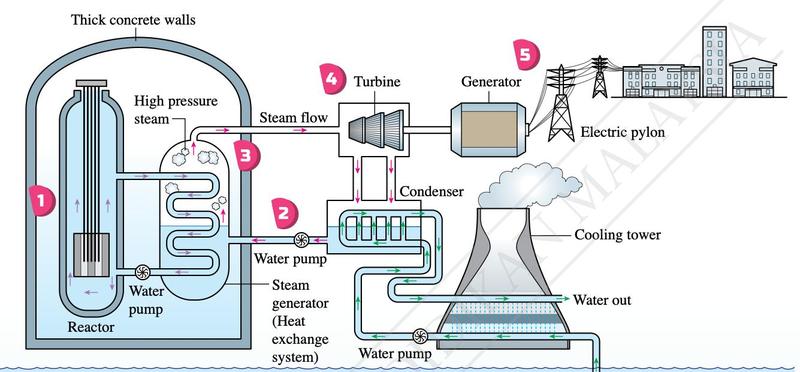
Figure: Physics Form 5 (DLP) textbook, Figure 6.12, p. 214.
Energy changes: nuclear energy → heat energy → kinetic energy (turbine) → electrical energy (generator).
| Part | Job |
|---|---|
| Uranium rods | Fuel for fission |
| Control rods (boron or cadmium) | Absorb excess neutrons to control the rate of reaction |
| Moderator (graphite or water) | Slows down fast neutrons so that fission can occur |
| Water coolant | Absorbs heat to make steam and controls the temperature |
| Thick concrete walls | Stop radiation leaking to the surroundings |