Electricity
What this chapter covers
- Describe electric fields, electric field strength and the motion of charged particles in a field (3.1)
- Define current and potential difference and solve problems using Q = It and V = W/Q (3.1)
- Distinguish ohmic and non-ohmic conductors and solve series, parallel and combination circuit problems (3.2)
- Explain how length, cross-sectional area and resistivity affect the resistance of a wire, and use R = ρl/A (3.2)
- Compare e.m.f. and potential difference and explain internal resistance and voltage drop (3.3)
- Solve problems on cells in series and in parallel using ε = I(R + r) (3.3)
- Use E = VIt, P = VI, P = I²R and P = V²/R, calculate the cost of electricity in kWh and suggest ways to save energy (3.4)
3.1Current and potential difference
Electric field
Everyday signs of an electric field: a charged comb bends a thin stream of tap water, and a charged balloon attracts hair or small pieces of paper. Semolina powder floating on olive oil lines up along the field lines when a high voltage is applied across two electrodes, which is how the shape of a field is shown in the laboratory.
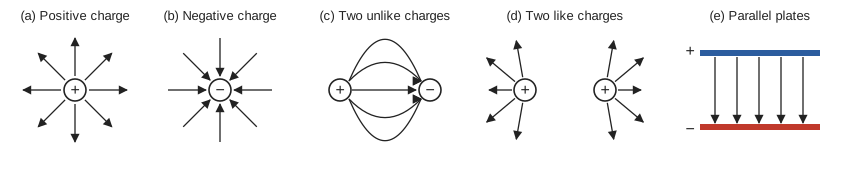
- Field lines start on a positive charge and end on a negative charge. They never cross.
- Lines are closer together where the field is stronger.
- Between two oppositely charged parallel plates the lines are parallel and evenly spaced: a uniform field.
Electric field strength
| Situation | Formula | Unit |
|---|---|---|
| Any field, force F on charge q | E = F / q | N C−1 |
| Uniform field between plates, voltage V, separation d | E = V / d | V m−1 |
1 V m−1 is the same as 1 N C−1.
Charged particles in an electric field
- A metal-coated polystyrene ball touching one of two charged plates picks up that plate's charge, is repelled and is attracted to the other plate. It swings to and fro, carrying charge across, until the supply is switched off.
- A candle flame between the plates spreads out because the hot air is ionised. Negative ions go to the positive plate and positive ions go to the negative plate. The flame spreads more towards the negative plate because positive ions are larger and heavier.
Current and potential difference
Q = It = 0.2 × (1 × 3600) = 720 C.
E = VQ = 3.0 × 720 = 2160 J.
Show answerHide answer
3.2Resistance
Ohmic and non-ohmic conductors
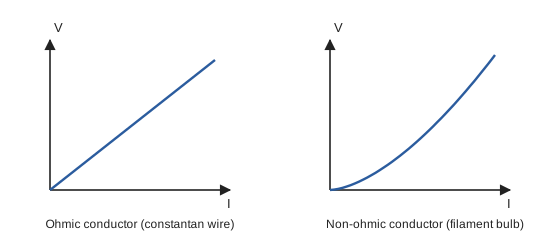
A conductor that obeys Ohm's law (V ∝ I at constant temperature, so the ratio V / I = R stays constant) is ohmic, for example a constantan wire. A filament bulb is non-ohmic: as the current rises the filament gets hotter, its resistance increases and the graph of V against I bends upward.
| Ohmic conductor | Non-ohmic conductor | |
|---|---|---|
| Graph of V against I | Straight line through the origin | Curve through the origin |
| Gradient (= resistance) | Constant | Increases |
Series and parallel circuits
| Series | Parallel | |
|---|---|---|
| Current | Same everywhere: I = I1 = I2 | Splits: I = I1 + I2 |
| Potential difference | Shared: V = V1 + V2 | Same across each branch: V = V1 = V2 |
| Effective resistance | R = R1 + R2 + R3 | 1/R = 1/R1 + 1/R2 + 1/R3 |
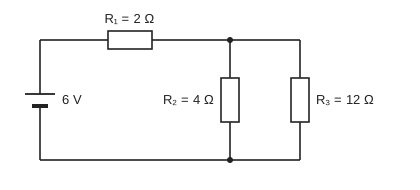
Parallel part: 1/R = 1/4 + 1/12 = 4/12, so R = 3 Ω.
Total resistance = 2 + 3 = 5 Ω. Current I = 6 ÷ 5 = 1.2 A.
V across the 2 Ω resistor = 1.2 × 2 = 2.4 V, so V across the parallel part = 6 − 2.4 = 3.6 V.
Current in the 4 Ω resistor = 3.6 ÷ 4 = 0.9 A (and 3.6 ÷ 12 = 0.3 A in the 12 Ω; 0.9 + 0.3 = 1.2 A).
Show answerHide answer
Factors that affect the resistance of a wire
| Factor | Effect on R (temperature constant) | Graph |
|---|---|---|
| Length, l | R is directly proportional to l | R against l: straight line through the origin |
| Cross-sectional area, A | R is inversely proportional to A; thicker wire, smaller R | R against 1/A: straight line through the origin |
| Resistivity, ρ (the material) | R is directly proportional to ρ |
Putting the three factors together: R = ρl / A, where A = πr2 = πd2/4 for a round wire.
r = 0.3 mm = 3 × 10⁻⁴ m, so A = π(3 × 10⁻⁴)2 = 2.83 × 10⁻⁷ m2.
R = ρl / A = (49 × 10−8 × 0.5) ÷ (2.83 × 10⁻⁷) = 0.87 Ω.
Uses of resistivity
- Heating elements (rice cooker, kettle, iron): high resistivity and a high melting point, e.g. nichrome, so the wire gets hot and does not melt or oxidise quickly.
- Connecting wires: copper has low resistivity, so the wire does not heat up as current flows.
- Fuse: a thin wire of low melting point that melts and cuts the circuit when the current is too large.
| Material | Resistivity | Examples |
|---|---|---|
| Non-conductor (insulator) | Highest | Plastic, wood |
| Semiconductor | Between conductors and insulators | Silicon, germanium |
| Conductor | Low | Iron, copper, carbon |
| Superconductor | Zero below its critical temperature, Tc | Used in coils of MRI scanners |
3.3Electromotive force and internal resistance
| e.m.f., ε | Potential difference, V | |
|---|---|---|
| Measured | Across the cell with no current flowing (open circuit) | Across the cell, or between any two points, while current flows |
| Voltmeter across the cell | Reading is the e.m.f. | Reading is the terminal potential difference, which is less than ε |
| Meaning | Work done by the source per coulomb in the whole circuit | Work done per coulomb between two points |
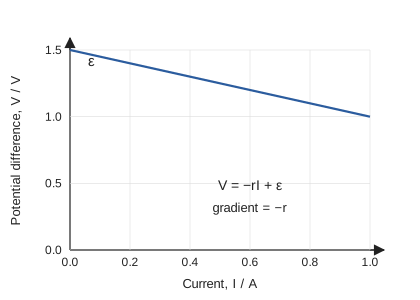
Voltage drop (lost volts) = Ir = ε − V. With an external resistance R: ε = I(R + r), or ε = V + Ir.
Cells in series and in parallel
| n identical cells (ε, r each) | Series | Parallel |
|---|---|---|
| Effective e.m.f. | nε | ε (same as one cell) |
| Effective internal resistance | nr | r / n |
| Main advantage | Higher voltage | Lower internal resistance and the cells last longer |
Series: ε = 3.0 V, r = 1.0 Ω, so I = 3.0 ÷ (10 + 1.0) = 0.27 A.
Parallel: ε = 1.5 V, r = 0.25 Ω, so I = 1.5 ÷ (10 + 0.25) = 0.146 A.
Series gives the larger current because its effective e.m.f. is larger.
Show answerHide answer
Electric and hybrid vehicles use batteries (and solar panels at charging stations) arranged in series and parallel to give the high voltage and high current the motor needs, and so reduce the use of fossil fuel and air pollution.
3.4Electrical energy and power
| Quantity | Formula | Unit |
|---|---|---|
| Electrical energy | E = VQ = VIt | joule (J) |
| Electrical power | P = E / t = VI | watt (W) = J s−1 |
| Using V = IR | P = I2R = V2 / R | watt (W) |
The label on an appliance, such as 240 V, 700 W, gives its working voltage and power rating. At 240 V it uses 700 J of electrical energy every second.
Current I = P / V = 32 ÷ 240 = 0.133 A.
Resistance R = V2 / P = 2402 ÷ 32 = 1800 Ω.
Energy in 3 hours = 32 × (3 × 3600) = 345 600 J = 346 kJ.
Cost of electricity
Cost = number of units (kWh) × cost per unit, where units = power in kW × time in hours.
CFL: 0.040 × 12 × 30 = 14.4 kWh, cost RM3.14.
LED: 0.012 × 12 × 30 = 4.32 kWh, cost RM0.94.
The LED uses less energy for the same light, so it is more efficient.
Saving electricity at home
- Switch off appliances, lights and fans when not in use.
- Use energy-saving lamps such as LEDs.
- Wash a full load of laundry; keep air-conditioner filters clean and doors and windows closed.
- Choose appliances with a high efficiency or energy-saving label.