Science notes, unit 4
Humans
Textbook Science Year 1 (DLP), pages 31–40
What this chapter covers
- You can name the five senses and the body part for each sense (4.1.1)
- You can use your senses to say what things are like and to sort them into groups (4.1.2, 4.1.5)
- You can use one or more senses to tell what an object is (4.1.3)
- You can use other senses when one sense cannot be used, and name things that help (4.1.4)
We find out about the world with our senses. Each sense uses a part of our body.
4.1Parts of the body and the senses
We have five senses: sight, hearing, smell, taste and touch.
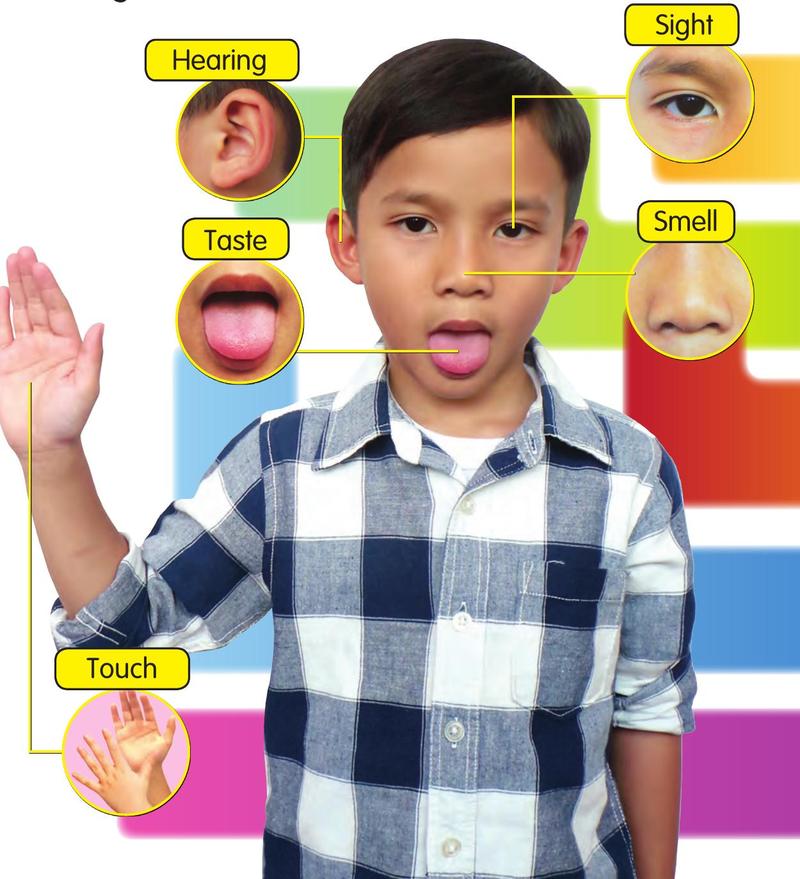
| Sense | Body part | We use it to |
|---|---|---|
| Sight | Eyes | see |
| Hearing | Ears | hear |
| Smell | Nose | smell |
| Taste | Tongue | taste |
| Touch | Skin | feel |
Remember: the skin is on all of your body. The hand is a good part to feel with.
Which body part do we use to hear?
Show answerHide answer
The ears.
What each sense tells us
| Sense | It tells us |
|---|---|
| Sight | colour, size and shape |
| Hearing | sounds, such as soft or loud |
| Smell | smells, such as nice or bad |
| Taste | sweet, sour, salty, bitter or no taste |
| Touch | coarse (rough), smooth, soft or hard |
Do not taste things unless a grown-up says it is safe. Keep loud sounds away from your ears.
Zaki licks a lollipop and says "It is sweet!" Which sense does he use?
Show answerHide answer
Taste, with his tongue.
4.1.2–4.1.5Using our senses
Sorting things
To classify is to put things into groups. We use our senses to see how things are the same or different.
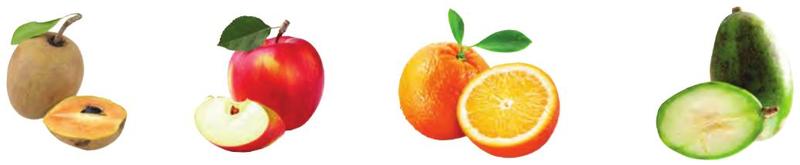
| Fruit | Taste | Shape |
|---|---|---|
| Sapodilla | Sweet | Oval |
| Apple | Sweet | Round |
| Orange | Sour | Round |
| Ambarella | Sour | Oval |
Example: sort the fruits by taste
Sweet: sapodilla, apple.Sour: orange, ambarella.
We can also sort the same fruits by shape. Round: apple, orange. Oval: sapodilla, ambarella.

Soft things: clay, cupcake, sponge. Hard things: bell, whistle, marble. We use the sense of touch.
Is an orange sweet or sour? Is it round or oval?
Show answerHide answer
Sour. Round.
Naming things with one or more senses
We can use one sense or many senses to tell what an object is. A fruit cube can be known by its colour (sight), smell and taste.
When one sense cannot be used

When one sense does not work well, we can still use our other senses.
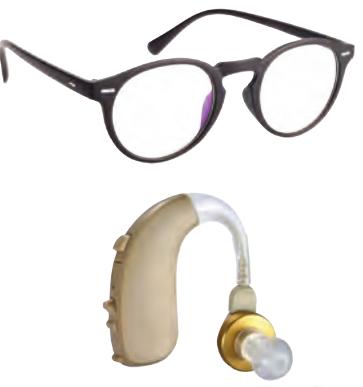
- Spectacles help us see clearly.
- A hearing aid helps us hear.
A blindfold covers the eyes. We use touch, hearing and smell to guess what is in the box. We do not taste unknown things.
Amir cannot read the small words in his book. What can help him?
Show answerHide answer
Spectacles.
Pictures: Science Year 1 (DLP) textbook, pp. 32, 34, 35, 37, 38.
Summary
| Sense | Body part | Example |
|---|---|---|
| Sight | Eyes | The apple is red and round. |
| Hearing | Ears | The bell is loud. |
| Smell | Nose | The rose smells nice. |
| Taste | Tongue | The orange is sour. |
| Touch | Skin | The sponge is soft. |