Measurement
What this chapter covers
- You can name the units for area (cm², m², km²) and volume (mℓ, ℓ, cm³, m³) (6.1.1)
- You can measure the area of a flat, regular shape with 1 cm × 1 cm paper squares (6.1.2)
- You can estimate the area of an odd-shaped surface using graph paper (6.1.3)
- You can find the volume of a hollow box by filling it with 1 cm³ cubes (6.1.4)
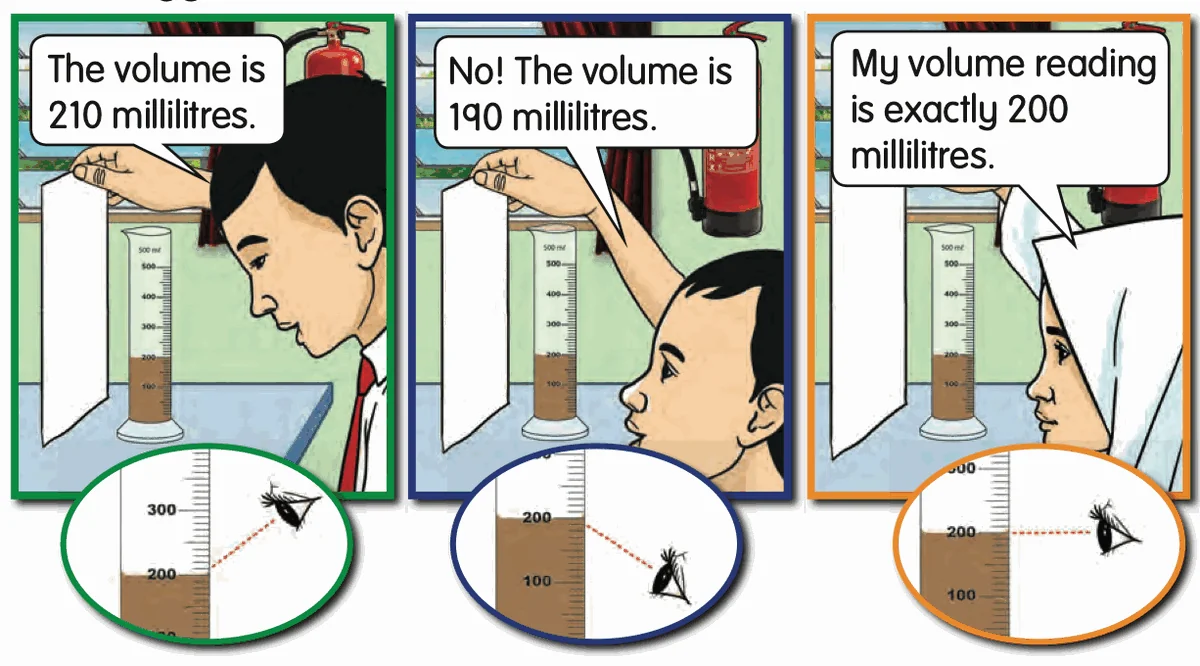
- You can read the volume of a liquid with your eyes level with the meniscus (6.1.5)
- You can find the volume of a stone using the water displacement method (6.1.6)
- You can explain why measuring carefully stops us from wasting things (6.1.7)
6.1Area and volume
A big fish pond can hold more fish than a small one. How do we know which one is bigger? We measure it! In this unit you will measure area and volume.
What is area?
A football field has a big area. Your exercise book has a small area. We write area with a square unit. Look at the little "2" at the top: cm2 is said "square centimetre".
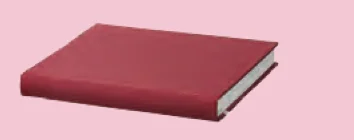 Booksquare centimetre (cm²)
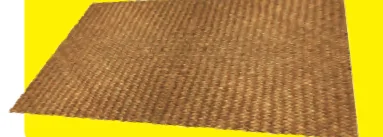 Matsquare metre (m²)
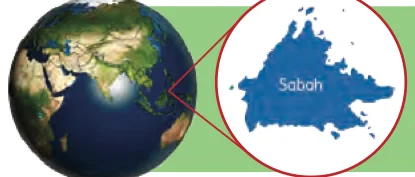 Sabahsquare kilometre (km²)
Pictures: Science Year 3 (DLP) textbook, p. 80.
Measuring the area of a regular surface
A regular surface has straight sides, like a card, a tile or a book cover. We can fill it with paper squares. Each square is 1 cm long and 1 cm wide. One square has an area of 1 cm².
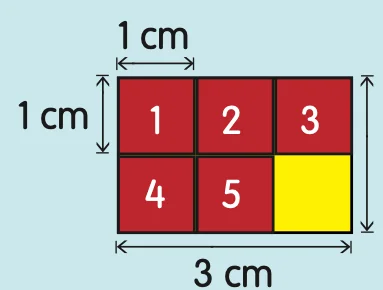
- Paste 1 cm × 1 cm paper squares on the card. Leave no gaps.
- Count the squares.
- The number of squares is the area in cm².
Show answerHide answer
Estimating the area of an irregular surface
An irregular surface has a wavy or odd shape, like a leaf, a starfish or a puddle. Paper squares will not fit nicely. So we estimate the area. To estimate means to find a number that is close, not exact.
We use graph paper. Graph paper is paper filled with small squares. On our graph paper each square is 1 cm × 1 cm.
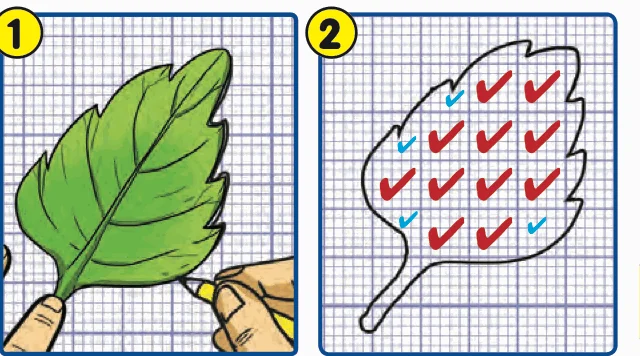
- Put the object on graph paper. Draw around it.
- Tick (✓) every full square.
- Tick every square that is half full or more.
- Do not tick squares that are less than half full.
- Count the ticks. That is the area in cm².
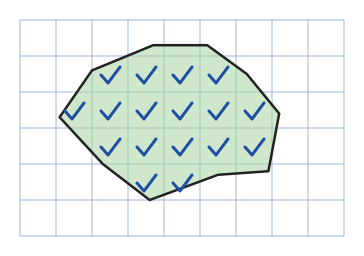
Show answerHide answer
What is volume?
A school bus can carry more pupils than a van. The bus is bigger, so its volume is bigger.
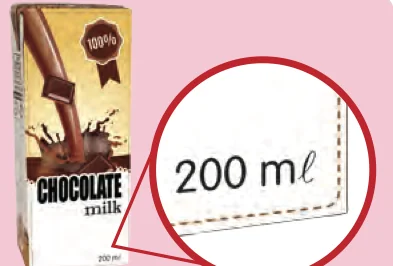 Carton of milkmillilitre (mℓ)
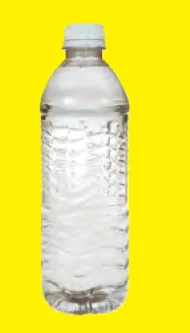 Bottle of waterlitre (ℓ)
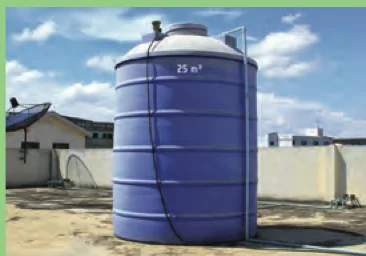 Water tankcubic metre (m³)
Pictures: Science Year 3 (DLP) textbook, p. 85.
Solids such as boxes use cubic centimetre (cm³). Look at the little "3" at the top: it means "cubic".
Measuring the volume of a hollow box
A hollow box is empty inside. We fill it with small cubes. Each cube is 1 cm long, 1 cm wide and 1 cm high. One cube has a volume of 1 cm³.
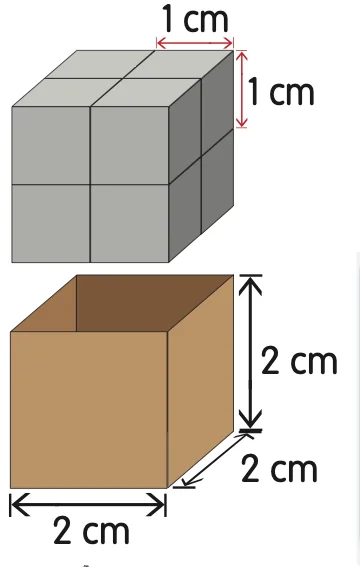
Empty box: 2 cm × 2 cm × 2 cm
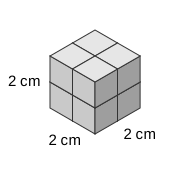
Filled with cubes: 8 cubes = 8 cm³
Left picture: textbook p. 86.
The box needs 8 cubes to fill it. So its volume is 8 cm³.
Show answerHide answer
Measuring the volume of a liquid
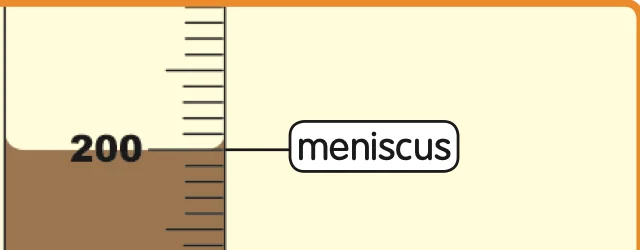
We use a measuring cylinder or a beaker. A measuring cylinder is a tall glass tube with a scale on it.
Water in a thin tube is not flat on top. It curves down in the middle. This curve is called the meniscus.
Volume of an irregular solid
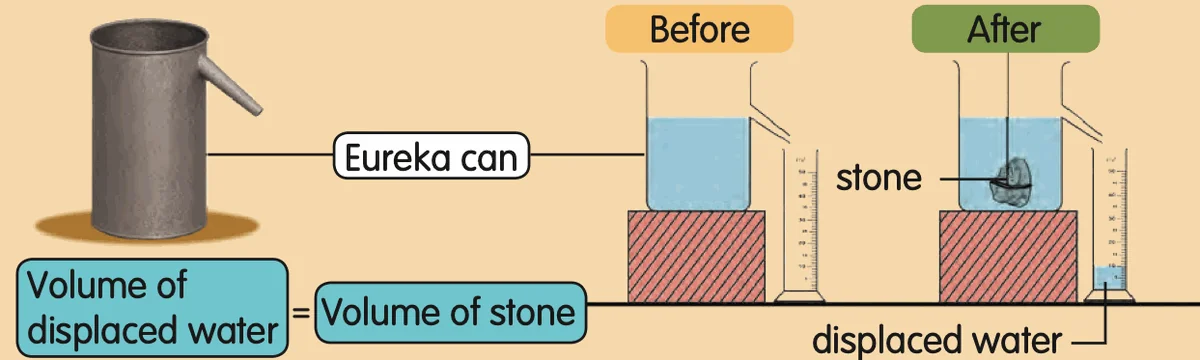
A stone, a key or a padlock has an odd shape. We cannot fill it with cubes. We use the water displacement method. "Displace" means "push away". The stone pushes the water up. The water that moves up has the same volume as the stone.
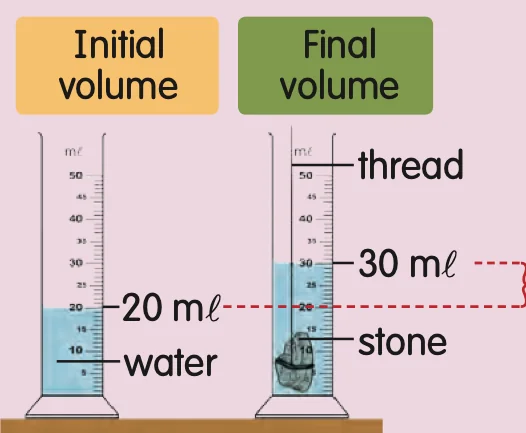
- Pour some water into a measuring cylinder. Read it. This is the initial volume (start): 20 mℓ.
- Tie the stone with thread. Lower it slowly into the water.
- Read the water level again. This is the final volume (end): 30 mℓ.
- Volume of stone = final volume − initial volume = 30 − 20 = 10 cm³.
Show answerHide answer
Why measuring is important
Measuring helps us not waste things. Lim's father wants new tiles for his floor. He measures the area of the floor first. Then he buys just enough tiles. If he does not measure, he may buy too many (waste money) or too few (not enough tiles).
Summary
| What | Units | How we measure |
|---|---|---|
| Area of a regular surface | cm², m², km² | Fill with 1 cm × 1 cm paper squares and count |
| Area of an irregular surface | cm² | Draw around it on graph paper; count full and half-or-more squares |
| Volume of a hollow box | cm³, m³ | Fill with 1 cm³ cubes and count |
| Volume of a liquid | mℓ, ℓ | Measuring cylinder; eyes level with the meniscus |
| Volume of an irregular solid | cm³ | Water displacement: final volume − initial volume |
Measuring carefully helps us to avoid wastage.