Celebrations
What this chapter covers
- I can say and write ordinal numbers (first to thirty-first) and give the date, "It's on 13 September." (4.1)
- I can say what people are going to do using be going to, like "I'm going to be a nurse." (4.2)
- I can read about celebrations in other countries and say what people are going to do on those days (4.3)
- I can make negative sentences with isn't / aren't / am not going to, like "I'm not going to go to bed early." (4.3)
- I can ask and answer Yes/No questions with Is / Are ... going to ...? (4.4)
- I can write a diary entry about a special day, starting with "Dear diary," (4.5)
- I can read a story and understand its value, "Always do the right thing." (4.6)
- I can read a story about a wish and explain the cause of events, "Be careful what you wish for." (4.7)
- I can say and spell words with oi and oy, like coin, boil, toys and boy (4.8)
Welcome to Module 4! You will meet Greg, Anna and their friends as they get ready for special days. You will learn ordinal numbers and dates, say what people are going to do, write a diary entry and read two stories.
4.1Sing a song: Special Days
Ordinal numbers show the order of things: first, second, third. We use them for dates.
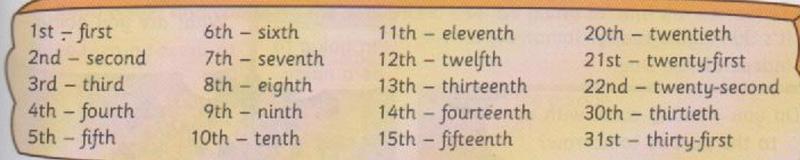
Get Smart Plus 4, p. 37.
| Number | Word | Number | Word |
|---|---|---|---|
| 1st | first | 12th | twelfth |
| 2nd | second | 13th | thirteenth |
| 3rd | third | 20th | twentieth |
| 5th | fifth | 21st | twenty-first |
| 8th | eighth | 22nd | twenty-second |
| 9th | ninth | 30th | thirtieth |
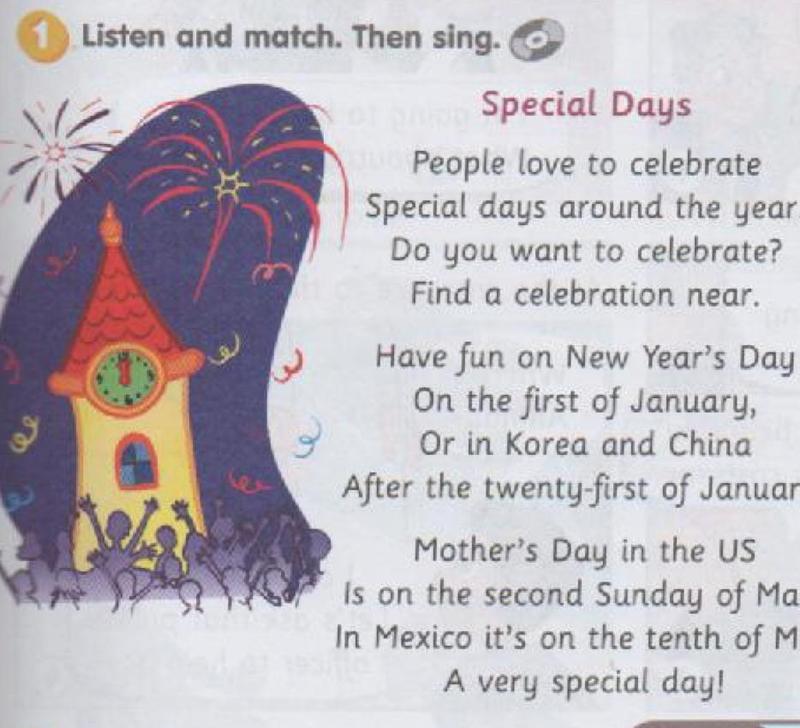
Get Smart Plus 4, p. 37.
The song is about special days around the year: New Year's Day on the first of January (in Korea and China it is after the twenty-first of January), and Mother's Day on the second Sunday of May in the US but on the tenth of May in Mexico.
| Question | Answer |
|---|---|
| What's the date today? | It's 3 November. (say: the third of November) |
| When's your birthday? | It's on 13 September. (say: the thirteenth of September) |
Show answerHide answer
4.2Smart kids: I'm going to be a nurse
New words: dress up as, costume, parade, scout, nurse, soldier, police officer, entrance.
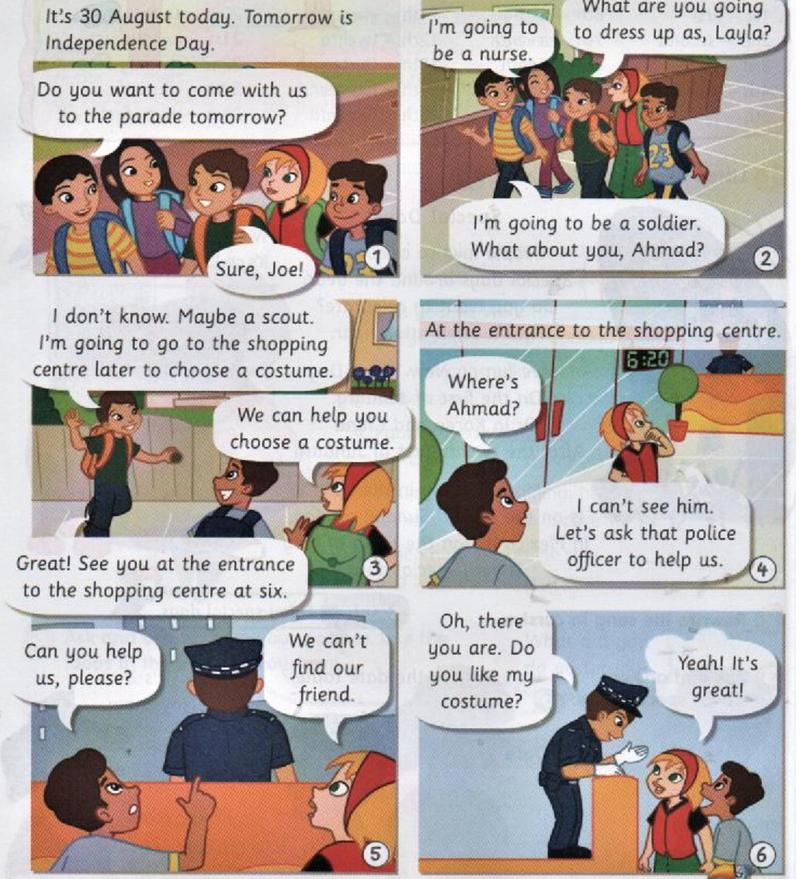
Get Smart Plus 4, p. 38.
The story: It is 30 August, and tomorrow is Independence Day. Joe asks his friends to come to the parade. Layla is going to be a nurse and Joe is going to be a soldier. Ahmad does not know yet; maybe he will be a scout. He is going to go to the shopping centre later to choose a costume. His friends say they can help him and agree to meet at the entrance at six. At the entrance they cannot see Ahmad, so they ask a police officer for help. Ahmad is the police officer in the costume, and he likes it.
Pattern: be going to (plans)
| Who | Be | Example |
|---|---|---|
| I | am (I'm) going to | I'm going to be a nurse. |
| He, She, It | is (He's, She's) going to | He's going to dress up as a soldier. |
| We, You, They | are (We're, They're) going to | We're going to have a party. |
We use be going to + the plain action word to talk about what we plan to do in the future: "I'm going to go to the parade."
Show answerHide answer
4.3Our world: Celebrations around the world
New words: stay up (not go to bed), money, fireworks, decorate, barbecue, give.
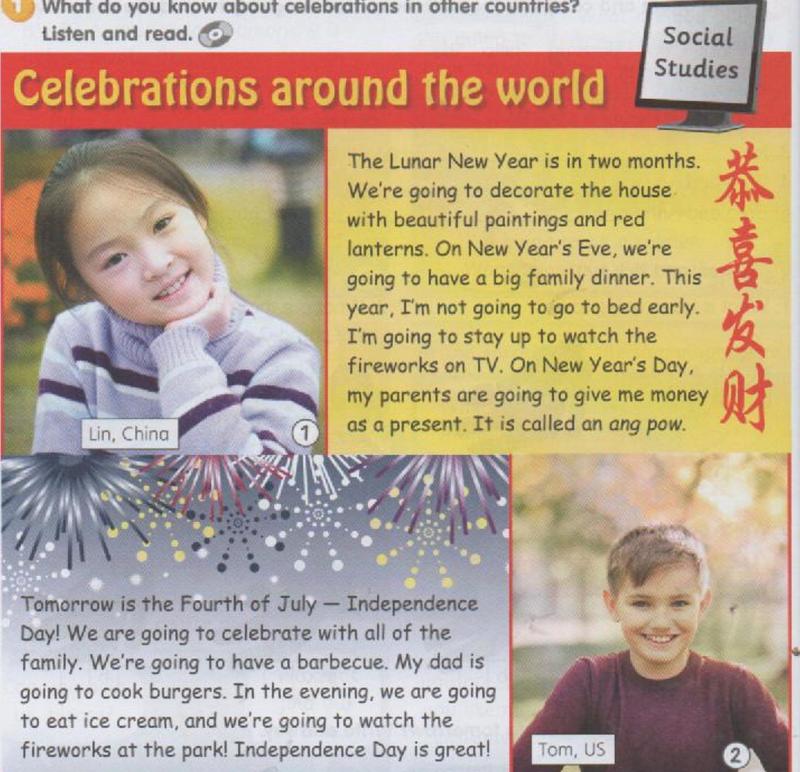
Get Smart Plus 4, p. 40.
| Lunar New Year (Lin, China) | Independence Day (Tom, US) | |
|---|---|---|
| When | In two months; New Year's Eve and New Year's Day | The Fourth of July (tomorrow) |
| Food | A big family dinner | A barbecue: Dad cooks burgers; ice cream in the evening |
| Other plans | Decorate the house with paintings and red lanterns; stay up to watch fireworks on TV; parents give money (an ang pow) | Celebrate with all the family; watch the fireworks at the park |
Pattern: negative (not going to)
| Who | Negative | Example |
|---|---|---|
| I | I'm not going to | I'm not going to go to bed early. |
| He, She, It | isn't going to | He isn't going to watch TV. |
| We, You, They | aren't going to | You aren't going to decorate the house. |
Show answerHide answer
4.4Let's play: Is he going to swim?
| Question | Yes | No |
|---|---|---|
| Is he / she going to watch TV? | Yes, he / she is. | No, he / she isn't. |
| Are you / they going to swim? | Yes, I am. / Yes, we / they are. | No, I'm not. / No, we / they aren't. |
In the guessing game, a player asks "Is it a boy or a girl?" and then "Is he going to swim?" until they find out who it is.
Show answerHide answer
4.5Project: Sabrina's special day
I'm very happy. Tomorrow is a very special day. It's 21 June, my birthday! I'm going to have a party. All my friends are going to come to my house. We're going to play and dance. I'm going to decorate the house and Mum is going to make sandwiches for us. Dad is going to make me a chocolate cake. We're going to have so much fun!
Bye for now,
Sabrina
Writing tip: start with "Dear diary,". Say where you are going to go, what you are going to do there, and who is going to be there.
| Question | Answer from the diary |
|---|---|
| When is Sabrina's birthday? | On 21 June. |
| What is she going to do? | Have a party, play and dance with friends, and decorate the house. |
| Who is going to make the cake? | Her dad. |
Show answerHide answer
4.6Story time: Prince Nebi's ring
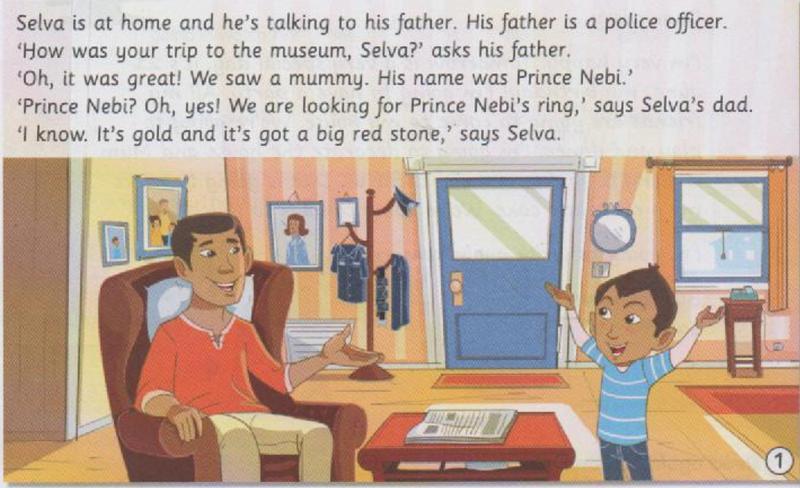
Get Smart Plus 4, p. 44.
Summary: Selva visits the museum and sees a mummy called Prince Nebi. His father, a police officer, says that Prince Nebi's ring is missing. It is gold with a big red stone. The next day is 31 August, Independence Day. Nora is dressed as a soldier and Selva as a police officer. They see a man's hat and want to give it back to him. The man sees Selva's father and the children running and puts his arms up. Selva sees that he is wearing Prince Nebi's ring, so they get it back. Their picture is in the newspaper and the class cheers.
Show answerHide answer
4.7Let's Read: The Wishing Fish
New words: fishing rod, line, pull, wool, think.
The story (pp. 46-47): Omar lives on a small farm. His family works hard but he does not like working. One morning he goes to the river with a new fishing rod and catches a big Wishing Fish. The fish says it can make his wish come true if he lets it go. Omar wishes for all the sheep to go away so he never has to work again. The next day it is very hot and it does not rain for many days. Many sheep die because there is no water. The family has no wool to sell, so they have no money. Omar is sad and says it is his fault. He has to catch the Wishing Fish again.
| Cause (why) | Effect (what happened) |
|---|---|
| It was very hot and it did not rain for many days, so there was no water | Many sheep died |
| The sheep died | No wool to sell, so no money |
| Omar did not like working | He made a bad wish |
Show answerHide answer
4.8Phonics: oi and oy
The letters oi and oy make the same sound, like in coin and boy. We usually write oy at the end of a word and oi in the middle.
| Sound | Book words | More words |
|---|---|---|
| oi | coin, boil | oil, noise |
| oy | toys, boy | enjoy, joy |
Get Smart Plus 4, p. 122 (Phonics 4).
Show answerHide answer
Summary
| Topic | Remember |
|---|---|
| Ordinals | first, second, third ... fifth, eighth, ninth, twelfth, twentieth, twenty-first, thirtieth, thirty-first. |
| Dates | What's the date today? It's 3 November. When's your birthday? It's on 13 September. |
| Plans | I'm / He's / We're going to + plain verb. |
| Negative | I'm not going to ... He / She isn't going to ... We / They aren't going to ... |
| Questions | Is he going to swim? Yes, he is. / No, he isn't. Are they going to swim? Yes, they are. / No, they aren't. |
| Writing | Diary entry: Dear diary, ... Bye for now, |
| Cause | Use because to give the reason. |
| Phonics | oi and oy: coin, boil, toys, boy. |
| Values | Enjoy special days. Honour your national history. Always do the right thing. Be careful what you wish for. |