Helping out
What this chapter covers
- I can ask for and offer help with verbs like help, carry bags and pick up rubbish (7.1)
- I can use the object pronouns me, you, him, her, it, us and them, like "Help us clean the park." (7.1)
- I can ask "Whose ... is this?" and answer with my / mine, your / yours, his, her / hers, our / ours and their / theirs (7.2)
- I can read a story and say what the characters do and whose things they find (7.2)
- I can read a text about recycling and say what we can and can't recycle (7.3)
- I can use someone, something, everyone and everything, and no one, nothing, anyone and anything (7.3, 7.4)
- I can read a story and understand its value, "Be helpful to others." (7.5)
- I can say and spell words with the sounds ay, ai /ei/ and i, ie /ai/ (7.6)
Welcome to Module 7! You will learn how to help other people, say whose things are whose, talk about recycling, and use words like someone and nothing.
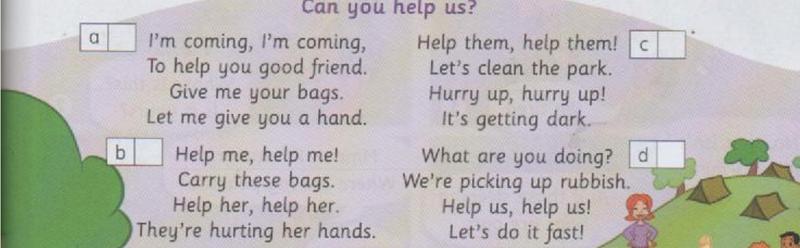
7.1Sing a song: Can you help us?
Words for helping: help, carry bags, pick up rubbish, and hurt (to feel pain). The children in the song carry bags and clean the park.
Get Smart Plus 4, p. 71.
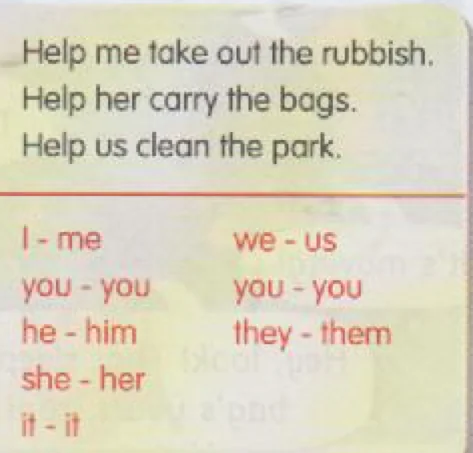
Pattern: subject and object pronouns
After a verb like help, use an object pronoun: "Help me", "Help her", "Help us".
| Subject pronoun | Object pronoun | Example |
|---|---|---|
| I | me | Help me take out the rubbish. |
| you | you | I can help you. |
| he | him | Let's help him. |
| she | her | Help her carry the bags. |
| it | it | Pick it up. |
| we | us | Help us clean the park. |
| they | them | Help them, help them! |
Get Smart Plus 4, p. 71.
Show answerHide answer
7.2Smart kids: Whose is this?
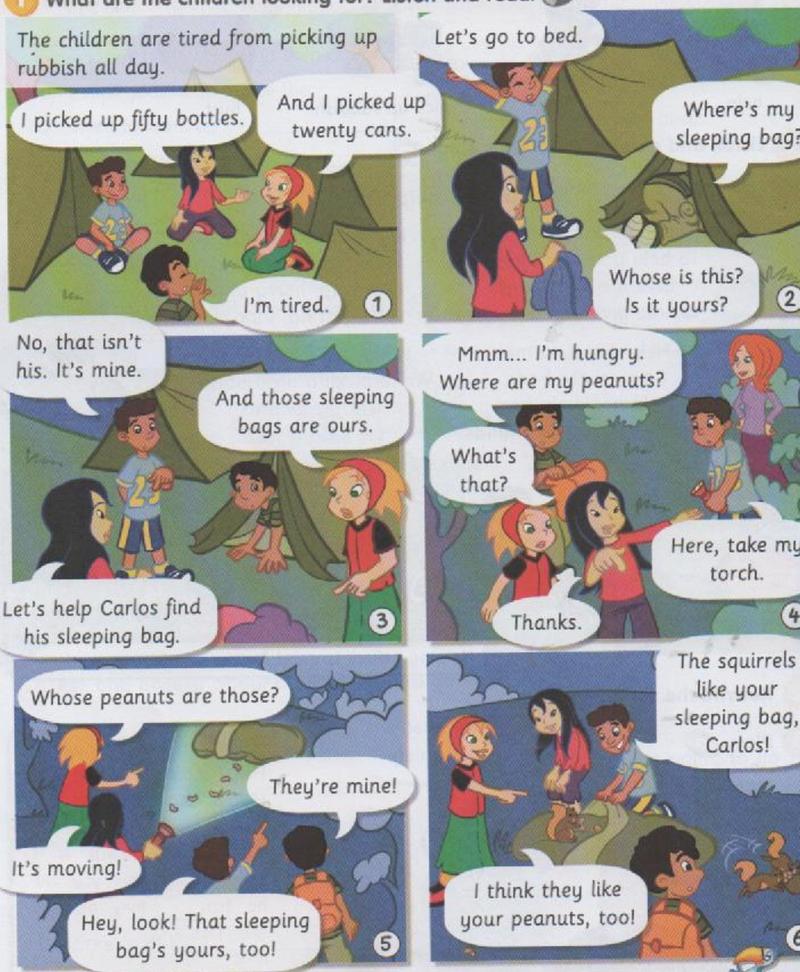
New words: sleeping bag, torch, peanuts, squirrel, tent.
Get Smart Plus 4, p. 72.
The story: The children are tired after picking up rubbish all day. One picks up fifty bottles and another twenty cans. At bedtime a boy cannot find his sleeping bag. The others ask "Whose is this?" They help Carlos find his sleeping bag, and one child shares a torch. In the dark they find some peanuts. Then something moves, and squirrels are in the sleeping bag. The squirrels like Carlos's sleeping bag and his peanuts, too!
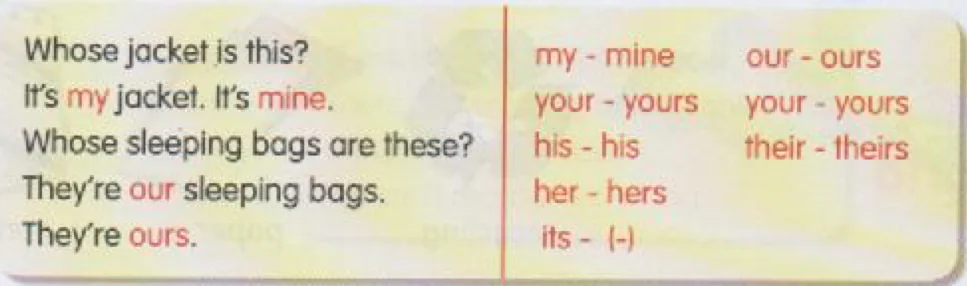
Pattern: Whose ...? and possessives
| Subject | Possessive adjective (before a noun) | Possessive pronoun (stands alone) |
|---|---|---|
| I | my jacket | mine |
| you | your jacket | yours |
| he | his jacket | his |
| she | her jacket | hers |
| it | its | (none) |
| we | our jacket | ours |
| they | their jacket | theirs |
Get Smart Plus 4, p. 73.
Whose sleeping bags are these? They're our sleeping bags. They're ours.
Is this yours? No, that isn't his. It's mine.
For a named person, add 's: "Whose hat is this?" "It's Alex's."
Show answerHide answer
7.3Our world: Help the Earth, recycle!
New words: recycling, paper, metal, glass, plastic, jar.
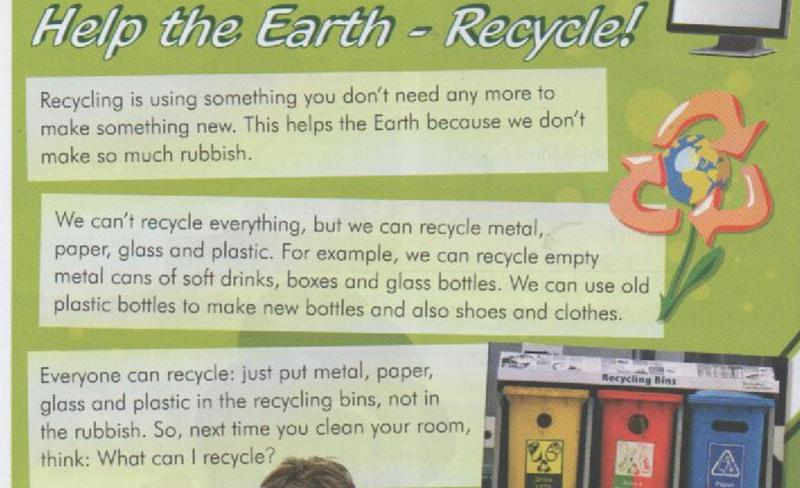
Get Smart Plus 4, p. 74.
- We can't recycle everything. We can recycle metal, paper, glass and plastic.
- For example, empty metal drink cans, boxes and glass bottles.
- Old plastic bottles can become new bottles, and also shoes and clothes.
- Put these things in the recycling bins, not in the rubbish.
Pattern: someone, something, everyone, everything
| Word | Means | Example |
|---|---|---|
| someone | a person, but we don't say who | There is someone at the door. |
| something | a thing, but we don't say what | There is something on the table. |
| everyone | all the people | Everyone can recycle. |
| everything | all the things | We can't recycle everything. |
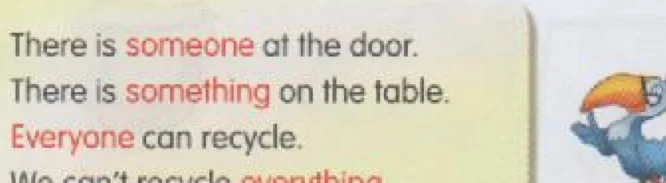
Get Smart Plus 4, p. 75.
Show answerHide answer
7.4Let's play: no one, nothing, anyone, anything
The board game on p. 76 asks questions about the rubbish bin, the fridge, a tent and a sleeping bag. Use these words to say that no one or nothing is there.
| Positive question | Negative with no one / nothing | Negative with not ... anyone / anything |
|---|---|---|
| Is there anyone in the tent? | There's no one in the house. | There isn't anyone on the bus. |
| Is there anything in the fridge? | There's nothing on the table. | There isn't anything in the fridge. |
Get Smart Plus 4, p. 76.
Project (p. 77): choose something you don't need any more, such as an old jam jar. Change it and make something new: wash it, paint flowers or birds on it, and use it as a pencil holder. This is recycling, too.
Show answerHide answer
7.5Story time: The lost boy 2
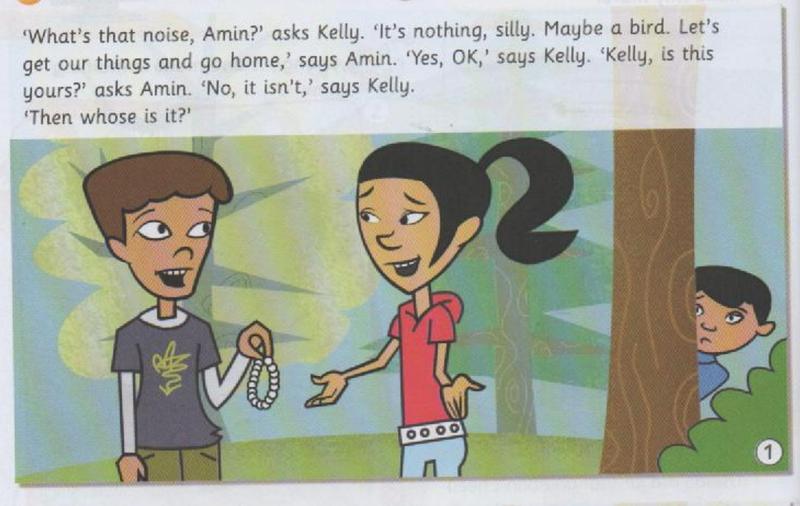
Get Smart Plus 4, p. 78.
The story: Kelly and Amin hear a noise in the trees. Amin finds a string of beads and asks Kelly, "Is this yours?" Kelly says no. A voice behind the trees says, "It's my cat's." It is a little boy, Adam. Adam is lost, and he has lost his cat, Tiger, too. He doesn't know where he lives, so Kelly and Amin take him to the police station to find his parents. Later Adam is at home. His parents were very worried. Tiger is at home too, and Adam is happy.
Show answerHide answer
7.6Phonics: ay, ai and i, ie
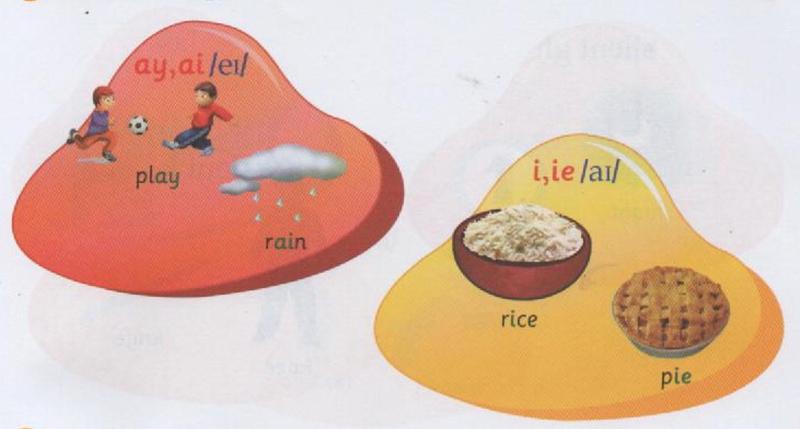
Get Smart Plus 4, p. 125 (Phonics 7).
| Letters | Sound | Words |
|---|---|---|
| ay, ai | /ei/ | play, rain, day, train |
| i, ie | /ai/ | rice, pie, pies |
The chant "On the train" has many of these words: train, rain, play, day, Fay, pies, rice.
Show answerHide answer
Summary
| Topic | Remember |
|---|---|
| Object pronouns | me, you, him, her, it, us, them: Help me. Help us. |
| Whose | Whose bag is this? It's my bag. It's mine. (yours, his, hers, ours, theirs) |
| Recycling | We can recycle metal, paper, glass and plastic. We can't recycle everything. |
| someone / something | someone = a person, something = a thing; everyone = all people, everything = all things. |
| Negatives | no one, nothing; isn't anyone, isn't anything. Only one negative word. |
| Phonics | ay, ai = /ei/ (play, rain); i, ie = /ai/ (rice, pie). |
| Values | Helping others is good for the community. Always help your friends. Help protect the environment. Be helpful to others. |