Science questions, unit 1
Nama / NameKelas / ClassTarikh / Date
Scientific skills
42 marks. Use Practice to check each answer as you go, or Exam to answer everything first. Ask a grown-up to help you mark the written answers.
Section A: objective questions
10 marksChoose the best answer for each question.
1
Question 1
Aishah watches the rubbish at the back of the school. She notices that it increases each day and that it smells unpleasant. Which science process skill is she using?
Show answerHide answer
B
Using the senses to get information, such as sight and smell, is observing.
2
Question 2
Four pupils collect paper, glass, metal and plastic rubbish into separate boxes. Which skill do they use?
Show answerHide answer
C
Sorting things into groups by their type is classifying.
3
Question 3
A shop buys aluminium cans at RM4.00 per kilogram. Hana has 3 kg of cans. How much money can she predict to get?
Show answerHide answer
A
RM4.00 × 3 = RM12.00.
4
Question 4
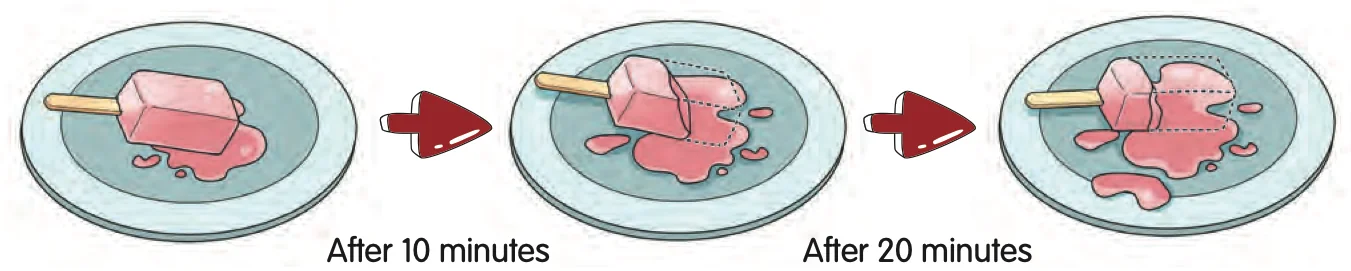
Diagram 1 shows a popsicle left in the sunlight. Which statement uses the space-time relationship?
Show answerHide answer
D
The space-time relationship links a change in a parameter, here size, to time.
5
Question 5
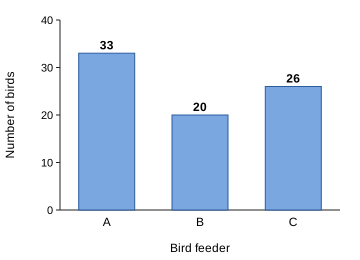
Diagram 2 shows the total number of birds at three bird feeders in five days. Which is the correct interpretation?
Show answerHide answer
B
Feeder B has the shortest bar (20 birds), so it was visited least. Feeder A (33) was visited most.
6
Question 6
Siva soaks tissue papers in 50 mℓ of water and measures the water left in each beaker. What is the operational definition of the ability of a tissue paper to absorb water?
Show answerHide answer
C
Operational definitions say what is measured. Here the volume of water left shows how much was absorbed.
7
Question 7
Fariz and Mei Lan investigate the effect of the volume of water on the growth of a plant. What is the manipulated variable?
Show answerHide answer
A
The manipulated variable is the one that the pupils change on purpose: the volume of water.
8
Question 8
In a fair test of plant growth, the quantity of soil is the same for both plants. What kind of variable is the quantity of soil?
Show answerHide answer
D
A variable that is kept the same is a constant variable.
9
Question 9
Mei Lan and Fariz investigate whether stirring changes the time taken for sugar to dissolve in warm water. Which of these is a hypothesis for their investigation?
Show answerHide answer
A
A hypothesis is a testable statement that relates the manipulated variable to the responding variable. The second option is a problem statement, the third is a step and the last is a result.
10
Question 10
In an experiment, the data has been collected and interpreted. What is the next stage?
Show answerHide answer
C
After interpreting the data you decide whether the hypothesis is accepted, which is the conclusion. Writing the report comes after that.
Section B: structured questions
32 marksAnswer all questions. Circle the answer or write it in the space.
11
Question 11
A group of pupils clean up their school. Choose the science process skill used in each sentence, from: observing, classifying, predicting, communicating.
[1 mark]
(a)"The rubbish increases each day and the smell is unpleasant."
Show answerHide answer
Observing
[1 mark]
(b)"We will sort the rubbish according to its type."
Show answerHide answer
Classifying
[1 mark]
(c)"We will get RM8.00 by selling the aluminium cans."
Show answerHide answer
Predicting
12
Question 12
Mei Lan puts a pencil and a coin into a beaker of water. The pencil floats on the water. The coin rests at the bottom of the beaker.
[1 mark]
(a)State one observation.
Show answerHide answer
Tick each point you got.
[1 mark]
(b)Make an inference from your answer in (a).
Show answerHide answer
Tick each point you got.
[1 mark]
(c)Predict what happens if Mei Lan ties three pencils together with a rubber band and puts them in the water.
Show answerHide answer
Tick each point you got.
13
Question 13
A popsicle is placed under the sunlight for 20 minutes, as in Diagram 3.
[2 marks]
(a)State two parameters of the popsicle that change.
Show answerHide answer
Tick each point you got.
[1 mark]
(b)Complete the sentence. As time increases, the size of the popsicle ______.
Show answerHide answer
decreases
14
Question 14
Fariz counts the birds at three bird feeders for five days. Diagram 4 shows the total for each feeder.
[1 mark]
(a)The bird feeder with the most birds in 5 days is ______.
Show answerHide answer
A
[1 mark]
(b)How many more birds visited feeder C than feeder B?
Show answerHide answer
Tick each point you got.
[1 mark]
(c)Feeder A had 4 birds on day 1 and 8 birds on day 2. How many birds visited feeder A on days 1 and 2 altogether?
Show answerHide answer
Tick each point you got.
[1 mark]
(d)Give one reason why feeder A might be the favourite of the birds.
Show answerHide answer
This is an inference from the data. It can be true or false.
Tick each point you got.
15
Question 15
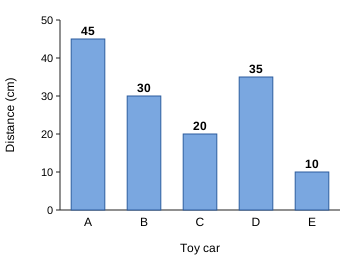
Diagram 5 shows the distance travelled by five toy cars, A to E, on the same floor.
[1 mark]
(a)Which toy car travelled the farthest?
Show answerHide answer
Tick each point you got.
[1 mark]
(b)What is the difference between the distance travelled by cars A and E?
Show answerHide answer
Tick each point you got.
[1 mark]
(c)How much farther did car D travel than car C?
Show answerHide answer
Tick each point you got.
16
Question 16
Siva and Teruni soak three tissue papers P, Q and R of different thickness in 50 mℓ of water each for one minute. They measure the volume of water left in each beaker. Their results are in the table.
| Tissue paper | P | Q | R |
|---|---|---|---|
| Volume of water left (mℓ) | 30 | 20 | 5 |
[1 mark]
(a)Which tissue paper absorbed the most water?
Show answerHide answer
R
R left the least water in the beaker (5 mℓ).
[1 mark]
(b)How much water did tissue paper Q absorb?
Show answerHide answer
Tick each point you got.
[1 mark]
(c)State the operational definition of the tissue paper that absorbs the most water.
Show answerHide answer
Tick each point you got.
17
Question 17
Siti wants to find out whether the volume of water affects the height of a bean plant. She uses three pots of the same size with the same soil and the same type of bean plant. She waters the plants with 50 mℓ, 100 mℓ and 150 mℓ of water each day and puts all the pots in the same place.
[1 mark]
(a)Name the manipulated variable.
Show answerHide answer
Tick each point you got.
[1 mark]
(b)Name the responding variable.
Show answerHide answer
Tick each point you got.
[1 mark]
(c)State one constant variable.
Show answerHide answer
Tick each point you got.
[2 marks]
(d)Write a hypothesis for this investigation.
Show answerHide answer
A hypothesis links the manipulated variable (volume of water) to the responding variable (height). Either direction is accepted if it is a clear, testable statement.
Tick each point you got.
18
Question 18
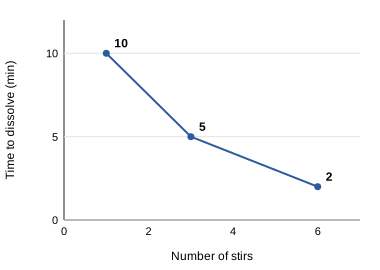
Mei Lan and Fariz stir sugar in three beakers of warm water and record the time taken for the sugar to dissolve completely. Diagram 6 shows the results.
[1 mark]
(a)How long did the sugar take to dissolve when it was stirred 3 times?
Show answerHide answer
Tick each point you got.
[1 mark]
(b)How many minutes faster was it with 6 stirs than with 1 stir?
Show answerHide answer
Tick each point you got.
[1 mark]
(c)Their hypothesis is that the more the number of stirs, the less the time to dissolve. Is the hypothesis accepted?
Show answerHide answer
Yes
As the number of stirs increases (1, 3, 6), the time decreases (10, 5, 2 minutes).
[1 mark]
(d)Why must the quantity of sugar be the same in all three beakers?
Show answerHide answer
Tick each point you got.
19
Question 19
Pupils build a rocket model from a bottle. They pour vinegar into the bottle, add baking soda wrapped in tissue, then flip the bottle upside down. They record the time the rocket stays in the air. Plan an experiment to find out what makes the rocket stay in the air longer.
[1 mark]
(a)Write a problem statement.
Show answerHide answer
Tick each point you got.
[2 marks]
(b)State the manipulated variable and the responding variable.
Show answerHide answer
Tick each point you got.
[1 mark]
(c)State one constant variable.
Show answerHide answer
Tick each point you got.