Learning world
What this chapter covers
- I can name school subjects and talk about homework, teachers and what I am good at (5.1)
- I can read a short project about schools in other countries and find the writer's opinion (5.2)
- I can use the present continuous to say what is happening now, in affirmative and negative sentences (5.3)
- I can use verbs for studying a language, such as revise, check, repeat, practise and make notes (5.4)
- I can ask present continuous questions and give short answers, like "Are you learning English? Yes, I am." (5.5)
- I can tell the difference between the present simple (routines) and the present continuous (now) (5.5)
- I can ask for help with languages: "How do you spell that?" and "Can you say that again, please?" (5.6)
- I can write an email to give information about my school, using so (5.7)
Welcome to Learning world (Unit 4 in the textbook, Unit 5 on this site)! You will learn the names of school subjects, read about unusual schools, say what is happening now, and ask for help when you study a language.
5.1Vocabulary: school subjects
Learn these ten school subjects (p. 42).
| Subject | What it is about |
|---|---|
| maths | numbers, adding, taking away, multiplying |
| science | experiments, plants, animals, materials |
| English, Spanish | languages (Spanish is another language you can study) |
| geography | maps, countries and the world (a globe) |
| history | people and events from long ago |
| art | drawing and painting |
| PE | Physical Education: sport and exercise |
| ICT | Information and Communication Technology: computers |
| PSHE | Personal, Social, Health and Economic Education |
English Plus 1 Year 5, p. 42.
The School Questionnaire on p. 42 uses these questions. Notice which subject word goes in each gap.
| Question | Subject word you can use |
|---|---|
| Are you good at ____? | PE, maths, art |
| When's our next ____ exam? | geography, history, science |
| Have you got ____ homework today? | history, maths |
| Do you study other languages, like ____? | Spanish |
Key phrases: talking about school subjects (p. 43)
| To say... | Use |
|---|---|
| how much homework you have | I've got no / a bit of / loads of maths homework. |
| what a teacher is like | Our art teacher is / isn't very / quite strict. |
| what you are good at | I'm great at ... / I'm really good at ... / I'm OK at ... / I'm not great at ... |
| what you like | I enjoy ... / I prefer ... |
Show answerHide answer
5.2Reading: Schools project
Skill: identify the writer's opinion. A fact can be checked ("The boat goes along the river"). An opinion tells us what the writer thinks ("It's a great idea").
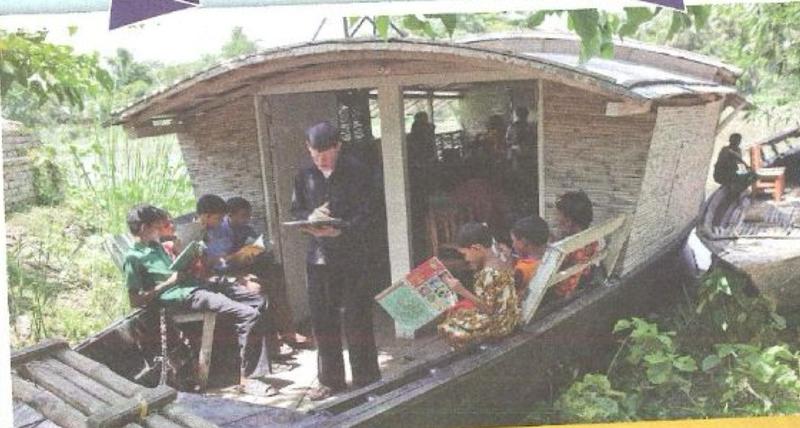
English Plus 1 Year 5, p. 44.
| School | Where | What we learn |
|---|---|---|
| Boat school | Bangladesh | Transport can be a big problem when there is a lot of rain, so the boat takes students along the river to and from their villages at the start and end of the day. |
| Eton College | Britain | One of the oldest and most expensive private schools. It is a boarding school: students study, eat and sleep there. |
| Chinese primary school | China | Students do eye exercises twice a day to relax their eyes while they study. |
| Secondary school | Ireland | A dance class: the writer is watching the dancers, and the teachers are playing the musical instruments. |
Show answerHide answer
5.3Language focus: present continuous (affirmative and negative)
Form: am / is / are + verb with -ing.
| Subject | Affirmative | Negative |
|---|---|---|
| I | I'm watching the dancers. | I'm not dancing. |
| He / She / It | The boat is moving. | The boat isn't moving. |
| We / You / They | The students are studying. | These students aren't sleeping. |
Examples from the text on English Plus 1 Year 5, p. 44; rules p. 45.
Spelling rules for -ing
| Rule | Example |
|---|---|
| Most verbs: add -ing | study → studying, wear → wearing, do → doing |
| Verbs ending in e: remove the e, add -ing | move → moving, have → having, dance → dancing |
| Short verbs ending in one vowel + one consonant: double the last letter, add -ing | chat → chatting, sit → sitting |
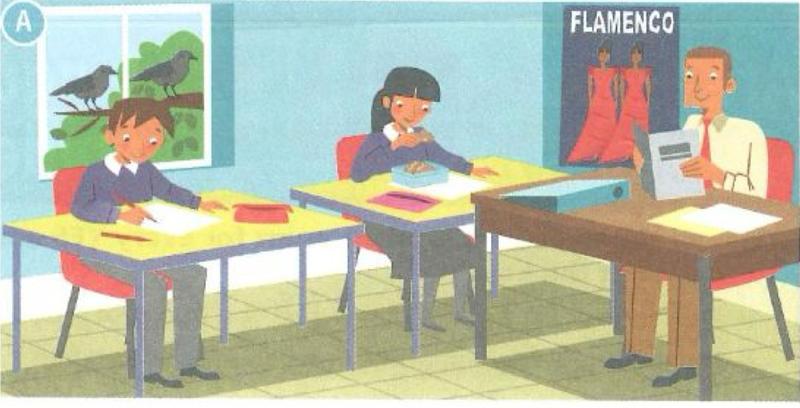 Picture A
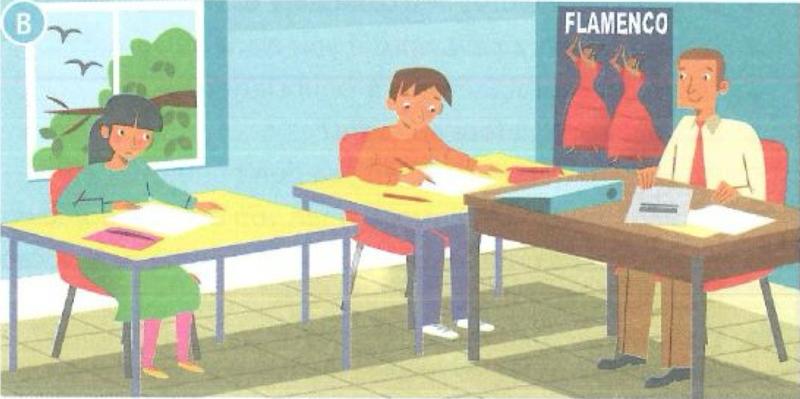 Picture B
Spot the differences. In B: the birds are flying, the boy is wearing an orange top, the girl isn't opening a box.
English Plus 1 Year 5, p. 45.
Show answerHide answer
5.4Vocabulary and listening: studying a language
The quiz "Are you a super language student?" (p. 46) uses these verbs.
| Verb | Example |
|---|---|
| listen to | Do you listen to English when you're out of school? |
| spell, know, check | Can you spell your name? Do you check words in a dictionary? |
| repeat, learn, practise | Do you repeat a new word if you want to learn it? |
| revise | Do you revise before an exam? (study again) |
| ask, understand, concentrate | Do you ask questions when you don't understand? |
| make notes, write, read | Do you make notes about grammar? |
English Plus 1 Year 5, p. 46.
Show answerHide answer
5.5Language focus: questions, and present continuous or present simple
Present continuous questions
| Question | Short answers |
|---|---|
| Am I ...-ing? / Are you learning English? | Yes, I am. / No, I'm not. |
| Is he / she learning English? | Yes, he / she is. / No, he / she isn't. |
| Are they / you learning the same language? | Yes, we / they are. / No, we / they aren't. |
| What are you doing now? | I'm watching TV. |
English Plus 1 Year 5, p. 47.
Present simple or present continuous?
| Present simple | Present continuous | |
|---|---|---|
| Use for | a routine or repeated action | an action happening now |
| Time words | always, usually, sometimes, every day | now, today, at the moment |
| Example | We sometimes do projects. They always wear a uniform. | We're doing a project today. They're wearing their uniform now. |
Show answerHide answer
5.6Speaking: asking for help when you're studying
Zac is revising for a French exam. He cannot remember the word for "tomorrow", so he asks Jasmine for help. She says it is "demain" and spells it D-E-M-A-I-N.
| Asking for help with languages |
|---|
| How do you spell that? |
| How do you say ... ? |
| Can you say that again, please? |
| Can you help me with something, please? |
English Plus 1 Year 5, p. 48.
Pronunciation: the alphabet
Letters with the same vowel sound go together.
| Sound | Letters |
|---|---|
| /eɪ/ | A, H, J, K |
| /iː/ | B, C, D, E, G, P, T, V |
| /e/ | F, L, M, N, S, X, Z |
| /aɪ/ | I, Y |
| /əʊ/ | O |
| /juː/ | Q, U, W |
| /ɑː/ | R |
Show answerHide answer
5.7Writing: an email about your school
Danny writes to Ela, a visitor, about his school in Ireland. His email gives information about the school and a photo. The writing guide on the same page shows four paragraphs.
| Paragraph | What to write | Starter |
|---|---|---|
| 1 Introduction | Say you are happy about the visit. | I'm really happy that ... |
| 2 The school | Size and place | It's a small / medium-sized / big school ... |
| 3 Timetable and subjects | Start, break, lunch, finish; subjects | Classes here start at ... |
| 4 Photo | Describe your photo | Here's a photo of ... |
English Plus 1 Year 5, p. 49.
More key phrases from the email: "Some subjects, like maths and English, are compulsory", "Other subjects are optional", "Maybe you can email me a photo of your class."
Facts in Danny's email: about 500 students; classes start at 9 a.m. and finish at 4 p.m.; break at 11 a.m.; lunch at 1.20 p.m.; maths and English are compulsory (you must study them); woodwork, business studies and languages are optional (you can choose).
Language point: so
So gives a result. First the reason, then so, then the result.
I like languages, so I study French and Spanish.
Show answerHide answer
5.8Review and games
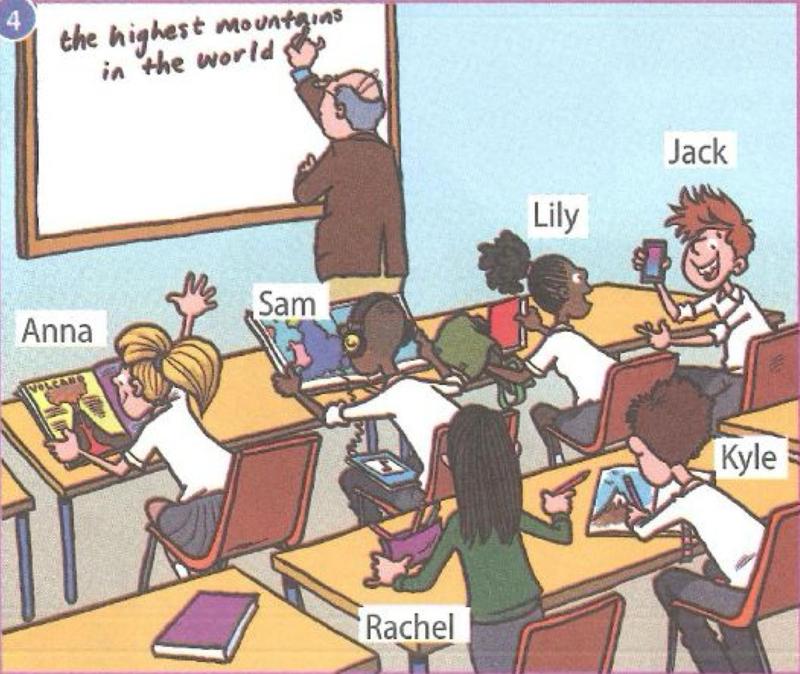
English Plus 1 Year 5, p. 51.
How do you say 'history' in Italian? - I think it's 'storia'.
Can you help me with something, please? - Yeah, sure.
Summary
| Topic | Remember |
|---|---|
| Subjects | maths, science, English, geography, history, art, PE, ICT, PSHE. I'm good at ...; loads of / a bit of / no homework. |
| Reading | A fact can be checked; an opinion says what the writer thinks. |
| Present continuous | am / is / are + verb-ing. Negative: isn't, aren't, I'm not. Spelling: studying, moving, chatting. |
| Questions | Are you learning English? Yes, I am. Is he sleeping? No, he isn't. |
| Simple or continuous | usually, always, sometimes = present simple; now, today, at the moment = present continuous. |
| Study verbs | listen to, repeat, practise, revise, check, understand, concentrate, make notes. |
| Asking for help | How do you spell that? How do you say ...? Can you say that again, please? |
| Writing | Email in four paragraphs; so gives a result. |