Science questions, unit 5
Nama / NameKelas / ClassTarikh / Date
Electricity
43 marks. Use Practice to check each answer as you go, or Exam to answer everything first. Ask a grown-up to help you mark the written answers.
Section A: objective questions
10 marksChoose the best answer for each question.
1
Question 1
Which source of electrical energy changes chemical energy into electrical energy and is used to start up a car?
Show answerHide answer
D
An accumulator converts chemical energy into electrical energy and starts vehicles such as cars. A dry cell also changes chemical energy, but it is used for small things such as toy cars.
2
Question 2
A calculator is powered by a solar cell. What kind of energy does the solar cell change into electrical energy?
Show answerHide answer
A
Solar cells change light energy from the Sun into electrical energy.
3
Question 3
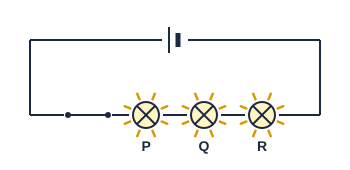
Diagram 1 shows the circuit diagram of three bulbs, P, Q and R. What type of circuit is this?
Show answerHide answer
B
All three bulbs are in one chain with only one path for the electric current. That is a series circuit.
4
Question 4
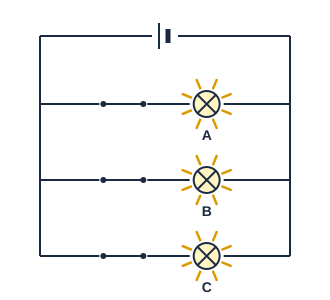
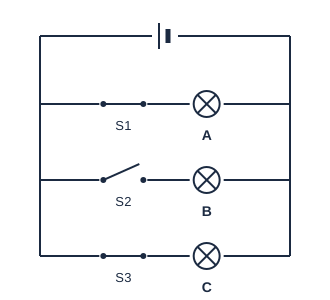
How many paths does the electric current have in the circuit in Diagram 2?
Show answerHide answer
C
Each branch is one path. The circuit has three branches, so there are three paths.
5
Question 5
Which symbol represents an open switch?
Show answerHide answer
B
An open switch is drawn with a gap and a slanted line. A closed switch is a straight line between two dots (P). R is a bulb and S is two dry cells.
6
Question 6
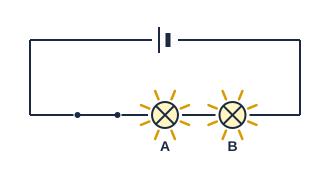
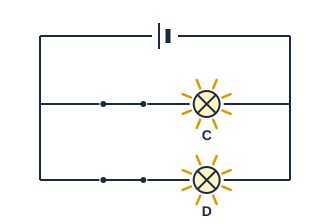
Diagram 3 shows circuit P and circuit Q. Each has one dry cell and two identical bulbs. Which statement is correct?
Show answerHide answer
A
Circuit Q is a parallel circuit. Each branch gets the same electrical energy, so its bulbs are brighter. In series circuit P the two bulbs share the current and are dimmer.
7
Question 7
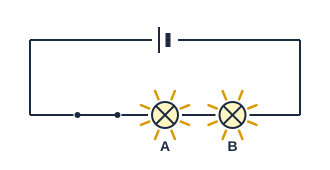
Diagram 4 shows a series circuit. Which change will make bulbs A and B brighter?
Show answerHide answer
C
In a series circuit, more dry cells give brighter bulbs. Another bulb would make every bulb dimmer.
8
Question 8
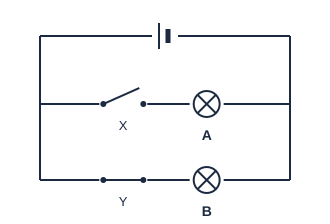
Diagram 5 shows a parallel circuit. Switch X is open and switch Y is closed. Which bulb lights up?
Show answerHide answer
B
Bulb A's branch is incomplete because switch X is open. The branch of bulb B is complete, so bulb B still lights up.
9
Question 9
Which action helps a family to save electrical energy?
Show answerHide answer
C
An LED lamp uses less electrical energy than a filament lamp. The other three actions waste electrical energy.
10
Question 10
Which is a safe way to use electrical appliances?
Show answerHide answer
D
Turn off the switch before pulling out the plug. The other actions can cause a short circuit or electrocution.
Section B: structured questions
33 marksAnswer all questions. Circle the answer or write it in the space.
11
Question 11
Choose the correct answer for each source of electrical energy.
[1 mark]
(a)A dynamo changes ______ energy into electrical energy.
Show answerHide answer
kinetic
When the wheel turns, the dynamo turns too, and kinetic energy is changed into electrical energy.
[1 mark]
(b)A generator changes the chemical energy of ______ into electrical energy.
Show answerHide answer
fossil fuels
[1 mark]
(c)Which source is used in satellites and calculators?
Show answerHide answer
Solar cell
12
Question 12
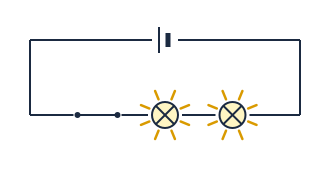
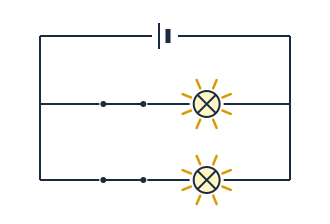
Diagram 6 shows two circuits, R and S, each with two bulbs.
[1 mark]
(a)Circuit R is a ______ circuit.
Show answerHide answer
series
[1 mark]
(b)Circuit S is a ______ circuit.
Show answerHide answer
parallel
[1 mark]
(c)Which circuit has more than one path for the electric current?
Show answerHide answer
S
Each branch of a parallel circuit is a path.
13
Question 13
Diagram 7 shows a circuit drawn with symbols.
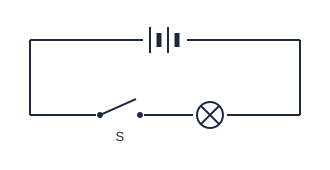
[1 mark]
(a)How many dry cells are in the circuit?
Show answerHide answer
Tick each point you got.
[2 marks]
(b)Is the bulb lit? Give a reason for your answer.
Show answerHide answer
Tick each point you got.
14
Question 14
Mei Ling builds circuits A and B in Diagram 8. Each has one dry cell and three identical bulbs, and all the switches are closed.
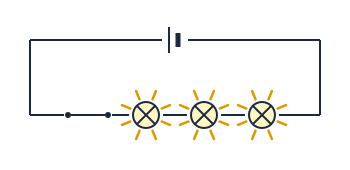
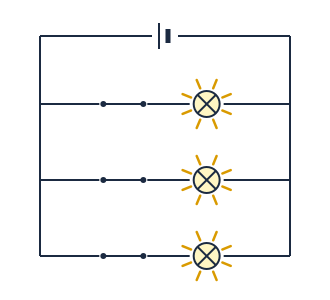
[1 mark]
(a)In which circuit are the bulbs brighter?
Show answerHide answer
Circuit B
[2 marks]
(b)Explain your answer.
Show answerHide answer
Tick each point you got.
15
Question 15
Aiman builds series circuits with one bulb and a different number of dry cells. He observes the brightness of the bulb. The table shows his results.
| Number of dry cells | Brightness of the bulb |
|---|---|
| 1 | bright |
| 2 | brighter |
| 3 | brightest |
[1 mark]
(a)State the manipulated variable.
Show answerHide answer
Tick each point you got.
[1 mark]
(b)State the responding variable.
Show answerHide answer
Tick each point you got.
[2 marks]
(c)Write a conclusion for this investigation.
Show answerHide answer
Tick each point you got.
16
Question 16
Diagram 9 shows three parallel circuits with one, two and three bulbs. Each uses one dry cell.
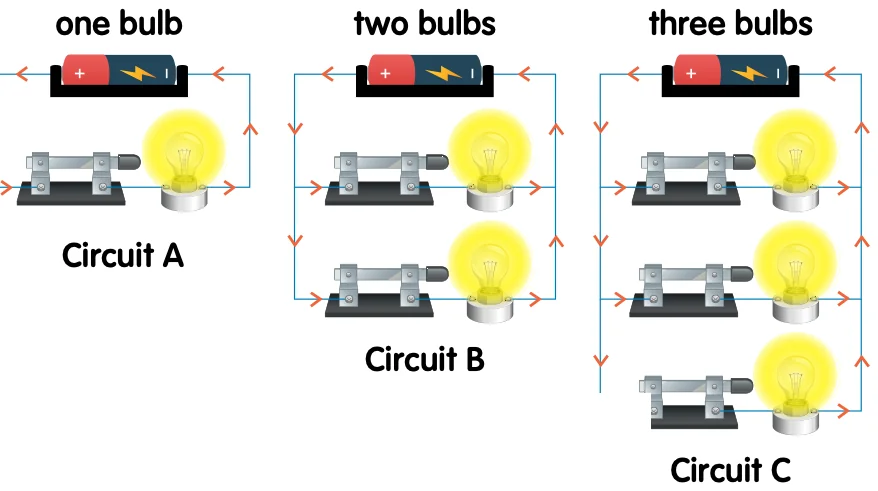
[1 mark]
(a)How does the brightness of one bulb in circuit A compare with one bulb in circuit C?
Show answerHide answer
The same
Every bulb has its own branch, so adding bulbs does not change the brightness.
[1 mark]
(b)Suggest how to make the bulbs in circuit C brighter.
Show answerHide answer
Tick each point you got.
[1 mark]
(c)If the same three bulbs were joined in a series circuit with one dry cell, would they be brighter, dimmer or the same as in circuit C?
Show answerHide answer
Dimmer
In a series circuit the bulbs share the electric current, so they are dimmer.
17
Question 17
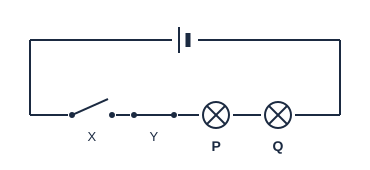
Diagram 10 shows a parallel circuit and Diagram 11 shows a series circuit.
[2 marks]
(a)In Diagram 10, which bulbs light up?
Show answerHide answer
Tick each point you got.
[1 mark]
(b)Give a reason why bulb B does not light up.
Show answerHide answer
Tick each point you got.
[1 mark]
(c)In Diagram 11, what is the condition of bulbs P and Q?
Show answerHide answer
Tick each point you got.
18
Question 18
Ana's family has several lamps at home. One day one bulb in the living room stops working, but all the other lamps still light up.
[1 mark]
(a)Are the lamps connected in a series circuit or a parallel circuit?
Show answerHide answer
Parallel circuit
[2 marks]
(b)Explain why the other lamps still light up.
Show answerHide answer
Tick each point you got.
19
Question 19
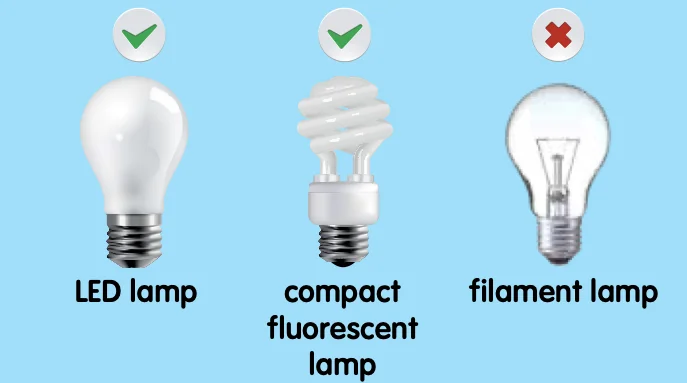
Diagram 12 shows three types of lamps. Ahmad's family wants to lower its monthly electricity bill.
[1 mark]
(a)Which lamp should Ahmad's family stop using?
Show answerHide answer
Filament lamp
A filament lamp uses more electrical energy. LED and compact fluorescent lamps are energy-saving.
[2 marks]
(b)Suggest two other ways the family can save electrical energy.
Show answerHide answer
Any 2 points
Tick each point you got.
20
Question 20
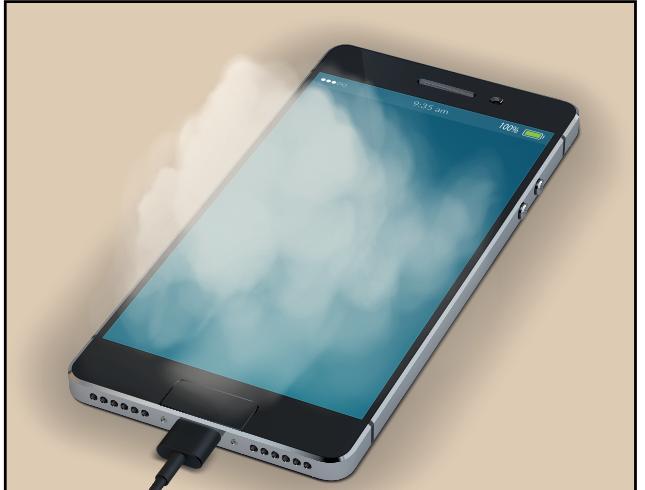
Diagram 13 shows a phone that has been charging for a very long time.
[1 mark]
(a)What could happen if a phone is charged for too long?
Show answerHide answer
Tick each point you got.
[1 mark]
(b)How can this mishandling be avoided?
Show answerHide answer
Tick each point you got.
[2 marks]
(c)State two safety precautions when handling electrical appliances.
Show answerHide answer
Any 2 points
Tick each point you got.