Heat
What this chapter covers
- You can explain that heat is a form of energy and that temperature is the degree of hotness or coldness of a material (6.1.1)
- You can measure temperature with a thermometer, using the correct technique and reading the meniscus level, in degrees Celsius (6.1.2)
- You can state the freezing point (0°C) and boiling point (100°C) of water and describe how the temperature changes when water is heated (6.1.3)
- You can describe how hot water cools until it reaches room temperature, and say that heat flows from hot to cold (6.1.4)
- You can show that solids, liquids and gases expand when they gain heat and contract when they lose heat (6.1.5)
- You can explain why expansion and contraction matter, such as gaps on bridges and railway tracks and loose electric cables (6.1.6)
Why does a hot drink become cold? Why do the railway tracks and the electric cables need special care in hot weather? The answers are all about heat. In this unit you will learn what heat and temperature are, how to measure temperature with a thermometer, and how heat makes materials expand and contract.
6.1Heat and temperature
What are heat and temperature?
When Ana's hot drink becomes cold, the drink loses heat to the surroundings. Its temperature goes down.
Thermometers
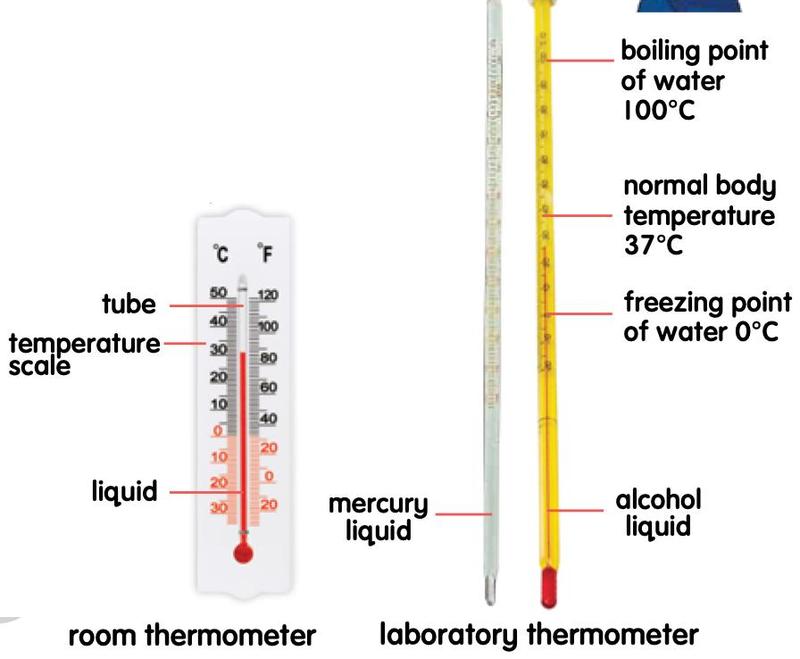
A thermometer has a glass tube with a temperature scale and a liquid inside. There are two kinds you must know.
| Thermometer | Liquid inside | Where it is used |
|---|---|---|
| Room thermometer | Coloured liquid | Reading the temperature of a room |
| Laboratory thermometer | Alcohol (coloured) or mercury (silver) | Measuring the temperature of liquids in experiments |
How a thermometer works
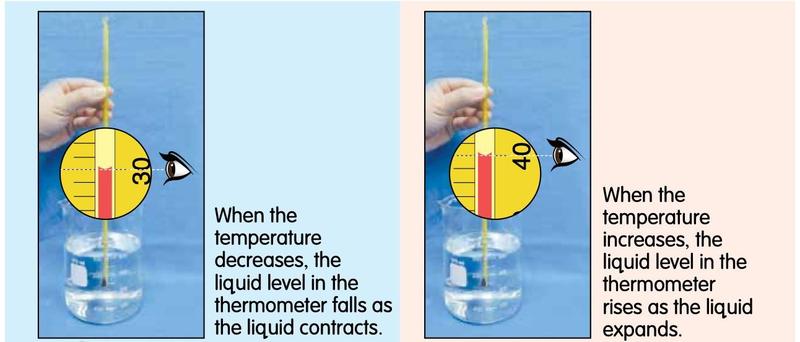
The liquid in a thermometer expands (gets bigger) when it gains heat and contracts (gets smaller) when it loses heat.
| When the temperature | The liquid | The liquid level |
|---|---|---|
| increases | expands | rises |
| decreases | contracts | falls |
Show answerHide answer
Using a thermometer correctly
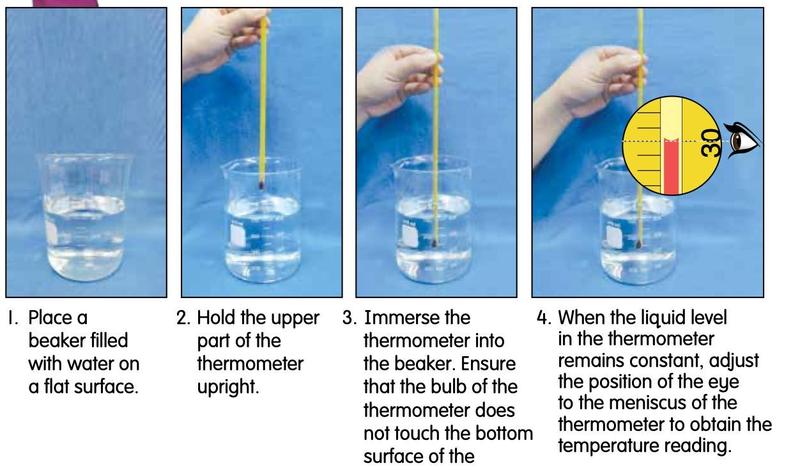
- Put a beaker of water on a flat surface.
- Hold the upper part of the thermometer so that it is upright.
- Put the thermometer into the water. The bulb must not touch the bottom of the beaker.
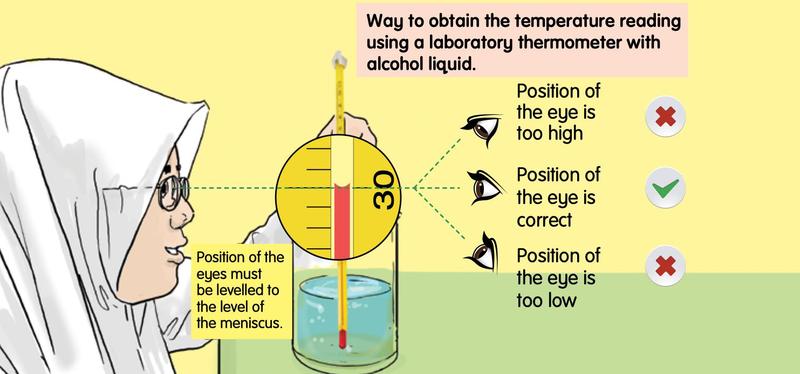
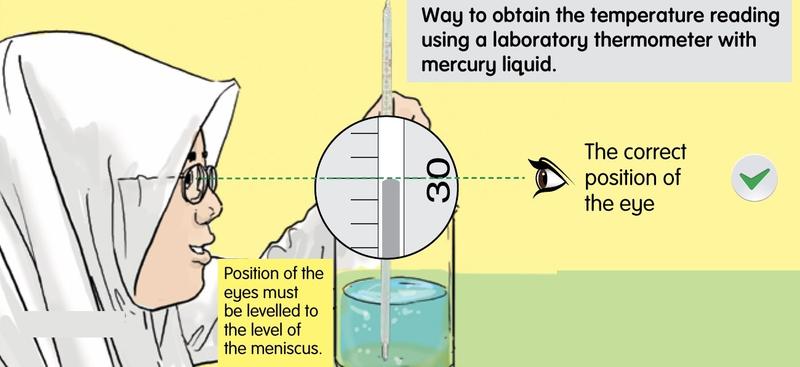
- Wait until the liquid level stops moving. Then put your eye level with the meniscus and read the temperature.
Reading the scale
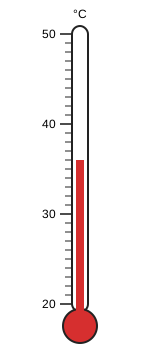
First find the value of one small mark. Between 30 and 40 there are 10 spaces, so each small mark is 1 °C. Count up from the last number and write the unit.
Freezing point and boiling point of water
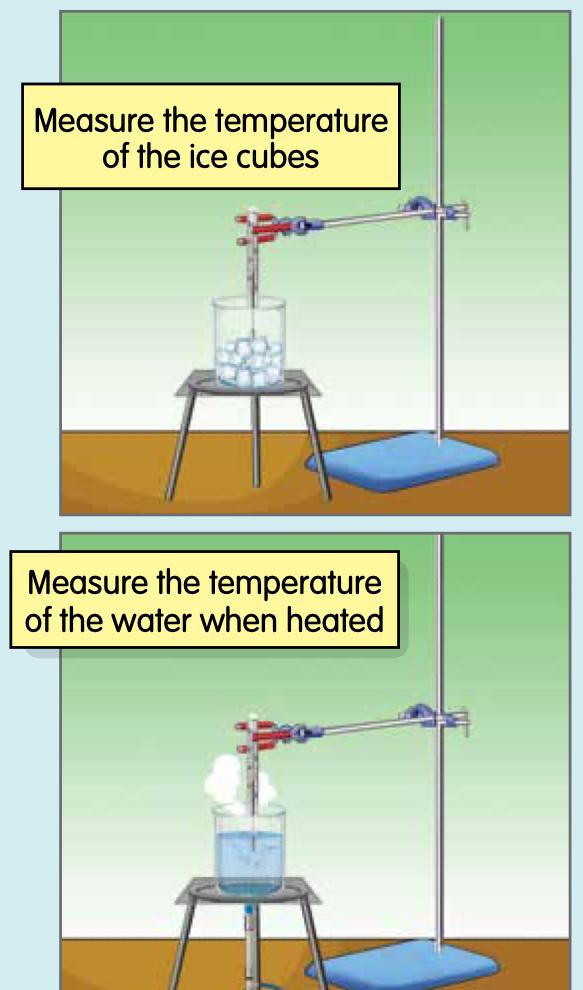
When ice is heated, it changes to water and the temperature goes up. The longer we heat the water, the higher its temperature, until it boils at 100 °C.
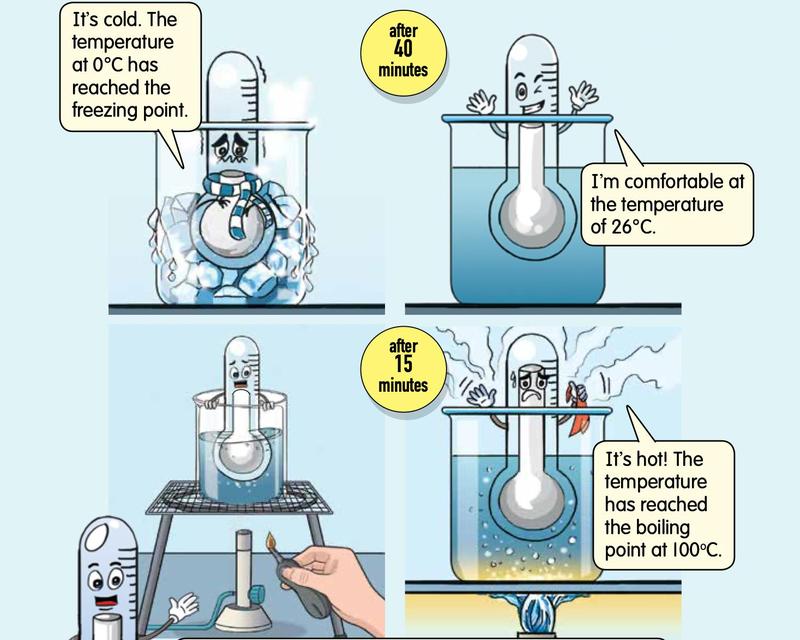
Heating water in the laboratory. Measure the temperature every five minutes. Stop heating when the water boils, and be careful with the hot water and the Bunsen burner.
Show answerHide answer
Heat flows
Heat always flows from a hotter place to a colder place. Look at the cup of hot tea.
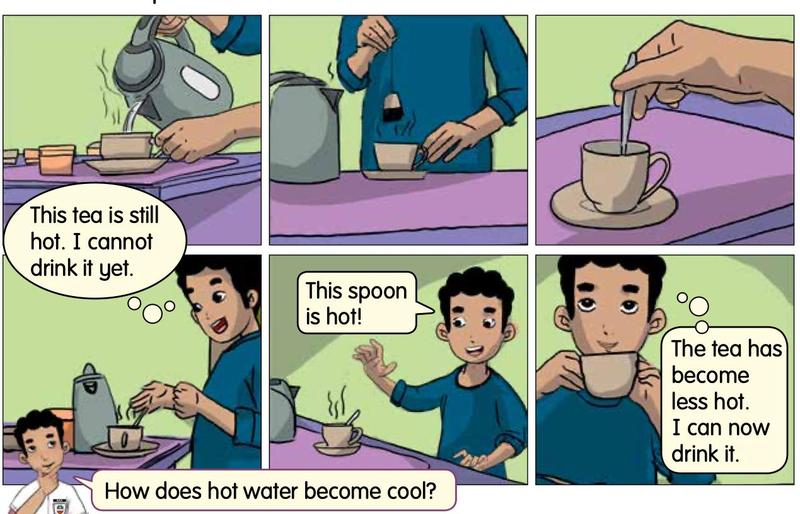
- The metal spoon becomes hot because it gains heat from the hot tea.
- The tea loses heat to the spoon and to the air, so its temperature decreases.
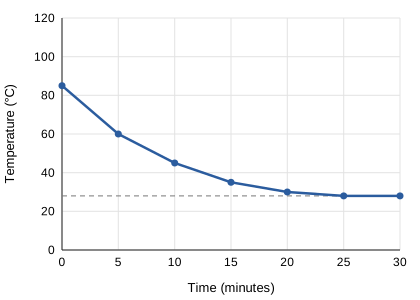
- The temperature keeps falling until it is equal to the room temperature. Then it stays constant.
Show answerHide answer
Show answerHide answer
Expansion and contraction of materials
| Material | Heated or cooled | What happens |
|---|---|---|
| Solid (metal ball) | Heated with a Bunsen burner | The ball expands and cannot pass through the ring. |
| Solid (metal ball) | Put in water to cool | The ball loses heat and contracts, so it passes through the ring again. |
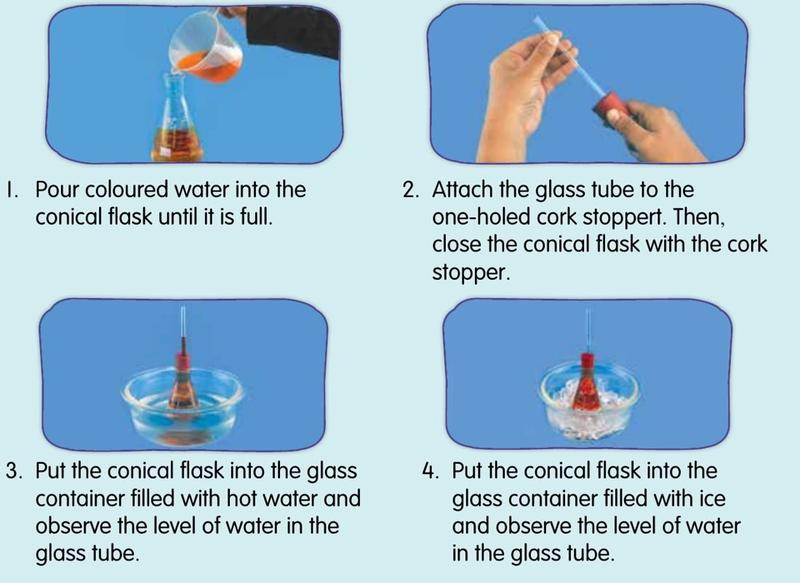
| Liquid (coloured water) | Flask in hot water | The water expands and its level rises in the glass tube. |
| Liquid (coloured water) | Flask in ice | The water contracts and its level falls. |
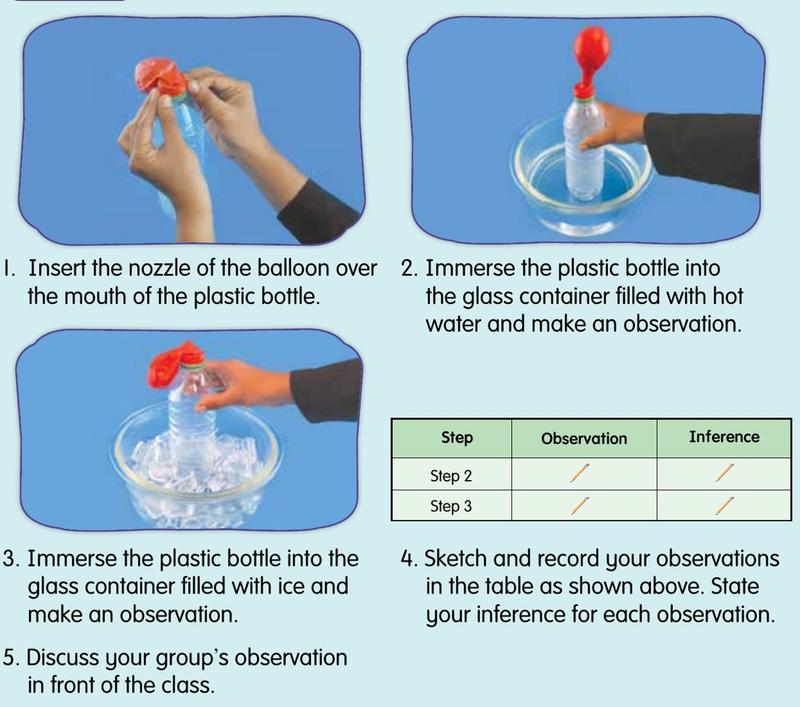
| Gas (air in a bottle) | Bottle in hot water | The air expands and the balloon gets bigger. |
| Gas (air in a bottle) | Bottle in ice | The air contracts and the balloon gets smaller. |
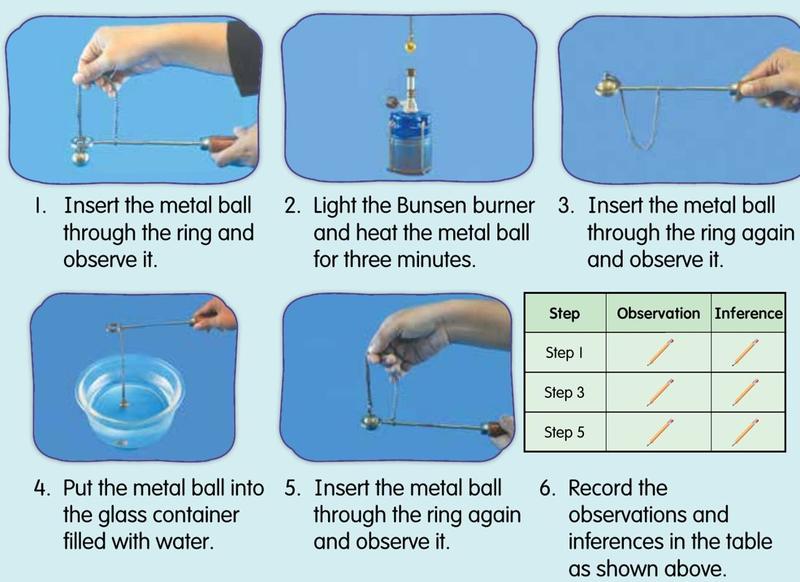
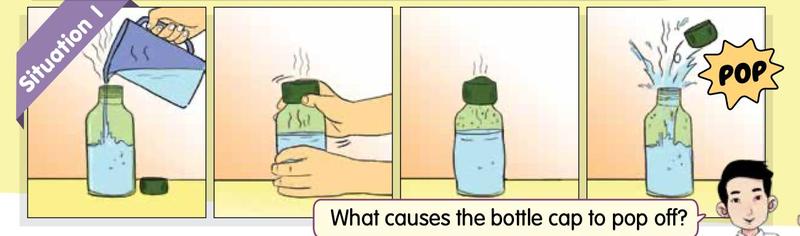
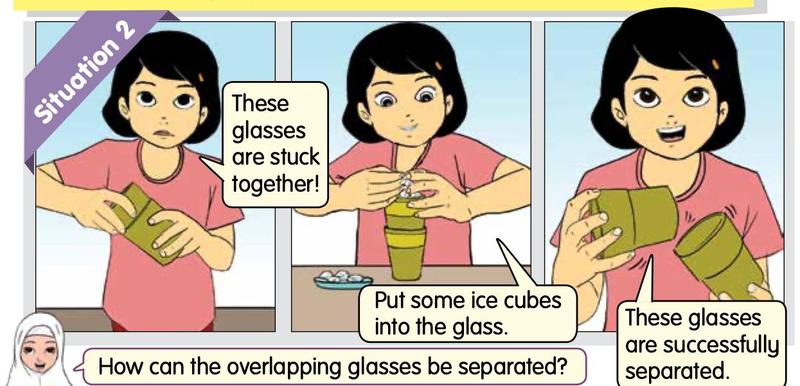
Everyday examples. Melia poured hot water into a bottle and screwed on the cap. The air inside gained heat and expanded, so the cap popped off. Two glasses were stuck together. Ice cubes were put into the top glass. The glass lost heat and contracted, so the glasses came apart.
Why expansion and contraction matter
Builders know that materials change size. They design things with this in mind.
| Situation | Why it is designed this way |
|---|---|
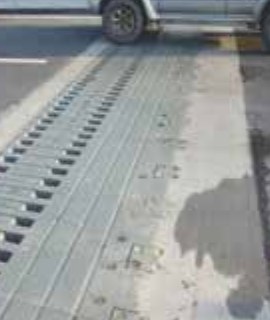
| Gaps between metal connectors on a bridge | Let the bridge expand when the surroundings are hot. This prevents damage to the bridge surface. |
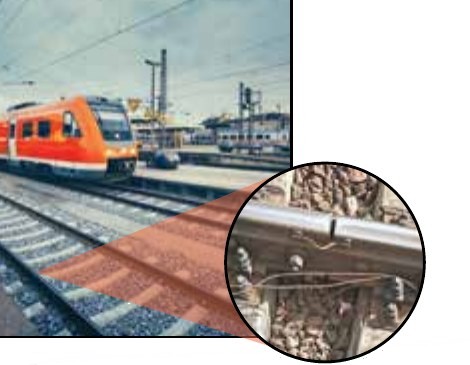
| Gaps between connectors on a railway track | Let the track expand when the surroundings are hot. This prevents the track from bending. |
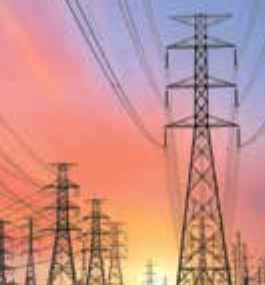
| Electric cables hung loosely between poles | Let the cables contract when the surroundings are cold. This prevents the cables from snapping. |
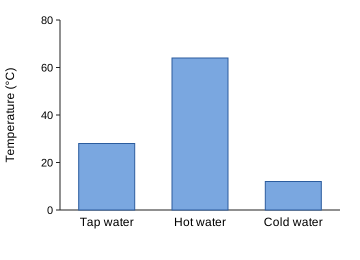
Pictures: Science Year 5 (DLP) textbook, pp. 146–158 (thermometers p. 146, liquid level and use steps p. 147, meniscus p. 148, Mr Thermometer p. 150, freezing and boiling point set-up p. 151, tea p. 152, bottle cap and glasses p. 154, activities 1, 2 and 3 pp. 155–157, bridge, railway and cables p. 158). The thermometer scale and graphs are drawn for this site.
Summary
| Idea | Remember |
|---|---|
| Heat | A form of energy transferred because of a temperature difference. Flows from hot to cold. |
| Temperature | Degree of hotness or coldness. Measured in °C with a thermometer. |
| Thermometer | Liquid rises when it expands and falls when it contracts. Eye level with the meniscus. |
| Freezing point and boiling point | Water freezes at 0 °C and boils at 100 °C. |
| Hot water left in a room | Temperature falls until it equals the room temperature, then stays constant. |
| Expansion | Solids, liquids and gases expand when they gain heat. |
| Contraction | Solids, liquids and gases contract when they lose heat. |
| Uses | Gaps in bridges and railway tracks, and loose electric cables. |