Step Up!
What this chapter covers
- I can listen to a conversation about bullying and fill in a form with the key facts (4.1)
- I can talk about a pamphlet on cyber bullying and say how to stay safe online (4.2)
- I can read a blog on animal abuse and complete a table with the definition, types, effects and prevention (4.3)
- I can read a newspaper article on vandalism and sort the types, reasons and prevention ideas (4.4)
- I can use the details of an online invitation to write an announcement for the school assembly (4.5)
- I can turn short notes into sentences about caring for pets (4.5)
- I can use the relative pronouns who, whom and which correctly (4.6)
- I can recite a poem and give advice about polite public behaviour (4.7)
Unit 4 is called Step Up! It is about taking a stand against things that harm people, animals and property: bullying, cyber bullying, animal abuse and vandalism. You will also learn the relative pronouns who, whom and which.
4.1Listening and speaking: reporting a bully
Kamal from 6 Robotics goes to the school counsellor to report a bully. The counsellor asks questions to fill in a report form.
| Form item | What Kamal says |
|---|---|
| Name and class | Kamal, 6 Robotics |
| Problem | Boys from a neighbouring school threaten him and ask for money |
| How often | Every morning |
| Where | On the way to school |
| Contact | His father, Encik Rosli |
English Year 6 SK, p. 32.
Show answerHide answer
4.2Cyber bullying pamphlet
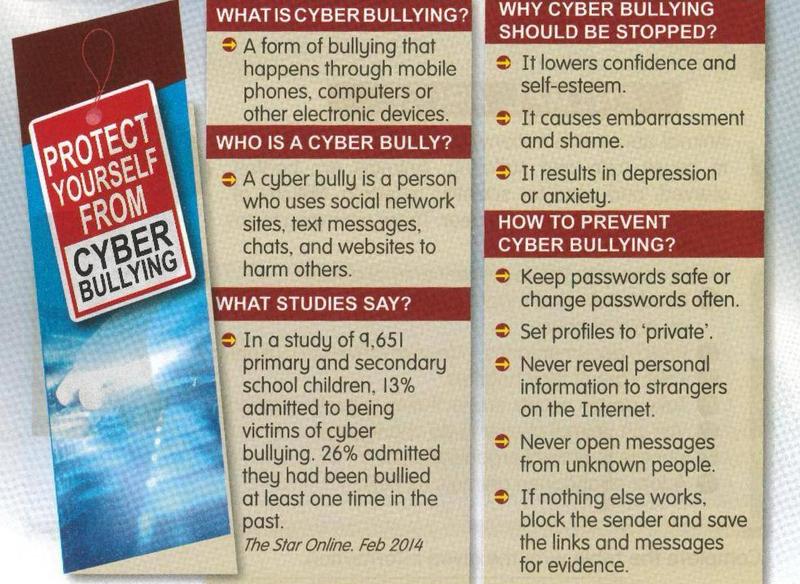
English Year 6 SK, p. 33.
| Box | Main idea |
|---|---|
| Why stop it? | It lowers confidence and self-esteem, causes embarrassment and shame, and can lead to depression or anxiety. |
| How to prevent it | Keep passwords safe and change them often; set profiles to private; never share personal information with strangers; never open messages from unknown people; if nothing works, block the sender and save the messages as evidence. |
| Studies | In a study of primary and secondary pupils, 13% said they were victims and 26% said they had been bullied at least once. |
Show answerHide answer
4.3Reading: animal abuse
Idith reads a blog about animal abuse. Abuse means to cause pain and suffering. Animals are beaten, starved and used for scientific research, and millions die each year.
| Part | What the blog says |
|---|---|
| Definition | Causing pain and suffering to animals |
| Types | Animals are beaten, starved and used for scientific research |
| Effect | Millions of helpless animals die every year |
| Prevention | Read and watch to learn more, take care of animal habitats, join events to protect animals, do charity work at a shelter, donate to animal organisations, adopt abandoned animals |
English Year 6 SK, p. 34.
Show answerHide answer
4.4Reading: Stop Vandalism!
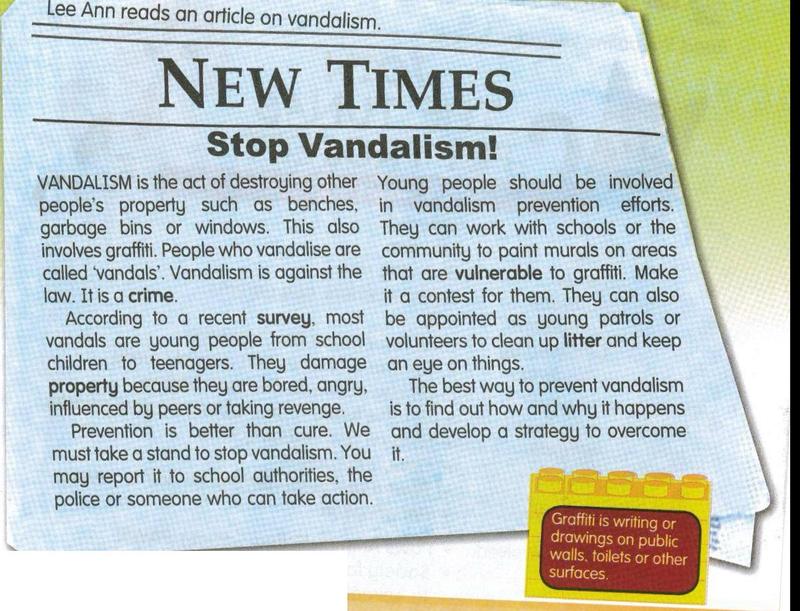
English Year 6 SK, p. 35.
| Brace map | Details |
|---|---|
| Types | Damaging benches, garbage bins and windows; graffiti |
| Reasons | Bored, angry, influenced by friends, taking revenge |
| Prevention | Report it; paint murals in places that get graffiti; young patrols and volunteers who clean up litter; find out how and why it happens and make a plan |
Show answerHide answer
4.5Writing: an announcement and notes into sentences
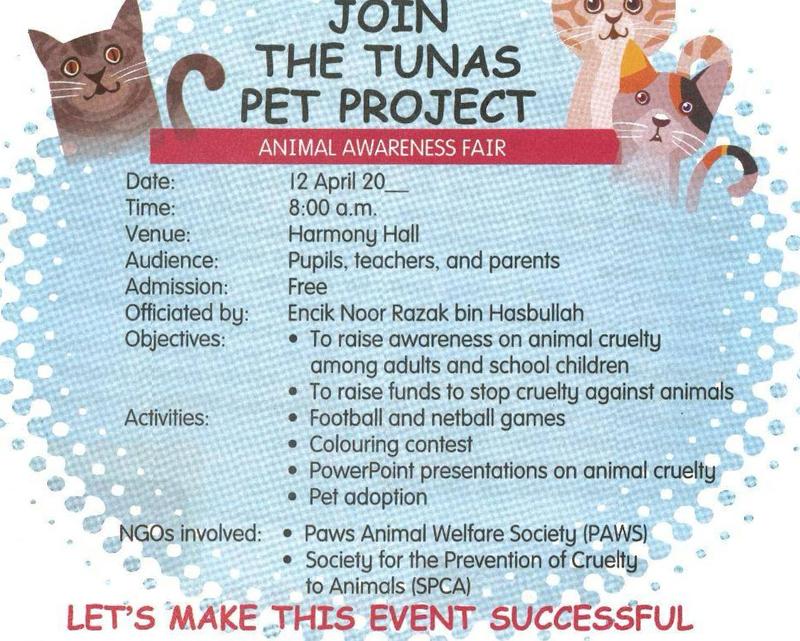
English Year 6 SK, p. 36.
An announcement answers: what the event is, when, where, who may come and why (the objectives and activities).
Notes into sentences (p. 37)
| Notes | Sentence |
|---|---|
| feed - pets - regularly | We should feed our pets regularly. |
| feed them - nutritious food | We need to feed them nutritious food. |
| remember - give - water | We must remember to give them water. |
Show answerHide answer
4.6Grammar: relative pronouns who, whom, which
A relative pronoun joins two ideas into one sentence. It tells us more about a noun.
| Pronoun | Used for | Example |
|---|---|---|
| who | a person, as the subject | The man who lives in the bungalow is my uncle. |
| whom | a person, as the object | They hired the man whom we interviewed yesterday. |
| which | a thing or an animal | The bag which he bought last week is torn. |
English Year 6 SK, pp. 38-39.
A doctor is a person who treats sick people.
Show answerHide answer
4.7Language arts: the poem "Don't do this, don't do that"
This poem by John Kitching lists many things a child is told not to do, such as scraping a plate, teasing the cat and slurping tea. It ends with the question, "Whatever can I do?" The poem is funny, but it reminds us that some habits are impolite in front of others.
English Year 6 SK, p. 40.
Show answerHide answer
Summary
| Topic | Remember |
|---|---|
| Reporting | Say what happened, how often, where, and give a contact. |
| Cyber bullying | Keep passwords safe, private profiles, never open messages from strangers, block and save evidence. |
| Animal abuse | Abuse means pain and suffering; prevent it by learning, protecting habitats, donating and adopting. |
| Vandalism | Destroying property is a crime; reasons: bored, angry, peers, revenge. |
| Announcement | What, when, where, who, why. |
| Grammar | who (person, subject), whom (person, object), which (thing). |