Data Handling and Likelihood
What this chapter covers
- You can complete a pie chart and read data from it when the angles are 45°, 90° and 180° (8.1.1)
- You can link each angle to a fraction of the whole circle and to a number of items (8.1.1)
- You can write facts about a pie chart: largest part, most and least data, differences and fractions (8.1.1)
- You can describe how likely an event is as impossible, less likely, equally likely, more likely or certain (8.2.1)
- You can give a sensible reason for the likelihood of an event (8.2.2)
- You can solve problems about pie charts and likelihood (8.3.1)
8.1Pie charts
A pie chart shows data as slices of a circle. The whole circle stands for all the data, and each slice shows one part of it. In Year 6 we use pie charts where the slices are 180°, 90° or 45°.
| Angle | Fraction of the circle | How to find it |
|---|---|---|
| 180° | 1/2 | 360° ÷ 2 |
| 90° | 1/4 | 180° ÷ 2 |
| 45° | 1/8 | 90° ÷ 2 |
Reading a pie chart
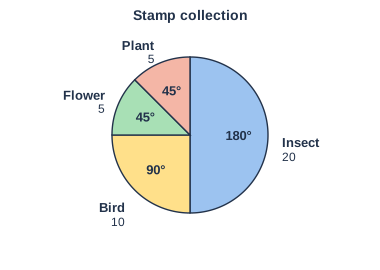
Insect stamps take half the circle, so 20 stamps are half of all the stamps. The whole collection is 40 stamps. Bird stamps are a quarter of the circle: 40 ÷ 4 = 10. Flower stamps are 45°, which is half of 90°, so there are 5 flower stamps. Plant stamps are also 45°, so they are also 5.
Step 2. Halve both together: 90° = 10 stamps and 45° = 5 stamps.
Step 3. Add the parts to check the total: 20 + 10 + 5 + 5 = 40 stamps.
Completing a pie chart from a table
Sixteen marbles are put in a pie chart. The marbles are red (8), green (4), blue (2) and yellow (2).
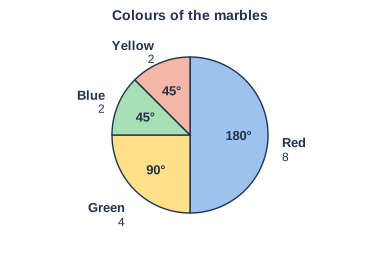
Step 2. Change the fractions to angles: 1/2 = 180°, 1/4 = 90°, 1/8 = 45°.
Step 3. Check: 180° + 90° + 45° + 45° = 360°.
Show answerHide answer
8.2Likelihood
Likelihood tells us how possible it is that an event happens. There are five words, from the least to the most possible.
| Word | Meaning | Example |
|---|---|---|
| impossible | can never happen | A sea turtle climbs a tree. |
| less likely | may happen, but not often | Picking a yellow ball from a bag with 1 yellow and 5 blue. |
| equally likely | same chance either way | A tossed coin shows a head. |
| more likely | will probably happen | Picking a blue ball from a bag with 1 yellow and 5 blue. |
| certain | always happens | The day after Monday is Tuesday. |
Counting to decide
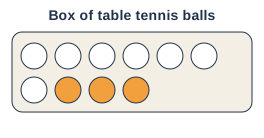
Step 1. Count each colour: 7 white, 3 orange.
Step 2. Compare: 7 is more than 3.
Step 3. Picking a white ball is more likely, because there are more white balls than orange balls. Picking an orange ball is less likely.
Show answerHide answer
8.3Solving problems
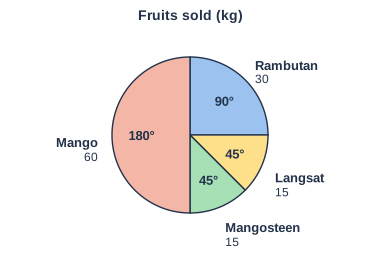
Step 1. 45° is half of 90°, so langsat and mangosteen are each half of 30 kg = 15 kg.
Step 2. The rest of the circle is 360° − 90° − 45° − 45° = 180°, which is twice 90°, so mango is 2 × 30 kg = 60 kg.
Step 3. Check: 30 + 15 + 15 + 60 = 120 kg.
Show answerHide answer
Ideas follow the Mathematics Year 6 (DLP) textbook, Unit 8, pp. 207-223. Figures redrawn.