Science questions, unit 1
Nama / NameKelas / ClassTarikh / Date
Scientific skills
38 marks. Use Practice to check each answer as you go, or Exam to answer everything first. Ask a grown-up to help you mark the written answers.
Section A: objective questions
10 marksChoose the best answer for each question.
1
Question 1
Which of the following is not a science process skill?
Show answerHide answer
C
Memorising is not a science process skill. The twelve skills include classifying, predicting and controlling variables.
2
Question 2
Before the race, Raju and his friends agree to keep the shape, size and mass of all the balloon cars the same and to change only the size of the balloon. Which science process skill is this?
Show answerHide answer
B
Changing one thing and keeping the others the same (shape, size and mass) is controlling variables.
3
Question 3
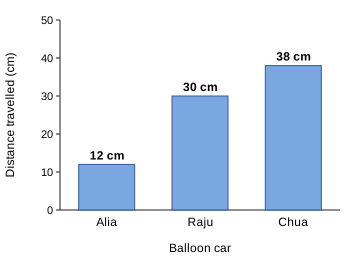
Diagram 1 shows the distance travelled by three balloon cars. Which car travelled the farthest?
Show answerHide answer
A
Chua's bar is the tallest (38 cm), so her car travelled the farthest.
4
Question 4
Chua's car travelled 38 cm and Alia's car travelled 12 cm. How much farther did Chua's car travel than Alia's car?
Show answerHide answer
C
38 cm − 12 cm = 26 cm.
5
Question 5
In the experiment, the pupils use balloons of different sizes to see how far the balloon car travels. What is the manipulated variable?
Show answerHide answer
D
The size of the balloon is the one thing the pupils change on purpose.
6
Question 6
Alia's balloon car travelled the shortest distance. Which is the best inference?
Show answerHide answer
B
An inference is a sensible reason. Option C is an observation and option D is a prediction.
7
Question 7
Which statement is a prediction?
Show answerHide answer
D
A prediction says what will happen, here from a pattern. The others are observations.
8
Question 8
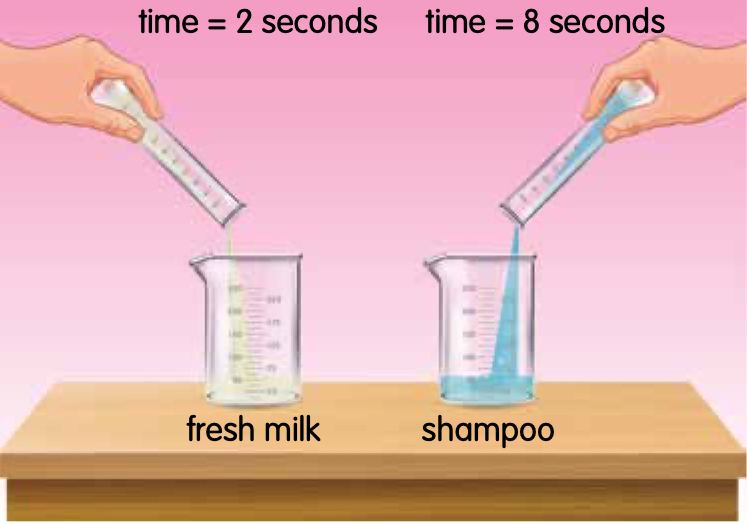
Laili pours 100 mℓ of fresh milk and 100 mℓ of shampoo through a measuring cylinder. The milk takes 2 seconds and the shampoo takes 8 seconds. Which is a suitable hypothesis?
Show answerHide answer
C
A hypothesis links the manipulated variable (thickness of the liquid) with the responding variable (time to flow) and states the pattern.
9
Question 9
Alia says, "The balloon car that travelled the farthest is the fastest." How can the pupils be sure which car is the fastest?
Show answerHide answer
A
Speed depends on distance and time. The fastest car takes the shortest time to travel the same distance.
10
Question 10
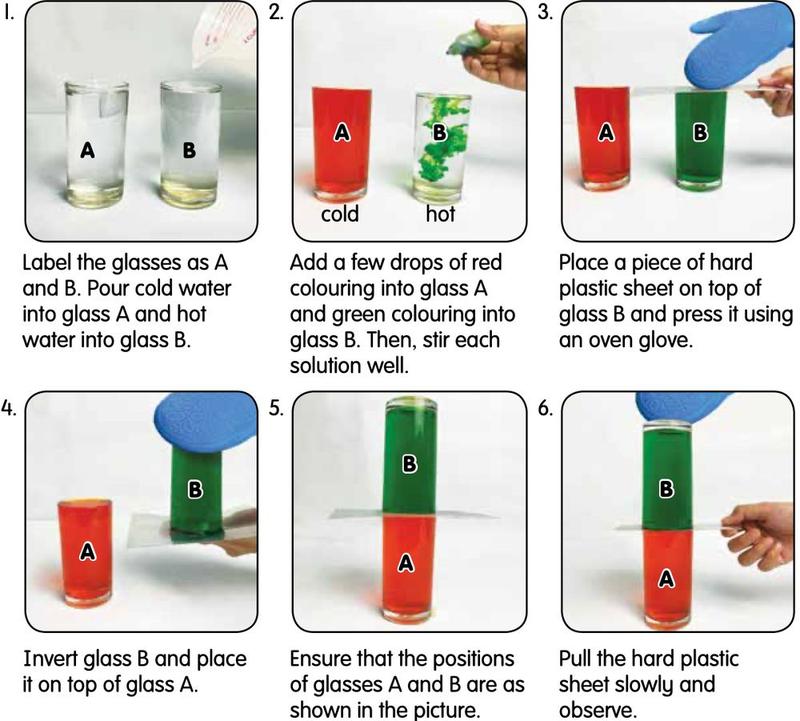
In the Magic Water activity, hot green water in glass B is placed on top of cold red water in glass A. When the plastic sheet is pulled out slowly, the two colours stay in two layers. What is the best inference?
Show answerHide answer
B
The sheet was removed, so something else keeps the layers apart. Hot water is lighter (less dense) than cold water, so it stays above it.
Section B: structured questions
28 marksAnswer all questions. Circle the answer or write it in the space.
11
Question 11
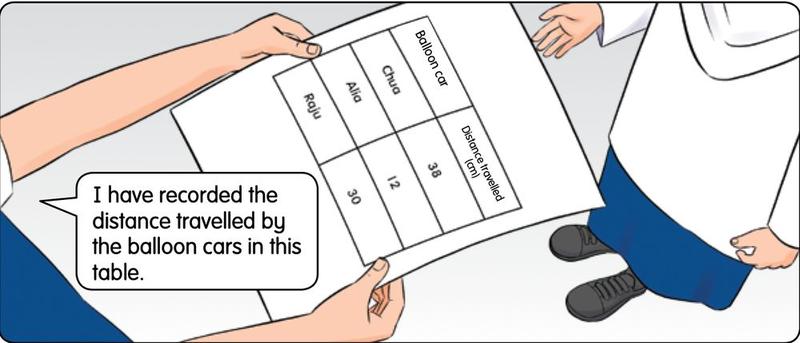
Diagram 3 shows the distance travelled by the balloon cars of Raju, Alia and Chua.
[1 mark]
(a)Which car travelled the shortest distance?
Show answerHide answer
Alia's car
[1 mark]
(b)Write the cars in order, from the farthest distance to the shortest distance.
Show answerHide answer
Tick each point you got.
[1 mark]
(c)Chua tells Alia, "The size of your balloon is small and contains the least amount of air." Which science process skill is Chua using?
Show answerHide answer
Making inferences
He gives a sensible reason for what was observed (the shortest distance).
12
Question 12
The pupils want to find out whether the size of the balloon affects the distance travelled by a balloon car.
[1 mark]
(a)State the manipulated variable.
Show answerHide answer
Tick each point you got.
[1 mark]
(b)State the responding variable.
Show answerHide answer
Tick each point you got.
[1 mark]
(c)State one constant variable.
Show answerHide answer
Tick each point you got.
[1 mark]
(d)Write a hypothesis for the experiment.
Show answerHide answer
A hypothesis links the two variables with a pattern.
Tick each point you got.
13
Question 13
Alia says, "The car that travelled the farthest is also the fastest."
[1 mark]
(a)Is Alia's statement always correct?
Show answerHide answer
No
A car can go far but slowly, so the time must be measured too.
[1 mark]
(b)What must the pupils measure, as well as the distance, to find the fastest car?
Show answerHide answer
Tick each point you got.
[1 mark]
(c)Car P travels 60 cm in 3 seconds and car Q travels 60 cm in 4 seconds. Which car is faster?
Show answerHide answer
Tick each point you got.
14
Question 14
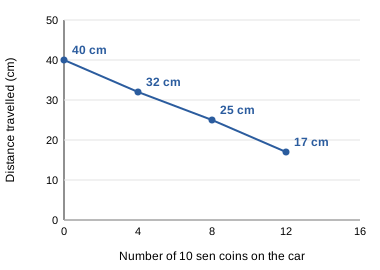
Aini changes the mass of a balloon car by adding 10 sen coins to it. Diagram 4 shows her results (practice numbers, not from the book).
[1 mark]
(a)What distance does the car travel with 8 coins?
Show answerHide answer
Tick each point you got.
[1 mark]
(b)State the pattern shown by the graph.
Show answerHide answer
Any 1 points
Tick each point you got.
[1 mark]
(c)Predict the distance travelled with 16 coins.
Show answerHide answer
Tick each point you got.
[1 mark]
(d)Is the hypothesis "The lighter the balloon car, the farther the distance it travels" accepted or not accepted?
Show answerHide answer
Accepted
15
Question 15
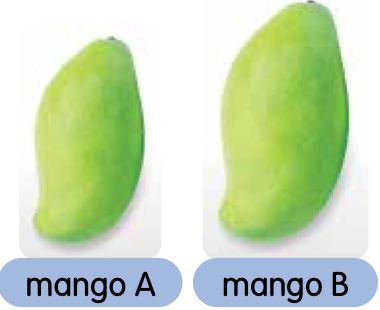
Diagram 5 shows two mangoes of the same type from different orchards. Mango A has a mass of 400 g and tastes sour. Mango B has a mass of 600 g and tastes sweet.
[1 mark]
(a)Write one observation about the differences between the two mangoes.
Show answerHide answer
Any 1 points
Tick each point you got.
[1 mark]
(b)Make one inference from your observation.
Show answerHide answer
Any 1 points
Tick each point you got.
[1 mark]
(c)State one more observation that supports your inference.
Show answerHide answer
Tick each point you got.
16
Question 16
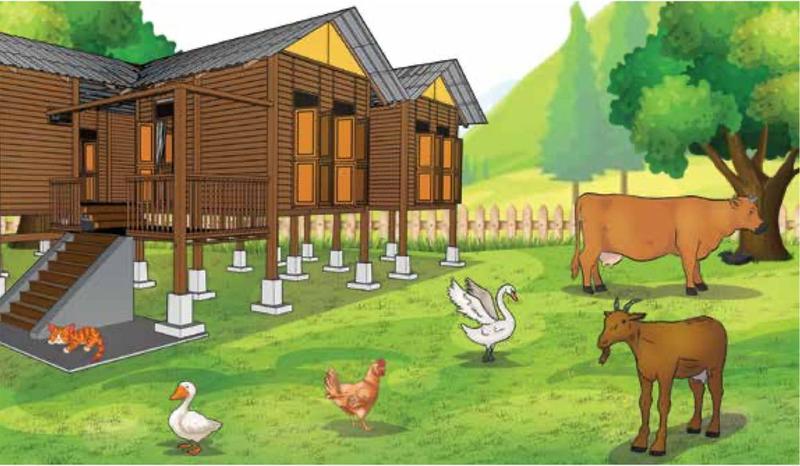
Diagram 6 shows the animals reared by Pak Teh: a cat, a cow, a goat, a hen, a duck and a swan.
[1 mark]
(a)State one common characteristic of all the animals.
Show answerHide answer
Tick each point you got.
[1 mark]
(b)Suggest a characteristic that can be used to sort the animals into two groups.
Show answerHide answer
Any 1 points
Tick each point you got.
[2 marks]
(c)Name the animals in each group in (b).
Show answerHide answer
With 'fur or feathers' the groups are the same.
Tick each point you got.
17
Question 17
Diagram 7 shows the Magic Water activity. Glass A has cold red water and glass B has hot green water.
[1 mark]
(a)Write one observation after the plastic sheet is pulled out slowly.
Show answerHide answer
Tick each point you got.
[1 mark]
(b)Give a reason for your observation.
Show answerHide answer
Tick each point you got.
[1 mark]
(c)Name one safety precaution in this activity.
Show answerHide answer
Tick each point you got.
[1 mark]
(d)Write one constant variable that makes the test fair.
Show answerHide answer
Tick each point you got.
18
Question 18
Raju builds a balloon car (the lengths here are practice numbers, not from the book). He cuts two non-flexible drinking straws, each 11 cm long, and two skewer sticks, each 15 cm long.
[1 mark]
(a)Which science process skill does Raju use to cut the straws at 11 cm?
Show answerHide answer
Measuring and using numbers
[1 mark]
(b)How much longer is one skewer stick than one straw?
Show answerHide answer
Tick each point you got.
[1 mark]
(c)State one safety rule when using the scissors.
Show answerHide answer
Tick each point you got.