Décrire : l'âge, les personnes et les vêtements
What this chapter covers
- I can ask someone's age and say my own age with the verb avoir (Tu as quel âge ? J'ai douze ans.) (3.1)
- I can conjugate avoir and être in the present and choose the right one (j'ai, tu as, il a… / je suis, tu es, il est…) (3.1, 3.2)
- I can describe a person's height and hair with être and an adjective, and make the adjective feminine (Il est grand. Elle est grande et blonde.) (3.2)
- I can describe hair and eyes with avoir and make adjectives plural (J'ai les cheveux longs et les yeux bleus.) (3.3)
- I can use the pronoun on to mean we when I speak (On est jumelles. = Nous sommes jumelles.) (3.3)
- I can name clothes and colours and make the colour agree with the clothing (Elle porte une robe rouge et des baskets blanches.) (3.4)
- I can say how two people are alike and how they are different (Lise et Léa ont les yeux bleus. Tom est blond, mais Nino est brun.) (3.5)
- I can name three French painters and the colours of a painting (Monet, Renoir, Matisse ; bleu + jaune = vert) (3.5)
- I can count, read and write the numbers from 20 to 69 in French (vingt et un, trente-quatre, soixante-neuf) (3.6)
Module 3 of Adosphère 1 is about the twins Lise et Léa. They look the same, but they like different things: Lise aime la mode (fashion) and Léa préfère la peinture (painting). In this module you learn to say your age, describe people (height, hair, eyes), describe clothes and colours, and say how two people are alike or different. We also add the numbers 20 to 69, which you need for ages and for the UASA "write the numbers in letters" question.
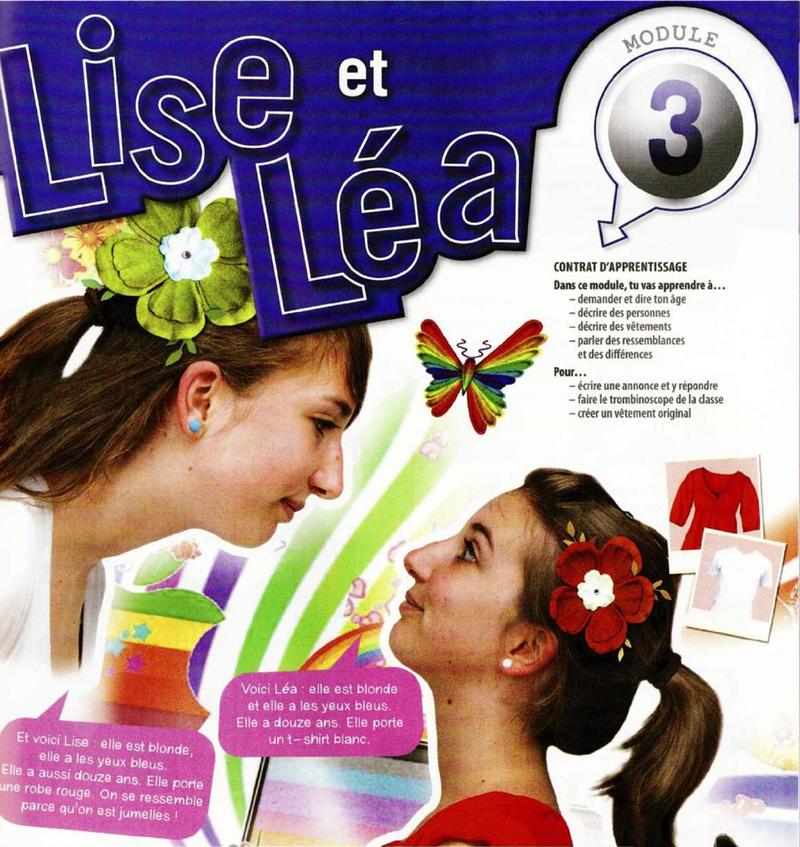
"This is Léa: she is blonde and she has blue eyes. She is twelve. She is wearing a white T-shirt."
Adosphère 1, Module 3 opener, p. 37.
3.1Asking and saying your age with avoir
In Leçon 1 (Je suis grande et blonde, pp. 38–39) Lise and Léa want to take part in a fashion show. Their friend Imane asks them:
Lise : – Nous avons douze ans, pourquoi ?
Imane : – Le défilé n'est pas pour vous ! C'est pour les jeunes de seize ans minimum…
"But how old are you?" "We are twelve, why?" "The show is not for you! It's for young people of sixteen minimum…"
Pour demander et dire son âge
| Asking (three ways, same meaning) | Answering |
|---|---|
| Tu as quel âge ? Quel âge tu as ? Quel âge as-tu ? | J'ai douze ans. (I am twelve.) J'ai treize ans. (I am thirteen.) |
| Polite or to several people: Vous avez quel âge ? | Nous avons douze ans. |
| About someone else: Il / Elle a quel âge ? | Il a seize ans. Elle a un an. |
The first row is the box on p. 39 (Communication); the other rows use the same pattern with vous, nous, il / elle. Notice that the answer always ends with ans (years), even for un an (one year, no -s).
Le verbe avoir (to have)
| Avoir | English | Say it |
|---|---|---|
| J'ai | I have | "zhay" |
| Tu as | you have (a friend) | "tew ah" |
| Il / Elle / On a | he / she has, we have (spoken) | "eel ah" |
| Nous avons | we have | "noo-zavon" (liaison) |
| Vous avez | you have (polite or plural) | "voo-zavay" (liaison) |
| Ils / Elles ont | they have | "eel-zon" (liaison) |
Le verbe avoir, p. 39 and Tableaux de conjugaisons, p. 125.
"I am thirteen" is not
Don't forget ans:
Ils ont (they have, with a "z" sound) and ils sont (they are, with an "s" sound) are different verbs. Listen for the z!
(a) Lise et Léa ______ douze ans.
(b) Vous ______ quel âge ?
(c) J'______ une robe originale.
(d) How do you say "My brother is sixteen"? (mon frère = my brother)
Show answerHide answer
(d) Mon frère a seize ans.
3.2Describing a person: être and the feminine of adjectives
To describe someone's size or hair colour, use être (to be) + an adjective: Il est grand. (He is tall.) The adjective changes when it describes a girl or a woman.
Le verbe être (to be)
| Être | English |
|---|---|
| Je suis | I am |
| Tu es | you are |
| Il / Elle / On est | he / she is, we are (spoken) |
| Nous sommes | we are |
| Vous êtes | you are (polite or plural) |
| Ils / Elles sont | they are |
Tableaux de conjugaisons, p. 125.
Le féminin des adjectifs
| Masculin | Féminin | English |
|---|---|---|
| Il est grand. | Elle est grande. | tall |
| Il est petit. | Elle est petite. | short, small |
| Il est blond. | Elle est blonde. | blond (fair-haired) |
| Il est brun. | Elle est brune. | dark-haired |
| Il est original. | Elle est originale. | original, unusual |
| Il est différent. | Elle est différente. | different |
| Il est roux. | Elle est rousse. | red-haired (exception) |
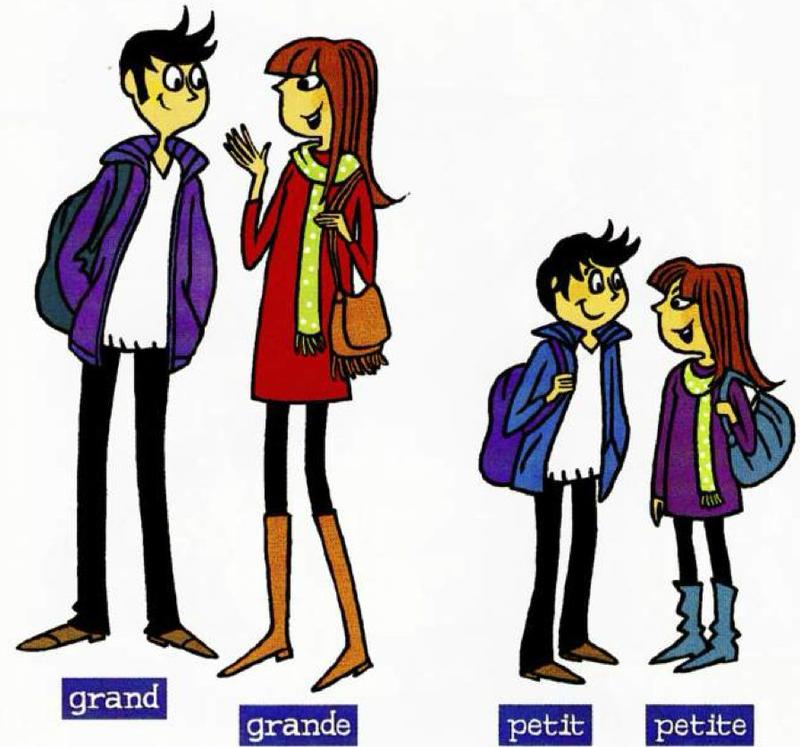
Le féminin des adjectifs, p. 39 and Précis grammatical, p. 121. Pictures: Ton dico illustré, p. 111.
Malay and English adjectives never change, so it is easy to forget the -e: Lise est
In French the adjective usually comes after the noun: une robe originale, not
– une fille petite et blonde ;
– un garçon grand et roux.
To act in a film, we are looking for: a short, blonde girl; a tall, red-haired boy.
(a) Il est petit et brun. → Elle…
(b) Le garçon est grand et roux. → La fille…
(c) Tu es blond. → (to Lise) Lise est…
Show answerHide answer
(b) La fille est grande et rousse.
(c) Lise est blonde. (exercise 5, p. 39)
3.3Hair, eyes, plural adjectives and the pronoun on
In Leçon 2 (Jumelles, mais différentes !, pp. 40–41) Lise and Léa write on their web page:
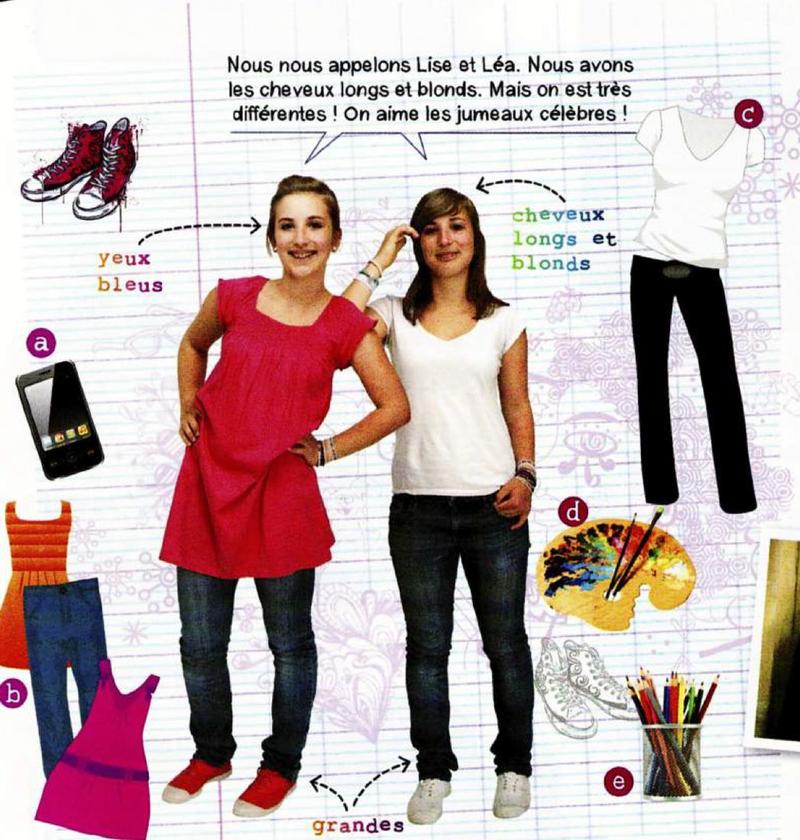
"We are called Lise and Léa. We have long blond hair. But we are very different! We like famous twins!"
Leçon 2, p. 40.
Hair and eyes: avoir + les cheveux / les yeux
| French | English |
|---|---|
| J'ai les cheveux blonds. | I have blond hair. |
| J'ai les cheveux bruns. | I have dark (brown) hair. |
| J'ai les cheveux roux. | I have red hair. |
| J'ai les cheveux longs / courts. | I have long / short hair. |
| J'ai les yeux bleus. | I have blue eyes. |
| J'ai les yeux verts. | I have green eyes. |
| J'ai les yeux marron. | I have brown eyes. |
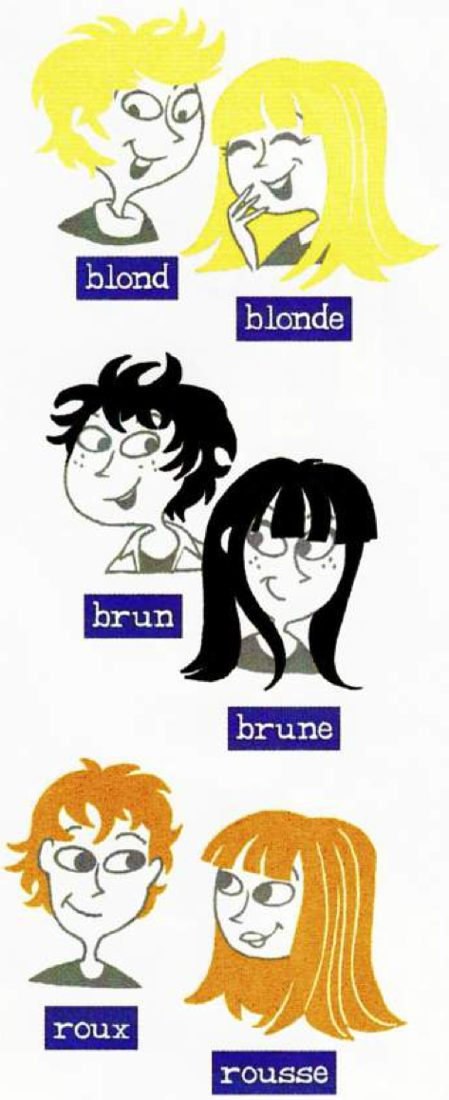
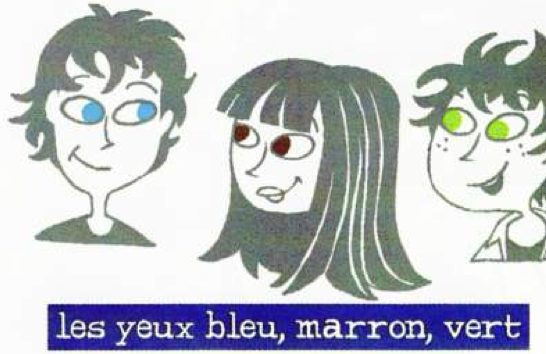
Pictures: Ton dico illustré, p. 111. Exercise 9, p. 41.
Le pluriel des adjectifs
| Singulier | Pluriel | Rule |
|---|---|---|
| grand / grande | grands / grandes | usually add -s |
| blond / blonde | blonds / blondes | |
| long / longue | longs / longues | |
| original / originale | originaux / originales | masculine -al → -aux |
| roux / rousse | roux / rousses | exception: ends in -x already |
| marron | marron | exception: never changes |
Le pluriel des adjectifs, p. 41 and Précis grammatical, p. 121.
Le pronom on
When French people speak, they often say on instead of nous. On takes the il / elle form of the verb (3rd person singular), but it means "we".
| With nous | With on (spoken) |
|---|---|
| Nous sommes jumelles. | On est jumelles. |
| Nous avons les mêmes yeux. | On a les mêmes yeux. |
| Nous aimons la mode. | On aime la mode. |
Le pronom on, p. 41 (exercise 6).
(b) Rewrite with on: Nous sommes grandes.
(c) Complete: Je suis brun. → J'ai les cheveux ______.
Show answerHide answer
(b) On est grandes.
(c) bruns
3.4Clothes and colours
In Leçon 3 (Dessiner la mode, pp. 42–43) teenagers between ten and sixteen draw clothes for the game Jeunes Stylistes (young designers). The winners are Léa, 12, and Paul, 13.
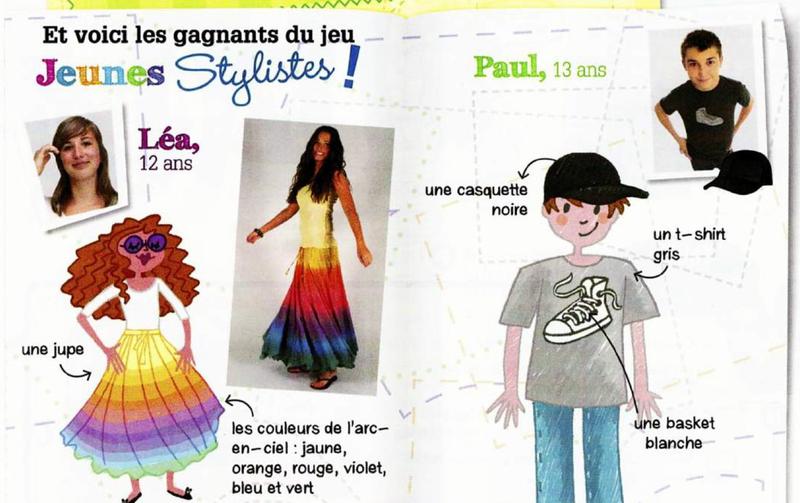
Leçon 3, p. 42.
Les vêtements (clothes)
| French | English |
|---|---|
| une robe | a dress |
| une jupe | a skirt |
| une casquette | a cap |
| un t-shirt | a T-shirt |
| un pantalon | a pair of trousers |
| un pull | a sweater |
| des baskets (une basket) | trainers, sports shoes |
| un vêtement / des vêtements | a piece of clothing / clothes |
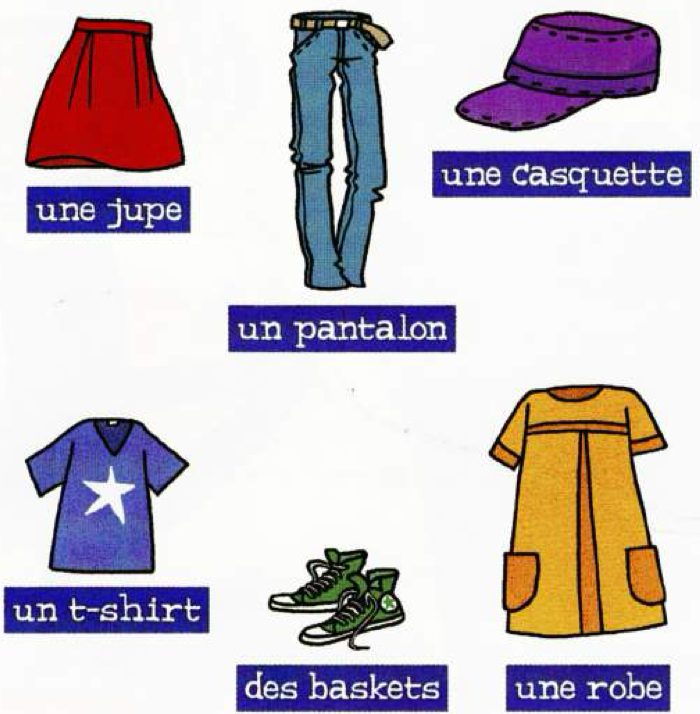
To say what someone is wearing, use porter (to wear), a regular -er verb: je porte, tu portes, il / elle porte, nous portons, vous portez, ils / elles portent.
Paul porte une casquette noire et un t-shirt gris.
J'adore les jupes longues, je déteste les baskets blanches… (p. 47)
Les couleurs (colours)
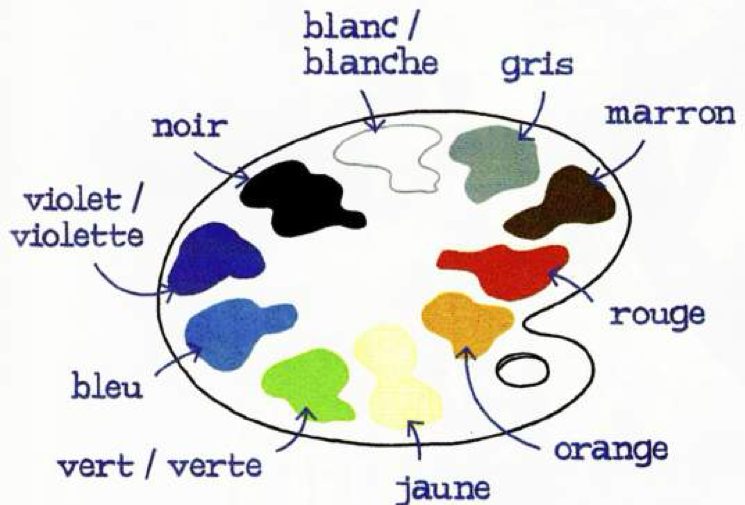
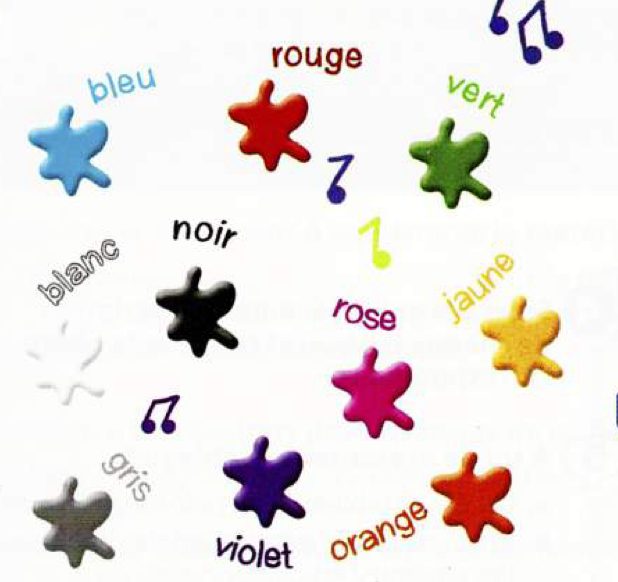
A colour is an adjective. It comes after the noun and agrees with it (feminine -e, plural -s):
| Masculin | Féminin | Masc. pluriel | Fém. pluriel | English |
|---|---|---|---|---|
| bleu | bleue | bleus | bleues | blue |
| vert | verte | verts | vertes | green |
| noir | noire | noirs | noires | black |
| gris | grise | gris | grises | grey |
| violet | violette | violets | violettes | purple |
| blanc | blanche | blancs | blanches | white |
| rouge | rouge | rouges | rouges | red |
| jaune | jaune | jaunes | jaunes | yellow |
| rose | rose | roses | roses | pink |
| orange | orange | orange | orange | orange |
| marron | marron | marron | marron | brown |
Le féminin des adjectifs de couleur, p. 46; the plural forms follow the table on p. 47 (bleu(e)(s), blanc(he)(s)…) and the Précis grammatical, p. 121. Orange and marron are names of fruits (an orange, a chestnut), so they never change.
Word order:
Agreement: une casquette
les yeux
(a) une jupe (vert) (b) des yeux (bleu) (c) une robe (violet) (d) des baskets (blanc) (e) un sac (marron)
Show answerHide answer
3.5Alike or different, and French painters
Lise and Léa se ressemblent (look alike) parce qu'elles sont jumelles, but they are different inside: Lise loves fashion and Léa prefers painting (pp. 37–40).
| To say you are alike | To say you are different |
|---|---|
| Lise et Léa ont les yeux bleus. Elles sont grandes et blondes. On a les mêmes yeux. (the same eyes) On est tous les deux bruns. (we are both dark-haired, p. 41) – J'aime la mode. – Moi aussi ! (me too) | On est très différentes ! Tom est blond, mais Nino est brun. J'ai les yeux bleus. Moi, j'ai les yeux marron ! J'adore le chocolat. Moi, je déteste le chocolat ! (p. 41) |
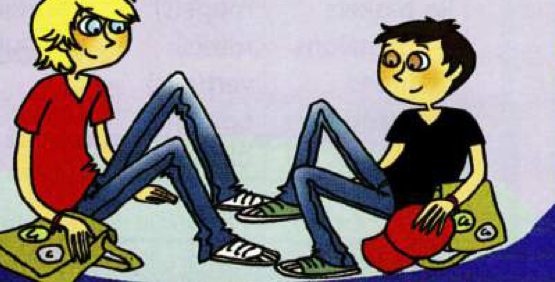
Notice différents: Tom and Nino are two boys, so masculine plural. For two girls it is différentes.
Culture: des tableaux d'artistes français (pp. 44–45)
| Painter | Painting in the book | What you see |
|---|---|---|
| Claude Monet (1840–1926) | Blanche Monet peignant | a woman painting in a green garden (« Je m'appelle Blanche et j'adore la peinture ! ») |
| Pierre-Auguste Renoir (1841–1919) | La Lecture | two girls reading (« Nous aimons les livres ! ») |
| Henri Matisse (1869–1954) | La Chute d'Icare | un collage de papiers bleus, noirs et jaunes |
On p. 45 (Mon cours de dessin) you meet art materials, un pinceau (brush), un crayon (pencil), du papier, une toile (canvas), de la colle (glue), des ciseaux (scissors), and colour mixing:
« Le noir et le blanc donnent du gris. » (Black and white make grey.)
Show answerHide answer
3.6The numbers 20 to 69
Ages of older people, page numbers and scores need bigger numbers. The textbook teaches them as a song in Module 4 (p. 55), and every page of the book has its number in words at the bottom (trente-sept on p. 37, quarante et un on p. 41). The UASA always has a question Écrivez les nombres en lettres.
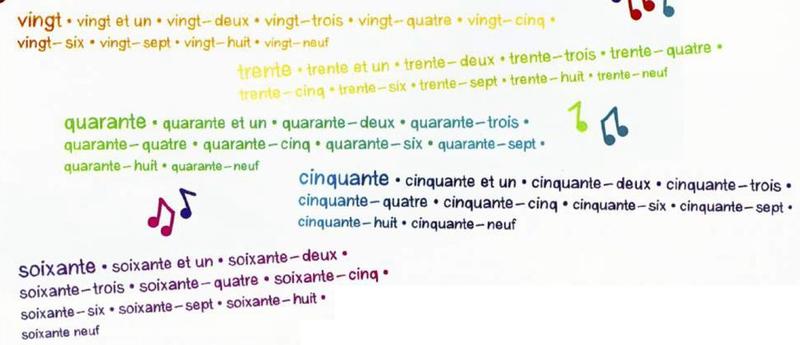
Module 4, Leçon 3, p. 55.
| Tens | + 1 | + 2 to + 9 |
|---|---|---|
| 20 vingt | 21 vingt et un | 22 vingt-deux, 23 vingt-trois … 29 vingt-neuf |
| 30 trente | 31 trente et un | 34 trente-quatre, 38 trente-huit |
| 40 quarante | 41 quarante et un | 45 quarante-cinq, 47 quarante-sept |
| 50 cinquante | 51 cinquante et un | 56 cinquante-six, 58 cinquante-huit |
| 60 soixante | 61 soixante et un | 63 soixante-trois, 69 soixante-neuf |
Spelling of the tens: quarante (not
un an but vingt et un ans: after 21, 31… the word ans is plural.
Show answerHide answer
Ma mère a quarante-deux ans.
Summary
| I want to… | French pattern |
|---|---|
| ask and say an age | Tu as quel âge ? – J'ai treize ans. (avoir, never être) |
| describe height or hair | Il est grand et brun. Elle est petite et rousse. (être + adjective, feminine + e) |
| describe hair and eyes | J'ai les cheveux longs et blonds et les yeux marron. |
| say "we" in speech | On est jumelles. On a douze ans. (on + il/elle form) |
| describe clothes | Elle porte une jupe verte et des baskets blanches. (colour after the noun, it agrees) |
| compare two people | Ils ont les mêmes yeux, mais Tom est blond et Nino est brun. |
| count 20–69 | vingt, vingt et un, vingt-deux… trente… quarante… cinquante… soixante-neuf |